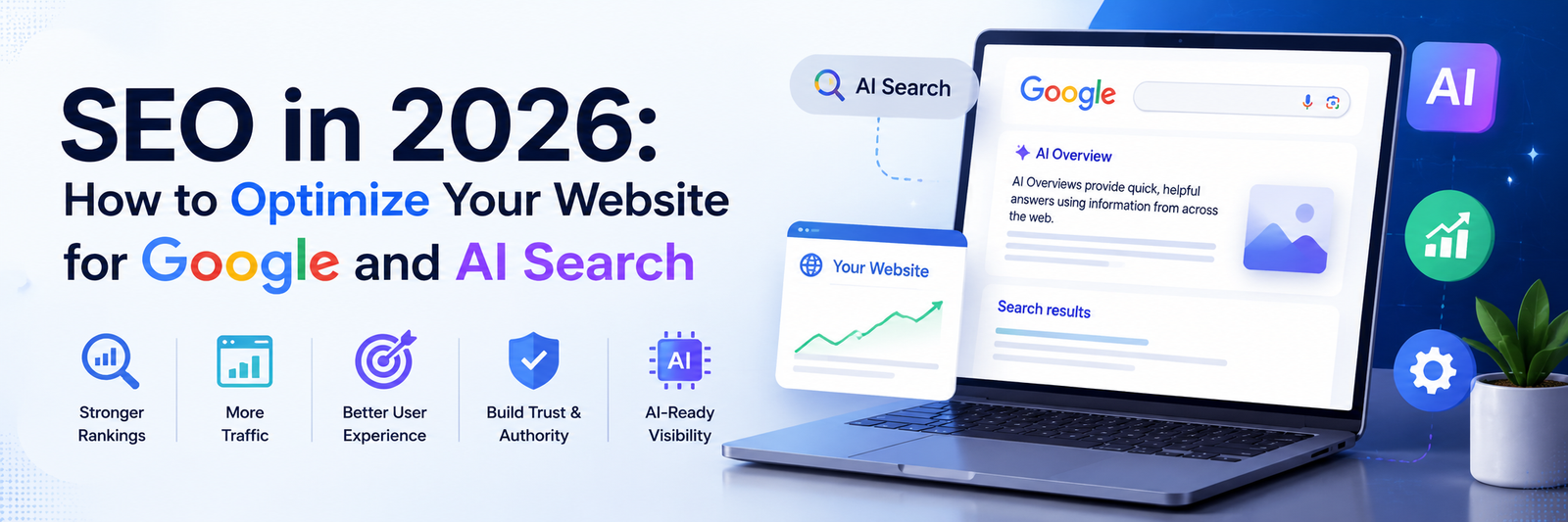
Search has changed shape again in 2026, but not in the way a lot of headlines suggest. Traditional organic rankings still matter a lot. What’s different is that users now encounter AI-generated answers through Google AI Overviews and AI Mode alongside the classic results page, and that’s shifted how visibility gets measured.
Here’s the part that gets lost in most “AI SEO” content: businesses don’t need a completely separate system to show up in AI search. Google has been consistent on this point: its generative AI search experiences are built on top of its existing Search ranking and quality systems, not a parallel one. If your site is genuinely well optimised for Search, you’re already most of the way toward AI visibility too.
This guide covers what actually matters for SEO in 2026: the strategies that hold up, the technical work that still counts, what AI search really relies on, and just as importantly, what businesses can stop worrying about.
Is SEO Still Important in 2026?
Yes, and arguably more than before, because it now feeds two visibility surfaces instead of one.
Google’s AI Search features draw directly from its Search index and ranking systems rather than operating independently. That means the same signals that earn strong organic rankings relevance, authority, technical health, and helpful content are the same signals influencing whether your business gets surfaced in an AI-generated answer.
What has changed is that ranking alone is no longer the only visibility metric worth tracking. A page can rank well and still lose some clicks to an AI Overview that answers the query directly. The relationship between SEO, AI visibility, and website traffic is more layered than it used to be, which is exactly why businesses should evolve their SEO strategy rather than abandon it. For companies evaluating SEO services in Bangalore or an SEO agency in Bangalore, this distinction matters: you want a partner optimizing for the whole picture, not just classic blue-link rankings.
How Google Search Has Changed in 2026
From Traditional Search to AI-Powered Search
Search has evolved from a page of ranked blue links to a layered experience that can include AI Overviews, AI Mode conversational results, and traditional organic listings, often on the same query.
How AI Overviews and AI Mode Find Information
Google has been explicit that its generative AI features rely on Search’s existing ranking systems to retrieve relevant, current pages. There’s no separate “AI index” pulling from a different source; it’s the same retrieval and ranking infrastructure, applied to generate a synthesized answer.
What This Means for Businesses
In practice, this means the fundamentals haven’t changed; they’ve just become more important:
- Strong organic visibility
- Authoritative, well-supported content
- A crawlable, technically sound website
- Clear topical relevance
- Strong brand and entity signals
- Genuinely helpful, original information
The Core SEO Strategies That Matter in 2026
1. Build Helpful, People-First Content
Google continues to recommend creating unique, valuable content rather than reproducing what’s already available across the web. That means:
- Original insights, not recycled summaries
- Firsthand experience woven into the content
- Genuine expert opinion, not generic AI-generated filler
- Content that solves the reader’s actual problem
- Information competitors haven’t already covered
2. Focus on Search Intent Instead of Keyword Stuffing
Every query carries an intent informational, commercial, transactional, or navigational and understanding which one you’re answering matters more than matching exact keyword phrasing. Google’s systems understand related concepts and synonyms well, so there’s no need to create a separate page for every keyword variation of the same topic.
3. Build Topical Authority
Rather than a collection of disconnected pages, build around clear topic clusters: a strong pillar page supported by related blog content, tied together with deliberate internal linking. This structure signals depth of expertise and helps Google understand the full scope of what you cover.
4. Strengthen EEAT Signals
Experience, Expertise, Authoritativeness, and Trustworthiness remain central to how Google evaluates content quality. Practical ways to strengthen this include clear author information, original research, documented case studies, real client results, and credible external references.
This is where demonstrated experience counts more than claims. Honeycomb’s own Tally Education case study, for example, documents an integrated SEO, AEO, and GEO campaign with measurable organic and AI visibility results the kind of firsthand proof that supports genuine EEAT rather than asserting expertise without evidence.
Technical SEO Still Matters for AI Search
AI search hasn’t made technical SEO optional; if anything, it raises the bar, since a page has to be found and understood before it can be summarized.
Make Your Website Crawlable
Keep your robots.txt, XML sitemaps, and internal linking structured so Google can crawl and index your site efficiently.
Improve Website Performance and Page Experience
Mobile usability, Core Web Vitals, page speed, and responsive design all continue to influence both rankings and user experience.
Fix Indexing and Duplicate Content Issues
Canonical tags, cleanup of duplicate pages, and addressing thin content all help Google process your site correctly instead of wasting crawl budget or diluting relevance signals.
Use Clean Website Architecture
A logical URL structure, clear navigation, semantic HTML, and a proper heading hierarchy all support the technical foundation that lets Search systems discover and process your content something Google itself continues to emphasize as foundational, AI features included.
How to Optimize Content for AI Search Without Over-Optimizing
Write Clear and Direct Answers
Answer the core query early, use descriptive headings, keep paragraphs focused, and use lists where they genuinely help readability.
Add Original Information and Expert Insights
Generic summaries are easy to produce and easy to overlook. Firsthand expertise, specific numbers, and real examples are what make content worth citing by readers and by AI systems alike.
Structure Content for Humans, Not Just AI
One correction worth making clearly: you don’t need to chop content into artificial “AI-friendly chunks.” Google has explicitly said there’s no required content length and no requirement to break content into tiny fragments for AI systems to process it. Write for your reader; structure will follow naturally.
Use Relevant Images, Videos and Supporting Media
Google’s AI search experiences can surface relevant images and videos alongside text answers, so well-chosen multimedia still supports broader visibility, not just aesthetic value.
AI SEO Services: What Businesses Should Actually Invest In
What Are AI SEO Services?
AI SEO services generally refer to optimization work aimed at improving visibility within AI-generated search experiences AI Overviews, AI Mode, and similar features. It’s worth being precise here: this isn’t a separate discipline from SEO; it’s an extension of it.
What Does AI SEO Optimization Include?
In practice, solid AI SEO optimization overlaps almost entirely with strong SEO fundamentals:
- Technical SEO
- Content optimization
- Search intent analysis
- Entity optimization
- Topical authority building
- Internal linking
- Brand authority development
- AI visibility monitoring
- Ongoing content quality improvement
SEO vs AI SEO Optimization
AI SEO optimization should be treated as an extension of strong SEO, not a replacement for it. Google itself has framed generative AI search optimization as still falling under the umbrella of SEO, not a distinct new practice requiring an entirely separate strategy.
Local SEO and Google Business Profile in AI Search
Local visibility carries into AI search too. Google’s current documentation notes that Google Business Profiles can help local businesses appear both in traditional Search results and in AI-generated responses.
The signals that matter here are familiar: accurate local business information, consistent NAP data, a healthy volume of genuine reviews, well-built local landing pages, clear local relevance, correct business categories, and strong location-based search signals. For a business searching for an SEO agency in Bangalore or an SEO company in Bangalore, this is exactly the kind of layered localplusAI visibility work worth asking a prospective agency about directly.
Do AEO and GEO Replace SEO in 2026?
Quick definitions, since the acronyms get used loosely:
- SEO Search visibility
- AEO Answer visibility
- GEO Generative/AI visibility
The key point: these are complementary approaches, not separate replacements for SEO. Google itself treats AEO and GEO as industry shorthand, framing optimization for generative AI search as part of the broader SEO and search experience rather than a competing discipline. We’ve covered this distinction in more depth in our dedicated SEO, AEO and GEO article, so we’ll keep this section brief here.
What You Don’t Need to Do for AI SEO
This is worth addressing directly, because a fair amount of AI SEO advice circulating right now isn’t accurate.
You Don’t Need LLMs.txt for Google Search
Google has stated plainly that it does not use llms.txt for Google Search or its generative AI features.
You Don’t Need to Create Tiny Content Chunks
There’s no requirement to break content into small fragments to make it more “digestible” for AI systems.
You Don’t Need to Rewrite Everything Just for AI
Google’s systems understand synonyms and broader meaning well, so obsessively inserting every possible keyword variation isn’t necessary and often makes content worse to read.
Don’t Chase Artificial AI Mentions
Focus on building genuine authority and useful content rather than trying to manufacture AI citations through shortcuts.
Don’t Overfocus on Schema
Structured data remains useful for eligible Search features, but there’s no special schema requirement specifically for generative AI search.
How to Measure SEO Performance in 2026
Rankings alone are an incomplete picture now. Track a fuller set of metrics:
- Organic clicks and impressions
- Click-through rate (CTR)
- Keyword visibility, including top 3/top 10 rankings
- Conversions and leads
- Branded vs. nonbranded traffic
- Google Search Console data
- AI visibility, citations, and mentions
- Referral traffic from AI platforms
- Local visibility
This is also where a documented track record helps. Honeycomb’s Tally case study, for instance, tracks both traditional organic metrics and AI-related visibility metrics side by side, giving a clearer sense of how a strategy performs across both surfaces rather than just one.
Common SEO Mistakes to Avoid in 2026
- Keyword stuffing
- Publishing generic, AI-generated content with no original value
- Creating content only for search engines, not readers
- Ignoring technical SEO fundamentals
- Publishing hundreds of low-value pages
- Ignoring search intent
- Neglecting internal linking
- Focusing only on rankings, not the full picture
- Ignoring brand authority
- Treating AI SEO as a replacement for SEO rather than an extension of it
Google has been direct on this last point too, warning against producing large volumes of content primarily to manipulate Search or generative AI responses rather than to genuinely help users.
How to Build a Future-Ready SEO Strategy in 2026
- Audit your technical SEO
- Identify search intent across your key pages
- Build topical authority through clusters and pillar content
- Improve and refresh existing content
- Create original, expert-driven content
- Strengthen internal linking
- Build authoritative backlinks and brand mentions
- Optimize local presence where relevant
- Monitor both organic and AI visibility
- Continuously improve based on performance data
Why Choose a Professional SEO Agency in Bangalore?
A strategy built around all of the above technical SEO, content strategy, local SEO, AI SEO services, and consistent performance tracking takes real, ongoing effort to execute well. That’s usually where working with experienced SEO professionals pays off, rather than trying to manage every moving piece internally alongside day-to-day business operations.
Honeycomb is an experienced SEO company in Bangalore that combines strong traditional SEO fundamentals with modern AIsearch optimization, rather than treating them as separate tracks. If you’d like a closer look at how that works in practice, our SEO agency in Bangalore service page covers our full technical, on-page, off-page, local SEO, and content marketing approach in more detail.
Frequently Asked Questions
Is SEO still relevant in 2026?
Yes. Google’s AI search features are built on its existing Search ranking systems, so strong SEO fundamentals directly support both traditional rankings and AI visibility.
How does AI affect SEO?
It adds a new visibility surface AI Overviews and AI Mode but doesn’t require a separate strategy. The same signals that earn strong organic rankings also support AI search visibility.
What is AI SEO optimization?
It’s the practice of optimizing a website to be well represented in AI-generated search experiences, built on the same foundation as traditional SEO rather than replacing it.
Can SEO help my website appear in Google AI Overviews?
Yes. Since AI Overviews draw from Google’s existing Search index and ranking systems, strong SEO signals relevance, authority, and technical health that support visibility.
Is GEO replacing SEO?
No. GEO (Generative Engine Optimization) is best understood as an extension of SEO focused on AI-generated visibility, not a standalone replacement.
Does AI-generated content hurt SEO?
Generic, low-value AI-generated content can hurt visibility if it lacks originality or expertise. The issue is content quality, not the tool used to help draft it.
Does Google use LLMs.txt for AI search?
No. Google has stated it doesn’t use llms.txt for Google Search or its generative AI features.
How can I optimize my website for AI search?
Focus on the same fundamentals that support strong SEO: helpful original content, clear search intent alignment, solid technical health, and strong EEAT signals.
How long does SEO take to show results?
Timelines vary by competitiveness and starting point, but most businesses see meaningful movement within three to six months of consistent, well-executed work.
Should businesses invest in SEO services in Bangalore in 2026?
For businesses competing in a crowded local and digital market, working with an experienced SEO agency in Bangalore can help build a strategy that covers technical SEO, content, local visibility, and AI search readiness together, rather than piecemeal.