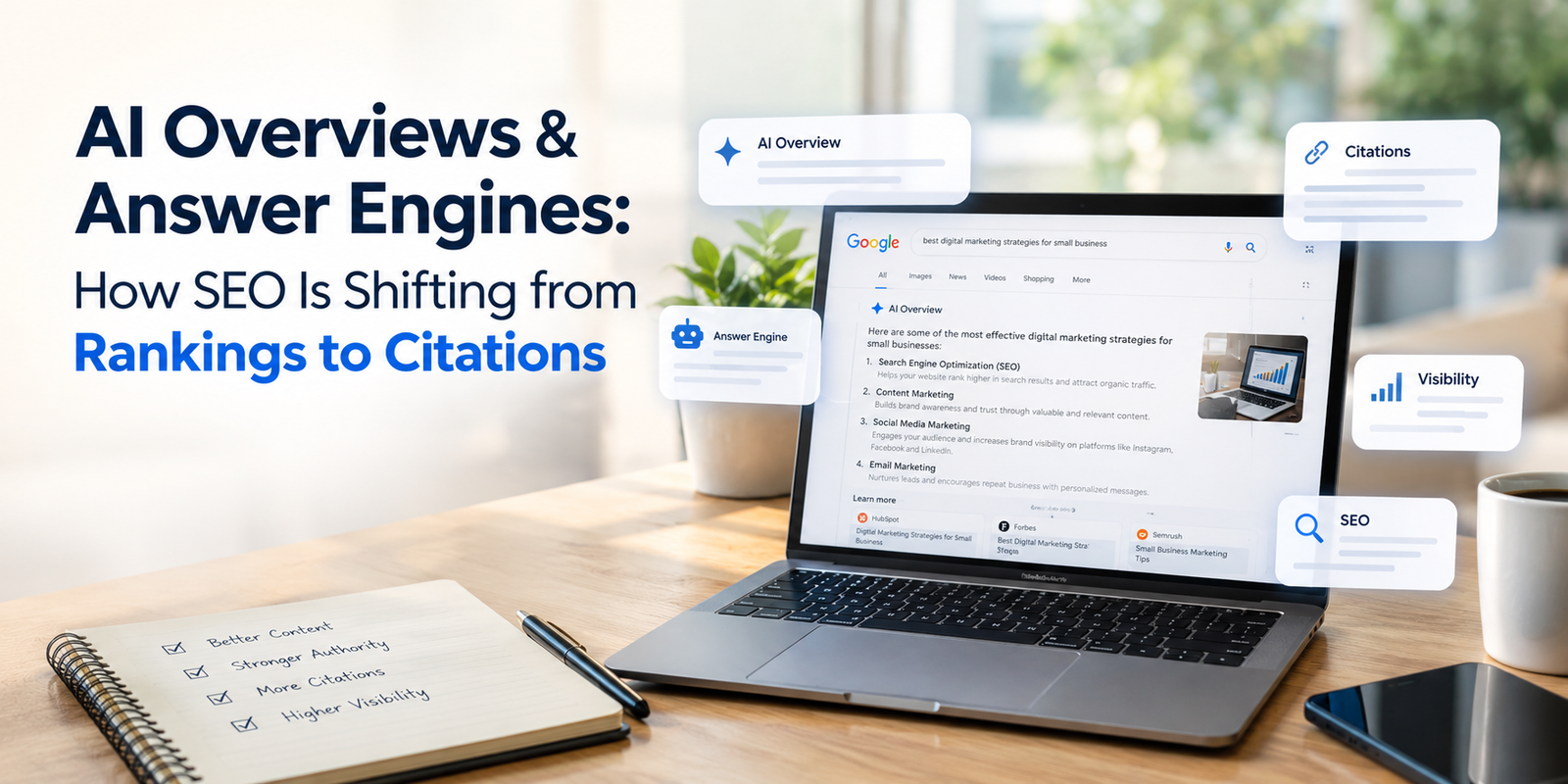
Search is changing, but SEO isn’t disappearing. For most of its history, SEO has focused on rankings, clicks, and traffic: get your page to position one, and the visitors follow. AI-powered search experiences increasingly change that equation by synthesizing answers directly, often with supporting links to a handful of sources. Ranking still matters, but being understood, selected, and cited as a source is becoming a second, equally important objective.
This doesn’t mean traditional SEO is obsolete. In its first official AI optimization guidance, published in May 2026, Google directly addressed the question of whether SEO still matters for generative AI search, answering simply that it does, since AI Overviews and AI Mode are built on the same core Search ranking and quality systems as traditional results. The discipline hasn’t changed. The surface it shows up on has.
What Are AI Overviews and Answer Engines?
Traditional search follows a simple path: query → search results → website → answer. AI-assisted search compresses that path: query → AI-generated response → supporting sources → optional deeper exploration.
An “answer engine” is any system, Google’s AI Overviews and AI Mode, ChatGPT, Perplexity, Gemini, that generates a direct, synthesized response to a query rather than a list of links to click through.
| Traditional Search | Answer/Generative Search |
|---|---|
| Rankings | Answers + sources |
| Blue links | Synthesized responses |
| Click-focused | Answer-first experience |
| Keyword relevance | Context + relevance |
| Website discovery | Source discovery + citation |
From Ranking for Keywords to Becoming a Trusted Source
This is the central shift. The question a brand needs to answer is no longer just “can I rank?” It’s expanded to: can search systems understand, trust, retrieve, and cite my content?
Rankings still matter. They remain the foundation both disciplines are built on, and a page that can’t rank organically is unlikely to be selected as an AI source either.
Citations are becoming important in AI search because answer engines have to choose, from potentially thousands of relevant pages, which handful to surface as supporting sources. That selection depends on authority, contextual relevance, content quality, and how clearly a page demonstrates expertise.
What makes content citation-worthy tends to share a few traits: original information rather than repackaged summaries, clear explanations, first-hand expertise, reliable supporting sources, strong topical coverage, and well-structured, extractable sections. Interestingly, one academic study of over 55,000 searches found that nearly 30% of domains cited in AI Overviews didn’t appear on page one of the organic results shown alongside them, a sign that ranking well and being cited well are related but genuinely separate competitions.
What Is AEO? Answer Engine Optimization Explained
AEO (Answer Engine Optimization) is the practice of structuring content so it can be directly extracted and surfaced as an answer: in featured snippets, People Also Ask boxes, voice search results, and AI-generated responses.
| SEO | AEO |
|---|---|
| Rankings | Direct answers |
| Keywords | Questions + intent |
| Organic traffic | Answer visibility |
| SERPs | Answer experiences |
| Web pages | Extractable answer sections |
Structuring content for answer engines generally involves: leading with a direct, self-contained answer before elaborating; using question-based headings phrased the way people actually ask (voice assistants and chatbots included); concise definitions; lists and tables; step-by-step explanations; and dedicated FAQ sections with clear entity relationships.
What Is GEO? Generative Engine Optimization Explained
GEO (Generative Engine Optimization) is the broader practice of improving a brand’s visibility across generative AI search experiences, not just for a single extractable answer, but as a source the underlying model draws on and cites when generating a response.
| SEO | AEO | GEO |
|---|---|---|
| Search rankings | Direct answers | Generative AI visibility |
| Search engines | Answer engines | Generative engines |
| Organic visibility | Answer visibility | AI/source visibility |
| Keywords + intent | Questions + answers | Context + entities + authority |
It’s worth being precise here: GEO isn’t a replacement for SEO, and shouldn’t be marketed as one. Google’s own guidance is explicit that generative AI features rely on the same underlying search index and quality systems, meaning SEO fundamentals, crawlability, indexing, content quality, and technical performance, remain essential rather than optional extras layered on top.
What Makes a Website More Likely to Be Understood and Cited?
Several factors consistently show up across how AI systems select and cite sources:
- Clear and direct answers
- Strong topical coverage (breadth and depth on a subject, not just a single keyword)
- Demonstrated expertise
- Original and useful information
- Clear entity relationships (who you are, what you do, who you serve)
- Consistent brand information across the web
- Strong internal linking
- Author and organization signals
- Supporting evidence and references
- Crawlable, indexable content
Why Entity SEO Matters in AI Search
AI systems need to build a working model of who you are, what you do, who you serve, where you operate, what you’re known for, and why you’re credible, before they’ll treat your content as a reliable source. This is the shift from optimizing for isolated keywords to optimizing for entities and the relationships between them: your brand, your services, your location, and your area of expertise, all consistently represented across your website and the wider web.
Consistent business information (name, service descriptions, location details) across your site, directories, and profiles reinforces that entity picture. Inconsistency, different service names or descriptions in different places, makes it harder for both traditional search engines and AI systems to build a confident understanding of your brand.
How Content Structure Can Improve AEO and GEO Visibility
Structure genuinely matters for extractability:
- Use question-based headings
- Answer first, explain second
- Create self-contained sections that make sense without needing the rest of the article for context
- Use tables and lists where they add real value, not decoratively
- Build topic clusters rather than isolated one-off pages
- Add relevant internal links connecting related content
Does Schema Markup Help With AI Search?
Structured data (schema markup) helps search systems understand the content and structure of a page, and can support certain search appearances like rich results. It’s a genuinely useful signal.
What it doesn’t do is guarantee AI citations. Organization, Article, LocalBusiness, Product, Service, and FAQ schema (where genuinely applicable) can all support content understanding, but schema is a clarity aid, not a shortcut. Content still has to be accurate, well-organized, and genuinely useful for any of that structured data to matter.
Technical SEO Still Matters in the Age of AI Search
This deserves its own section, because a headline about AI Overviews could otherwise wrongly suggest that traditional SEO has become optional. It hasn’t.
The core questions haven’t changed: Can search systems crawl your content? Can they index your important pages? Is your site technically accessible (fast, mobile-friendly, well-structured)? Does your site have clear information architecture? If search systems can’t reliably access and understand your content in the first place, AI visibility becomes significantly harder to achieve, regardless of how well the content itself is written.
How AI SEO Changes the Role of an SEO Agency
Modern SEO agencies increasingly need to understand more than keyword targeting: search intent, entity optimization, content architecture, AEO and GEO principles, structured data, brand authority, digital PR, and citation opportunities all now sit inside the scope of “SEO” rather than being separate specialties.
AI SEO services typically include: AI search visibility audits, citation analysis, entity and brand optimization, content optimization for AI search, AEO and GEO strategy, and ongoing AI search monitoring. A capable agency can help with query research, competitor AI-visibility analysis, content restructuring, and authority-building through digital PR, but should never claim to guarantee AI citations. No one controls what a generative model chooses to surface.
How AEO and GEO Work With Traditional SEO
A simple way to frame the relationship:
- SEO → gets you discovered
- AEO → gets your information selected for direct answers
- GEO → expands your visibility across generative search experiences
- Content quality + authority → supports all three
SEO builds the foundation of crawlable, well-ranked content. AEO makes that information easier to extract and answer directly. GEO expands the optimization lens to generative AI experiences broadly. None of the three works well in isolation, which is why abandoning traditional SEO in favor of AEO or GEO tactics alone is a mistake.
What Should Businesses Track Beyond Keyword Rankings?
| Traditional SEO Metrics | AI Search Metrics |
|---|---|
| Rankings | AI visibility |
| Organic clicks | AI-referred visits (where measurable) |
| Impressions | Citation/source appearances |
| CTR | Source selection |
| Organic traffic | Brand mentions in AI answers |
| Backlinks | Authority and citation opportunities |
It’s worth noting that not every AI platform exposes identical measurement data. Google has incorporated AI Overviews into Search Console’s Performance reporting, but visibility into how other AI platforms select and cite sources is far less standardized, so tracking AI search visibility today is still a developing practice rather than an exact science.
Common Myths About AI SEO, AEO and GEO
“Traditional SEO is dead.” It isn’t. Google’s own generative features run on the same core ranking and quality systems as regular search.
“There’s a single GEO trick that guarantees citations.” There isn’t. Citation selection depends on a combination of authority, relevance, and content quality that no single tactic can force.
“Adding more keywords improves AI visibility.” Semantic relevance and clear context matter more than keyword density; AI systems are evaluating meaning, not just word matches.
“Schema guarantees AI citations.” It doesn’t. It’s a clarity aid, not a shortcut.
“Publishing AI-generated content automatically improves visibility.” Quality and usefulness still matter, and Google’s spam policies apply to low-value, scaled content regardless of how it was produced.
“Only large brands can appear in AI answers.” Authority, relevance, and source quality drive citation, not company size alone, though established brands often have more existing signals to draw on.
How to Prepare Your Website for the Future of Search
Content: Answer real questions, cover topics comprehensively, add original insights, demonstrate expertise.
Technical SEO: Ensure crawlability, indexability, clear site architecture, strong internal linking, and good page experience.
AEO: Use question-based content, direct answers, FAQs, lists, and tables.
GEO: Build entity clarity, context, authority, original information, and citation-worthy content.
Brand: Keep business information consistent, maintain authoritative profiles, and pursue relevant digital PR and reviews where appropriate.
What to Look for in an SEO, AEO or GEO Agency
Whether you’re evaluating an agency in Bangalore, elsewhere in India, or anywhere else, the checklist is broadly the same: solid SEO fundamentals, genuine AI search knowledge, real AEO and GEO experience (not just the buzzwords), a coherent content strategy, technical SEO capability, entity and brand optimization know-how, honest measurement and reporting, and the ability to adapt as search continues to evolve. Be cautious of any agency making unqualified “guaranteed AI citation” or “guaranteed #1 ranking” promises, no one controls a generative model’s output that precisely.
Frequently Asked Questions
What are AI Overviews?
AI-generated summaries that appear in Google search results, synthesizing information from multiple web sources with supporting links.
How are AI Overviews different from traditional search results?
Traditional results show a ranked list of links; AI Overviews generate a synthesized answer first, with select sources cited alongside it.
What is AEO in SEO?
Answer Engine Optimization: structuring content so it can be directly extracted and surfaced as an answer, in snippets, voice search, or AI responses.
What is GEO in SEO?
Generative Engine Optimization: improving a brand’s visibility and citation likelihood across generative AI search experiences broadly.
What’s the difference between SEO, AEO and GEO?
SEO focuses on rankings and discovery, AEO on direct answer extraction, and GEO on visibility within generative AI responses. They overlap and reinforce each other rather than operating as separate strategies.
Does SEO still matter for AI Overviews?
Yes. Google has confirmed its generative AI features are rooted in the same core Search ranking and quality systems as traditional results.
How do AI search engines choose sources?
Based on a combination of relevance, authority, content quality, and clarity, not solely on organic ranking position.
How can I increase my chances of being cited by AI search engines?
Publish original, well-structured, expertise-demonstrating content with clear answers, strong topical coverage, and consistent brand signals
What are AI SEO services?
Services covering AI search visibility audits, citation analysis, entity optimization, content restructuring for AEO/GEO, and AI search monitoring.
Does schema markup help with AI search?
It helps search systems understand your content, but doesn’t guarantee citations on its own.
Can AI-generated content rank in Google?
Yes, if it’s genuinely useful and high-quality; Google’s spam policies target low-value, scaled content regardless of how it’s produced, not AI authorship itself.
How can businesses track AI search visibility?
Through Search Console’s AI Overview reporting where available, plus monitoring brand mentions and citations across major AI platforms, though standardized measurement is still developing.
Final Takeaway: SEO Is Expanding Beyond the Blue Links
The future of search visibility isn’t simply about moving from position 10 to position 1. It’s about becoming a source that search systems can understand, trust, retrieve, and reference. SEO provides the foundation, AEO makes information easier to extract and answer, and GEO expands the strategy toward generative search experiences. None of these replace the others: authority, expertise, useful content, technical accessibility, and clear entities support all three at once.