How to Get Cited in Google AI Overviews, ChatGPT and Perplexity: 2026 Playbook for Indian Websites

When someone in India asks Google, ChatGPT or Perplexity a question, the answer often arrives before any website is opened. The sites named or linked inside that answer get the attention, even when fewer people click through. Getting cited is not luck and it is not a trick. It comes from pages that are easy to access, easy to understand and worth trusting.

This playbook shows how to appear in AI results: what each platform says about how it finds sources, seven steps to follow, and how to measure progress. Where Google, OpenAI or Perplexity has confirmed something, we say so. Where it is good practice rather than a confirmed ranking factor, we say that too.

The short answer: Let Google, OAI-SearchBot and PerplexityBot crawl your site. Build pages that already rank and answer the question in their first two sentences. Back them with a named author, original facts and a trustworthy brand footprint. Then test your visibility every month. Nobody can guarantee a citation, so treat this as a system to improve, not a switch to flip.

How each platform picks its sources

PlatformHow it finds your pagesWhat you controlWhat is confirmed
Google AI Overviews and AI ModeThe Google Search indexSnippet controls: nosnippet, data-nosnippet and max-snippetA page must be indexed and eligible to show with a snippet. Google says there are no additional requirements or special optimizations beyond standard SEO best practices.
ChatGPT searchOAI-SearchBot, OpenAI’s search crawlerA robots.txt rule for OAI-SearchBot and firewall accessSites opted out of OAI-SearchBot are not shown in ChatGPT search answers, though they can appear as plain links. GPTBot, the training crawler, is a separate setting.
PerplexityPerplexityBot builds search results. Perplexity-User fetches a page when a person asks about itA robots.txt rule for PerplexityBot and firewall accessPerplexity says PerplexityBot is not used to train foundation models, and Perplexity-User generally ignores robots.txt because a person triggered the request.

For Indian businesses this matters now. Google announced AI Overviews for India in English and Hindi in August 2024. AI Mode reached India through Search Labs in June 2025, opened to all users in English in July 2025, and Google has since added Hindi. You are already competing for these answer spaces, in two languages.

Step 1: Let the right crawlers in

Most missed citations start with accidental blocking. Check three places.

Robots.txt. Make sure the search crawlers are allowed:

User-agent: OAI-SearchBot

Allow: /

User-agent: PerplexityBot

Allow: /

User-agent: Googlebot

Allow: /

Allowing OAI-SearchBot does not allow model training. GPTBot is a different crawler, so you can allow search and block training if you prefer. OpenAI and Perplexity both say changes can take up to about 24 hours to apply.

Your firewall or CDN. Security rules sometimes block unfamiliar bots even when robots.txt allows them. OpenAI and Perplexity both publish IP ranges you can allow.

Page-level tags. A nosnippet tag, or a very low max-snippet value, stops Google from showing your text in AI features. Check your templates, especially on service and blog pages.

One more detail: ChatGPT-User and Perplexity-User fetch pages on behalf of a person, and both companies say robots.txt may not apply to those requests.

Step 2: Get the SEO foundation right first

Google says the same SEO best practices that work for Search apply to its AI features. A page that is not indexed cannot be a supporting link, and Google also points to internal links and good page experience as part of the basics.

Start with the basics:

  • Confirm your important pages are indexed in Google Search Console.
  • Link every key page from at least one other page on your site.
  • Fix duplicates. If five posts answer the same question, merge them into one stronger page and redirect the others.
  • Keep one clear page for each service or topic.

An SEO audit is the fastest way to find indexing, duplicate content and internal linking problems. If you want a team to run it, talk to an SEO agency in Bangalore that already works with AI search visibility.

Step 3: Write answer-ready content

AI search tools assemble answers from passages. This is good practice rather than a confirmed rule: pages that state the answer plainly are easier to quote than pages that circle around it.

Put the answer first. Compare these two openings.

  • Weak: In today’s fast-changing digital landscape, many marketers are asking what GEO really means.
  • Strong: Generative engine optimization (GEO) is the practice of making your content easy for AI search tools to find, understand and cite.

Then apply these habits:

  • Use question headings that match real searches, such as How long does SEO take?
  • Keep paragraphs to two to four sentences with one idea each.
  • Use tables for comparisons and numbered lists for steps.
  • Add specifics: figures with dates, named sources, prices in rupees, city names and Indian rules where they apply.
  • Add original material that nobody else has: your own data, case studies, screenshots and expert quotes. A reason to cite you has to exist.
  • Keep one topic per page. Padding makes a page harder to quote.

If SEO, AEO and GEO sound like three terms for the same thing, our guide to the Search Trinity explains how they fit together. For help producing this kind of content at scale, see our content marketing services.

Step 4: Build trust signals people and machines can see

Search systems judge trust from signals beyond one page. This is general SEO guidance, not a confirmed AI citation rule, but it is consistent with how Google describes helpful, reliable content.

  • Put a named author and a short bio on every article.
  • Make your About and Contact pages clear: who you are, where you are, how long you have operated.
  • Keep your business name, address and phone number identical across your website, Google Business Profile and directory listings. Our guide to Google Business Profile optimization covers the setup.
  • Publish case studies with real results and ask happy clients for reviews.
  • Earn mentions on credible sites in your industry: publications, partners and category directories.
  • If you serve a city or region, see why local SEO matters more than ever.

Step 5: Use structured data honestly

There is no special AI schema. Google says structured data is not a requirement for AI Overviews, and valid markup does not guarantee a citation. It still helps search systems understand a page.

Use Organization, Article or BlogPosting and BreadcrumbList markup where they fit. Add FAQPage markup only where the page shows real questions and answers. The markup must match the visible text word for word.

Step 6: Make pages fast and easy to read

  • Keep key content in the HTML. Not every crawler renders JavaScript the way a browser does, so do not hide important answers behind tabs or scripts that load late.
  • Make the page fast and mobile friendly. Page experience is part of Google’s basics.
  • Use one H1, clear H2 and H3 headings and a short table of contents on long articles.
  • Write descriptive image alt text.

A well-built site makes all of this easier. If your site needs a rebuild, a website design company in Bangalore can build with SEO structure and speed from day one.

Step 7: Keep content fresh and dated

Show a visible last-updated date. Review statistics and prices every year, and remove claims you cannot support. Put the year in a title only if you will update the page when the year changes.

What Indian websites should do differently

  • Cover English and Hindi where your buyers use them. AI Overviews support both. Use a fluent writer, not machine translation.
  • Use Indian context. Mention prices in rupees, Indian cities and states, Indian regulations and tax terms, and examples your readers recognise.
  • Keep local details accurate. If you serve Bangalore, say so on the page, and keep your Google Business Profile correct.
  • Write unique pages for each city. Copying one template across ten cities adds no value.
  • Target the Indian version of the question. People search for how to appear in AI results with their own wording, so check your Search Console queries and use the phrases your customers actually type.

How to measure your AI search visibility

  1. Search Console. Google says clicks and impressions from AI features count in your overall Search traffic. Watch impressions and clicks for question-style queries and for your priority pages.
  2. Prompt testing. List 20 questions your customers ask. Once a month, run them in Google (AI Overviews and AI Mode), ChatGPT search and Perplexity. Record whether you are cited, which page appears and which competitors are named. Answers vary by person, place and day, so watch the trend, not a single result.
  3. Analytics. In GA4, look for referral traffic from AI platforms such as chatgpt.com and perplexity.ai.
  4. Brand searches. Growth in searches for your brand name often follows growing visibility.

Our roundup of the best AI SEO tools lists options for tracking and research.

A 90-day checklist

WhenWhat to do
Weeks 1 to 2Check robots.txt, firewall rules and snippet tags. Confirm key pages are indexed.
Weeks 3 to 6Pick 10 priority pages. Rewrite them answer-first, add authors, dates and real FAQs.
Weeks 5 to 8Merge duplicate pages, fix internal links and add structured data.
Weeks 7 to 12Collect reviews, publish case studies, clean up listings and earn relevant mentions.
Every monthRun your 20 test prompts and record the results.

Common mistakes to avoid

  • Blocking AI crawlers through a firewall without knowing it.
  • Publishing many thin posts that answer the same question.
  • Burying the answer under a long introduction.
  • Publishing anonymous articles with no author or company details.
  • Expecting guaranteed citations or results within a week.
  • Publishing unedited AI-written text.

Frequently asked questions

Do I need special schema or markup to appear in Google AI Overviews? 

No. Google says a page needs to be indexed and eligible to show with a snippet, and that there are no additional requirements or special optimizations.

If I block GPTBot, will I disappear from ChatGPT? 

Not from ChatGPT search. GPTBot is OpenAI’s training crawler. Visibility in ChatGPT search runs through OAI-SearchBot, which is a separate setting.

Is llms.txt required to get cited? 

None of the official documentation from Google, OpenAI or Perplexity that we reviewed lists it as a requirement. It is optional.

Do I need to rank number one to be cited? 

Google’s published requirement is indexing and snippet eligibility, not a specific ranking. In practice, pages that rank well and answer clearly give you the best chance, but no one can promise a citation.

How long does it take? 

Crawler access changes can apply within about 24 hours according to OpenAI and Perplexity. Content and trust improvements usually take weeks to months to show.

Get help with AI search visibility

If you want an audit of your site for AI search, talk to our SEO agency in Bangalore team, explore our digital marketing agency in Bangalore services, or contact us.
SEO Services List: What a Complete SEO Package Includes in 2026 (Technical, Content, Local and AI Search)

Quick answer

A complete SEO services list for 2026 includes an SEO audit, technical SEO, on-page optimization, content, link building, local SEO, AI search optimization and monthly reporting. Not every business needs every item, so the right package depends on your website, your competition and your goals. This guide explains each service, who needs it, and how to choose between SEO professional services providers in India.

Why every SEO package looks different

If you are comparing SEO professional services for your business, you will notice that every agency describes its package differently. One quote lists five items, another lists twenty, and it is hard to tell what you are actually paying for.

This SEO services list explains what a complete SEO package includes in 2026, what each service does, and how to decide which parts your business needs. It is written for business owners and marketing managers across India, whether you run a local shop, a manufacturing company, an ecommerce store or a growing B2B brand.

If you are completely new to the topic, start with our simple beginner guide to SEO and then come back to this list.

The complete SEO services list

A good package works in a sequence. First you understand where the website stands, then you fix the foundation, then you build content and authority, and finally you measure what is working. Here are the eight parts of a complete SEO package.

1. SEO audit and strategy

Every good package starts with an audit. The audit checks how your website performs today: which pages are indexed, which keywords you already rank for, where competitors are ahead, and what is holding your site back. The output should be a written strategy with priorities, not a generic list of fixes.

A proper audit and strategy usually covers:

  • A website crawl and indexing review
  • Keyword and competitor gap analysis
  • A review of current rankings, traffic and leads
  • A prioritised action plan with a clear order of work

2. Technical SEO

Technical SEO makes sure search engines can find, crawl and understand your website. If this layer is weak, even great content will struggle to rank.

Typical technical work includes:

  • Fixing crawl and indexing problems (robots.txt, XML sitemaps, canonical tags)
  • Improving page speed and Core Web Vitals
  • Making sure the site works well on mobile, since many of your visitors will arrive on a phone
  • Setting up HTTPS, clean URLs and correct redirects
  • Adding structured data (schema) so search engines understand your pages
  • Finding and fixing broken links, duplicate pages and pages that compete with each other

If you are planning a redesign or a new website, technical SEO should be part of the project from day one, not added after launch.

3. On-page SEO and keyword research

These are the SEO optimization services most people picture when they think of SEO. On-page work makes each page clear to both users and search engines.

It usually includes:

  • Keyword research based on search intent (people who want to learn versus people who want to buy)
  • Mapping each keyword to the right page, so two pages do not compete for the same search
  • Writing or improving title tags, meta descriptions and headings
  • Internal linking between related pages
  • Image optimization and alt text
  • Improving page content so it answers the questions searchers actually have

Good keyword research is the part that most affects results. A package that skips it and goes straight to “optimizing” pages is guessing.

4. Content strategy and creation

Search engines reward websites that answer real questions well. A complete package includes a plan for the content your website needs and, ideally, the writing itself.

That can include:

  • Service and product pages written around what buyers search for
  • Blog posts and guides that build topical depth
  • FAQ sections written in clear, direct language
  • Updating and merging older content that has stopped performing
  • Supporting formats such as video, where it makes sense. Our guide to video SEO strategies for YouTube shows how video can support search visibility.

Content volume matters less than usefulness. A smaller set of strong pages usually beats a large set of thin ones.

5. Off-page SEO and link building

Off-page SEO builds your website’s authority through signals from other websites. The most important part is earning links from relevant, trustworthy sites.

A responsible approach includes:

  • Outreach and guest contributions on relevant industry sites
  • Digital PR and brand mentions
  • Business listings and citations that keep your name, address and phone number consistent
  • Reviewing existing links and removing risky ones where needed

Be careful with packages that promise hundreds of links a month. Bulk link buying and directory spam can put your website at risk. A few good links from relevant sites are worth more than many weak ones.

6. Local SEO

Local SEO helps your business appear when people search for services near them or in a specific city. It matters for clinics, retail stores, service businesses and any company with a physical location.

Local SEO work usually includes:

  • Setting up and optimizing your Google Business Profile
  • Keeping your business details consistent across listings
  • Building a steady flow of genuine customer reviews and responding to them
  • Creating location pages for each city or branch you serve
  • Adding local schema markup

To go deeper, read our guides on Google Business Profile optimization, why local SEO matters more than ever and the importance of local SEO for small businesses. If your customers are in Bangalore, see our local SEO tactics for Bangalore businesses.

7. AI search optimization (GEO and AEO)

Search is no longer only a list of ten blue links. People now get AI-generated answers in search results and in tools such as ChatGPT and Perplexity. AI search optimization, often called GEO (generative engine optimization) or AEO (answer engine optimization), helps your content get understood and referenced in those answers.

In 2026, a complete package should include at least the basics of AI search optimization:

  • Answer-first content with clear headings and direct definitions
  • FAQ sections and structured data that make answers easy to extract
  • Consistent information about your brand, services and locations across your website and the wider web
  • Original expertise that others can cite, such as case studies, your own data and named authors
  • A technical setup that lets the crawlers you want to reach your pages
  • Tracking where your brand is mentioned in AI answers

Be honest with yourself about what this can do. No one can guarantee a mention in an AI answer, and anyone who promises one is overselling. What you can do is make your content clear, trustworthy and easy to quote.

We cover this topic in more detail in our guides on making your website visible on AI search tools and optimizing for Google and AI search in 2026. You can also see which tools can help in our roundup of the best AI SEO tools for 2026.

8. Reporting and analytics

SEO without reporting is hard to trust. Your package should include regular reports that show what was done and what it achieved.

A useful report covers:

  • Organic traffic and ranking movement from Google Search Console and analytics
  • Which pages and keywords are growing
  • Leads, calls and form submissions that came from organic search
  • Work completed this month and the plan for next month

Reports should show business outcomes, such as enquiries, and not only rankings. Rankings are a means to an end, not the goal.

Which SEO services does your business need?

The full list suits larger businesses with competitive keywords. Smaller businesses can start with the parts that matter most to them.

Local service businesses and clinics. Focus on local SEO, Google Business Profile, reviews and service pages for each area you serve. Add technical fixes and basic content next.

Ecommerce stores. Technical SEO, product and category page optimization, and content that supports buying decisions matter most. Site speed and clean site structure are especially important for stores with many pages.

B2B and manufacturing companies. Buyers research for a long time before they enquire. Strong service pages, case studies and informational content work well. Our article on why manufacturing companies need modern websites for SEO and leads explains this in more detail.

Startups. Start with a clean technical foundation, a small set of high-intent pages and a content plan you can keep up. Add link building and AI search work as the site grows.

Brands with multiple cities. You need location pages, consistent listings and local SEO for each branch, on top of a strong main website.

How SEO and digital marketing work together

SEO and digital marketing are not competing choices. SEO builds long-term organic visibility, while paid ads on Google and Meta can bring faster traffic. Social media and email keep your audience engaged once they find you.

The two sides help each other. SEO research shows which keywords and pages convert, and that insight improves your ad campaigns. Paid campaigns show which messages work, and that insight improves your SEO content. It also helps when the same team handles design, content and SEO, because pages are built to rank and to convert from the start.

How to choose SEO professional services in India

There are thousands of agencies and freelancers offering SEO professional services in India. These questions help you separate the good from the rest:

  • Is the scope written down? You should see a clear list of what is included each month.
  • Who does the work? Ask whether it is done by an experienced team or passed to an outsourced vendor.
  • Do they have relevant case studies? Look for results in your industry or a similar one.
  • Do you own your accounts? Google Search Console, analytics and Google Business Profile should be in your name.
  • How do they build links? Ask for examples of the kind of sites they approach.
  • What does reporting look like? Ask to see a sample report.
  • Do they understand your market? Businesses in India often serve several cities and languages, and the strategy should reflect that.

Watch out for these red flags:

  • A guarantee of first-page or number-one rankings
  • A very low price with a long list of vague deliverables
  • No access to reports or accounts
  • Pressure to sign a long contract before they have reviewed your website

How SEO packages are priced

SEO is usually sold in three ways. A monthly retainer covers ongoing work and suits most businesses. A one-time project covers a defined task, such as an audit or a site migration. A hybrid model starts with a project and moves to a retainer.

Price depends on the size of your website, how competitive your market is, how many locations you serve, how much content is needed and how much technical clean-up is waiting. Ask every provider for an itemised scope so you can compare quotes fairly. A cheaper quote that leaves out half of the SEO services list is not actually cheaper.

How long does SEO take?

SEO is a long-term channel. Technical fixes can show effects sooner, while competitive keywords and new content usually take months of steady work. Be careful with anyone who promises a fixed timeline for results. A better question to ask is how progress will be measured in the first few months, before major ranking gains arrive.

Why work with Honeycomb

Honeycomb Creative Support is a Bengaluru-based creative and digital agency. We handle SEO alongside branding, design and website development, so your pages are built to look right, load fast and rank. We work with businesses across India, from local service providers to B2B and manufacturing companies.

If you want a clear scope, honest reporting and a plan based on your goals, talk to the Honeycomb team and we will review your website and suggest the right package.

Frequently asked questions

What is included in a complete SEO package?

A complete SEO package typically includes an SEO audit, technical SEO, on-page optimization, content, link building, local SEO, AI search optimization and monthly reporting. The exact mix depends on your business and goals.

What is the difference between SEO and AI search optimization?

Traditional SEO helps your pages rank in search results. AI search optimization helps your content get understood and referenced in AI-generated answers. The two overlap, because clear, trustworthy and well-structured content helps with both.

Do small businesses need every service on the SEO services list?

No. A small business can start with technical basics, on-page work, local SEO and a few strong pages, then add other services as it grows. The SEO services list is a menu, not a requirement.

Is local SEO part of a standard SEO package?

It depends on the provider. Many packages include basic local SEO, but you should confirm whether Google Business Profile work, review management and location pages are included.

Can anyone guarantee a number-one ranking?

No. Search engines decide rankings, and no agency controls them. Treat any guarantee as a warning sign.

Should I choose a monthly retainer or a project?

Choose a project for a defined task, such as an audit or a migration. Choose a retainer if you need ongoing content, link building and reporting, which is how most SEO optimization services deliver results over time.

How do I compare SEO professional services providers?

Ask each provider for a written scope, sample reports, relevant case studies and clear account ownership. Compare what is included, not only the price.

Final thoughts

A useful SEO services list helps you ask better questions before you hire. The right complete SEO package covers the foundation, content, authority, local visibility and AI search optimization, and it reports on results you can understand. Start with the services that match your goals today, and add more as your business grows.

Want help choosing the right scope? Get in touch with Honeycomb for a review of your website and a clear plan.

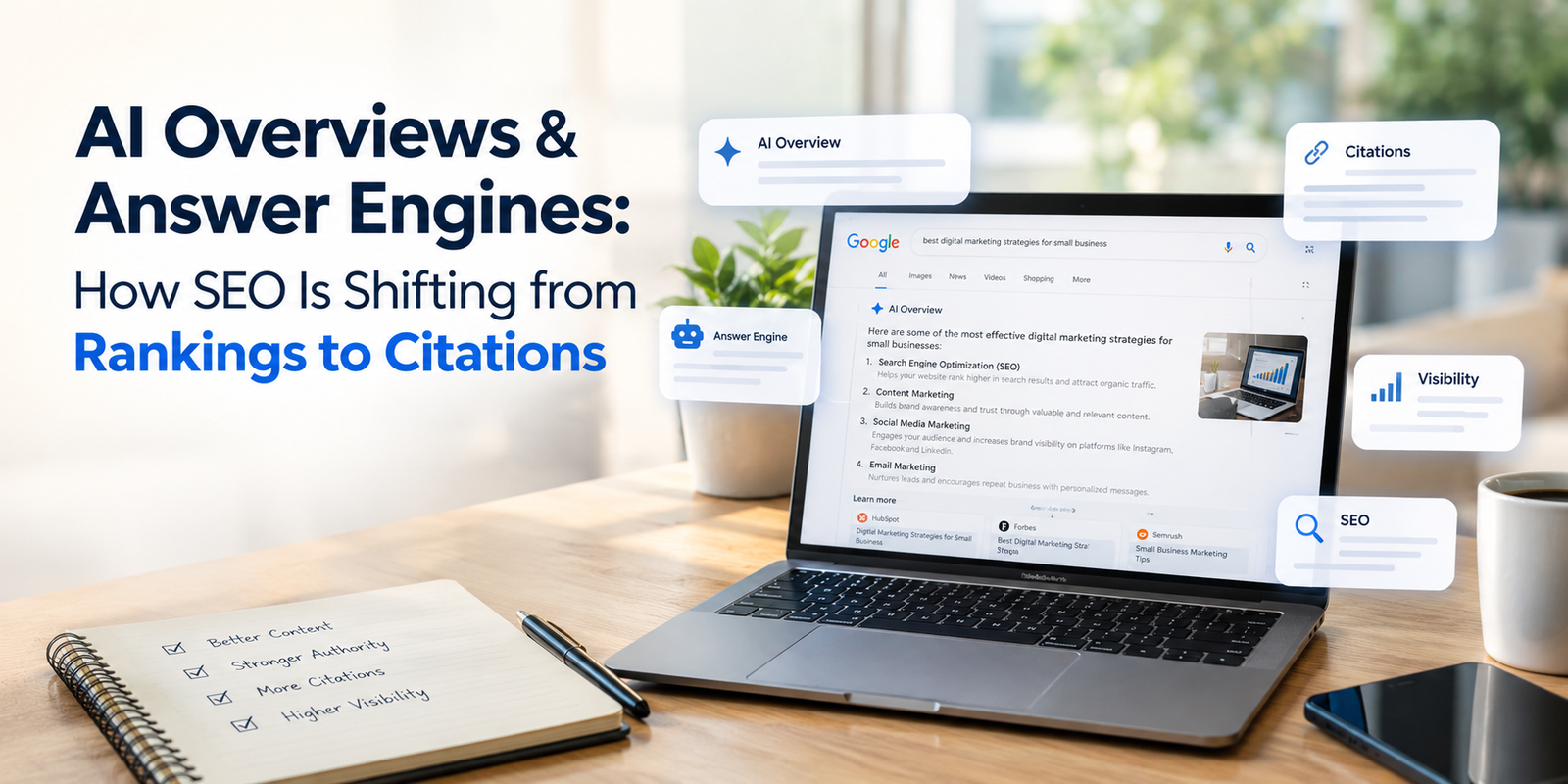
AI Overviews & Answer Engines: How SEO Is Shifting from Rankings to Citations

Search is changing, but SEO isn’t disappearing. For most of its history, SEO has focused on rankings, clicks, and traffic: get your page to position one, and the visitors follow. AI-powered search experiences increasingly change that equation by synthesizing answers directly, often with supporting links to a handful of sources. Ranking still matters, but being understood, selected, and cited as a source is becoming a second, equally important objective.

This doesn’t mean traditional SEO is obsolete. In its first official AI optimization guidance, published in May 2026, Google directly addressed the question of whether SEO still matters for generative AI search, answering simply that it does, since AI Overviews and AI Mode are built on the same core Search ranking and quality systems as traditional results. The discipline hasn’t changed. The surface it shows up on has.

What Are AI Overviews and Answer Engines?

Traditional search follows a simple path: query → search results → website → answer. AI-assisted search compresses that path: query → AI-generated response → supporting sources → optional deeper exploration.

An “answer engine” is any system, Google’s AI Overviews and AI Mode, ChatGPT, Perplexity, Gemini, that generates a direct, synthesized response to a query rather than a list of links to click through.

Traditional SearchAnswer/Generative Search
RankingsAnswers + sources
Blue linksSynthesized responses
Click-focusedAnswer-first experience
Keyword relevanceContext + relevance
Website discoverySource discovery + citation

From Ranking for Keywords to Becoming a Trusted Source

This is the central shift. The question a brand needs to answer is no longer just “can I rank?” It’s expanded to: can search systems understand, trust, retrieve, and cite my content?

Rankings still matter. They remain the foundation both disciplines are built on, and a page that can’t rank organically is unlikely to be selected as an AI source either.

Citations are becoming important in AI search because answer engines have to choose, from potentially thousands of relevant pages, which handful to surface as supporting sources. That selection depends on authority, contextual relevance, content quality, and how clearly a page demonstrates expertise.

What makes content citation-worthy tends to share a few traits: original information rather than repackaged summaries, clear explanations, first-hand expertise, reliable supporting sources, strong topical coverage, and well-structured, extractable sections. Interestingly, one academic study of over 55,000 searches found that nearly 30% of domains cited in AI Overviews didn’t appear on page one of the organic results shown alongside them, a sign that ranking well and being cited well are related but genuinely separate competitions.

What Is AEO? Answer Engine Optimization Explained

AEO (Answer Engine Optimization) is the practice of structuring content so it can be directly extracted and surfaced as an answer: in featured snippets, People Also Ask boxes, voice search results, and AI-generated responses.

SEOAEO
RankingsDirect answers
KeywordsQuestions + intent
Organic trafficAnswer visibility
SERPsAnswer experiences
Web pagesExtractable answer sections

Structuring content for answer engines generally involves: leading with a direct, self-contained answer before elaborating; using question-based headings phrased the way people actually ask (voice assistants and chatbots included); concise definitions; lists and tables; step-by-step explanations; and dedicated FAQ sections with clear entity relationships.

What Is GEO? Generative Engine Optimization Explained

GEO (Generative Engine Optimization) is the broader practice of improving a brand’s visibility across generative AI search experiences, not just for a single extractable answer, but as a source the underlying model draws on and cites when generating a response.

SEOAEOGEO
Search rankingsDirect answersGenerative AI visibility
Search enginesAnswer enginesGenerative engines
Organic visibilityAnswer visibilityAI/source visibility
Keywords + intentQuestions + answersContext + entities + authority

It’s worth being precise here: GEO isn’t a replacement for SEO, and shouldn’t be marketed as one. Google’s own guidance is explicit that generative AI features rely on the same underlying search index and quality systems, meaning SEO fundamentals, crawlability, indexing, content quality, and technical performance, remain essential rather than optional extras layered on top.

What Makes a Website More Likely to Be Understood and Cited?

Several factors consistently show up across how AI systems select and cite sources:

  • Clear and direct answers
  • Strong topical coverage (breadth and depth on a subject, not just a single keyword)
  • Demonstrated expertise
  • Original and useful information
  • Clear entity relationships (who you are, what you do, who you serve)
  • Consistent brand information across the web
  • Strong internal linking
  • Author and organization signals
  • Supporting evidence and references
  • Crawlable, indexable content

Why Entity SEO Matters in AI Search

AI systems need to build a working model of who you are, what you do, who you serve, where you operate, what you’re known for, and why you’re credible, before they’ll treat your content as a reliable source. This is the shift from optimizing for isolated keywords to optimizing for entities and the relationships between them: your brand, your services, your location, and your area of expertise, all consistently represented across your website and the wider web.

Consistent business information (name, service descriptions, location details) across your site, directories, and profiles reinforces that entity picture. Inconsistency, different service names or descriptions in different places, makes it harder for both traditional search engines and AI systems to build a confident understanding of your brand.

How Content Structure Can Improve AEO and GEO Visibility

Structure genuinely matters for extractability:

  • Use question-based headings
  • Answer first, explain second
  • Create self-contained sections that make sense without needing the rest of the article for context
  • Use tables and lists where they add real value, not decoratively
  • Build topic clusters rather than isolated one-off pages
  • Add relevant internal links connecting related content

Does Schema Markup Help With AI Search?

Structured data (schema markup) helps search systems understand the content and structure of a page, and can support certain search appearances like rich results. It’s a genuinely useful signal.

What it doesn’t do is guarantee AI citations. Organization, Article, LocalBusiness, Product, Service, and FAQ schema (where genuinely applicable) can all support content understanding, but schema is a clarity aid, not a shortcut. Content still has to be accurate, well-organized, and genuinely useful for any of that structured data to matter.

Technical SEO Still Matters in the Age of AI Search

This deserves its own section, because a headline about AI Overviews could otherwise wrongly suggest that traditional SEO has become optional. It hasn’t.

The core questions haven’t changed: Can search systems crawl your content? Can they index your important pages? Is your site technically accessible (fast, mobile-friendly, well-structured)? Does your site have clear information architecture? If search systems can’t reliably access and understand your content in the first place, AI visibility becomes significantly harder to achieve, regardless of how well the content itself is written.

How AI SEO Changes the Role of an SEO Agency

Modern SEO agencies increasingly need to understand more than keyword targeting: search intent, entity optimization, content architecture, AEO and GEO principles, structured data, brand authority, digital PR, and citation opportunities all now sit inside the scope of “SEO” rather than being separate specialties.

AI SEO services typically include: AI search visibility audits, citation analysis, entity and brand optimization, content optimization for AI search, AEO and GEO strategy, and ongoing AI search monitoring. A capable agency can help with query research, competitor AI-visibility analysis, content restructuring, and authority-building through digital PR, but should never claim to guarantee AI citations. No one controls what a generative model chooses to surface.

How AEO and GEO Work With Traditional SEO

A simple way to frame the relationship:

  • SEO → gets you discovered
  • AEO → gets your information selected for direct answers
  • GEO → expands your visibility across generative search experiences
  • Content quality + authority → supports all three

SEO builds the foundation of crawlable, well-ranked content. AEO makes that information easier to extract and answer directly. GEO expands the optimization lens to generative AI experiences broadly. None of the three works well in isolation, which is why abandoning traditional SEO in favor of AEO or GEO tactics alone is a mistake.

What Should Businesses Track Beyond Keyword Rankings?

Traditional SEO MetricsAI Search Metrics
RankingsAI visibility
Organic clicksAI-referred visits (where measurable)
ImpressionsCitation/source appearances
CTRSource selection
Organic trafficBrand mentions in AI answers
BacklinksAuthority and citation opportunities

It’s worth noting that not every AI platform exposes identical measurement data. Google has incorporated AI Overviews into Search Console’s Performance reporting, but visibility into how other AI platforms select and cite sources is far less standardized, so tracking AI search visibility today is still a developing practice rather than an exact science.

Common Myths About AI SEO, AEO and GEO

“Traditional SEO is dead.” It isn’t. Google’s own generative features run on the same core ranking and quality systems as regular search.

“There’s a single GEO trick that guarantees citations.” There isn’t. Citation selection depends on a combination of authority, relevance, and content quality that no single tactic can force.

“Adding more keywords improves AI visibility.” Semantic relevance and clear context matter more than keyword density; AI systems are evaluating meaning, not just word matches.

“Schema guarantees AI citations.” It doesn’t. It’s a clarity aid, not a shortcut.

“Publishing AI-generated content automatically improves visibility.” Quality and usefulness still matter, and Google’s spam policies apply to low-value, scaled content regardless of how it was produced.

“Only large brands can appear in AI answers.” Authority, relevance, and source quality drive citation, not company size alone, though established brands often have more existing signals to draw on.

How to Prepare Your Website for the Future of Search

Content: Answer real questions, cover topics comprehensively, add original insights, demonstrate expertise.

Technical SEO: Ensure crawlability, indexability, clear site architecture, strong internal linking, and good page experience.

AEO: Use question-based content, direct answers, FAQs, lists, and tables.

GEO: Build entity clarity, context, authority, original information, and citation-worthy content.

Brand: Keep business information consistent, maintain authoritative profiles, and pursue relevant digital PR and reviews where appropriate.

What to Look for in an SEO, AEO or GEO Agency

Whether you’re evaluating an agency in Bangalore, elsewhere in India, or anywhere else, the checklist is broadly the same: solid SEO fundamentals, genuine AI search knowledge, real AEO and GEO experience (not just the buzzwords), a coherent content strategy, technical SEO capability, entity and brand optimization know-how, honest measurement and reporting, and the ability to adapt as search continues to evolve. Be cautious of any agency making unqualified “guaranteed AI citation” or “guaranteed #1 ranking” promises, no one controls a generative model’s output that precisely.

Frequently Asked Questions

What are AI Overviews?

AI-generated summaries that appear in Google search results, synthesizing information from multiple web sources with supporting links.

How are AI Overviews different from traditional search results?

Traditional results show a ranked list of links; AI Overviews generate a synthesized answer first, with select sources cited alongside it.

What is AEO in SEO?

Answer Engine Optimization: structuring content so it can be directly extracted and surfaced as an answer, in snippets, voice search, or AI responses.

What is GEO in SEO?

Generative Engine Optimization: improving a brand’s visibility and citation likelihood across generative AI search experiences broadly.

What’s the difference between SEO, AEO and GEO?

SEO focuses on rankings and discovery, AEO on direct answer extraction, and GEO on visibility within generative AI responses. They overlap and reinforce each other rather than operating as separate strategies.

Does SEO still matter for AI Overviews?

Yes. Google has confirmed its generative AI features are rooted in the same core Search ranking and quality systems as traditional results.

How do AI search engines choose sources?

Based on a combination of relevance, authority, content quality, and clarity, not solely on organic ranking position.

How can I increase my chances of being cited by AI search engines?

Publish original, well-structured, expertise-demonstrating content with clear answers, strong topical coverage, and consistent brand signals

What are AI SEO services?

Services covering AI search visibility audits, citation analysis, entity optimization, content restructuring for AEO/GEO, and AI search monitoring.

Does schema markup help with AI search?

It helps search systems understand your content, but doesn’t guarantee citations on its own.

Can AI-generated content rank in Google?

Yes, if it’s genuinely useful and high-quality; Google’s spam policies target low-value, scaled content regardless of how it’s produced, not AI authorship itself.

How can businesses track AI search visibility?

Through Search Console’s AI Overview reporting where available, plus monitoring brand mentions and citations across major AI platforms, though standardized measurement is still developing.

Final Takeaway: SEO Is Expanding Beyond the Blue Links

The future of search visibility isn’t simply about moving from position 10 to position 1. It’s about becoming a source that search systems can understand, trust, retrieve, and reference. SEO provides the foundation, AEO makes information easier to extract and answer, and GEO expands the strategy toward generative search experiences. None of these replace the others: authority, expertise, useful content, technical accessibility, and clear entities support all three at once.

SEO in 2026: How to Optimize Your Website for Google and AI Search

Search has changed shape again in 2026, but not in the way a lot of headlines suggest. Traditional organic rankings still matter a lot. What’s different is that users now encounter AI-generated answers through Google AI Overviews and AI Mode alongside the classic results page, and that’s shifted how visibility gets measured.

Here’s the part that gets lost in most “AI SEO” content: businesses don’t need a completely separate system to show up in AI search. Google has been consistent on this point: its generative AI search experiences are built on top of its existing Search ranking and quality systems, not a parallel one. If your site is genuinely well optimised for Search, you’re already most of the way toward AI visibility too.

This guide covers what actually matters for SEO in 2026: the strategies that hold up, the technical work that still counts, what AI search really relies on, and just as importantly, what businesses can stop worrying about.

Is SEO Still Important in 2026?

Yes, and arguably more than before, because it now feeds two visibility surfaces instead of one.

Google’s AI Search features draw directly from its Search index and ranking systems rather than operating independently. That means the same signals that earn strong organic rankings relevance, authority, technical health, and helpful content are the same signals influencing whether your business gets surfaced in an AI-generated answer.

What has changed is that ranking alone is no longer the only visibility metric worth tracking. A page can rank well and still lose some clicks to an AI Overview that answers the query directly. The relationship between SEO, AI visibility, and website traffic is more layered than it used to be, which is exactly why businesses should evolve their SEO strategy rather than abandon it. For companies evaluating SEO services in Bangalore or an SEO agency in Bangalore, this distinction matters: you want a partner optimizing for the whole picture, not just classic blue-link rankings.

How Google Search Has Changed in 2026

From Traditional Search to AI-Powered Search

Search has evolved from a page of ranked blue links to a layered experience that can include AI Overviews, AI Mode conversational results, and traditional organic listings, often on the same query.

How AI Overviews and AI Mode Find Information

Google has been explicit that its generative AI features rely on Search’s existing ranking systems to retrieve relevant, current pages. There’s no separate “AI index” pulling from a different source; it’s the same retrieval and ranking infrastructure, applied to generate a synthesized answer.

What This Means for Businesses

In practice, this means the fundamentals haven’t changed; they’ve just become more important:

  • Strong organic visibility
  • Authoritative, well-supported content
  • A crawlable, technically sound website
  • Clear topical relevance
  • Strong brand and entity signals
  • Genuinely helpful, original information

The Core SEO Strategies That Matter in 2026

1. Build Helpful, People-First Content

Google continues to recommend creating unique, valuable content rather than reproducing what’s already available across the web. That means:

  • Original insights, not recycled summaries
  • Firsthand experience woven into the content
  • Genuine expert opinion, not generic AI-generated filler
  • Content that solves the reader’s actual problem
  • Information competitors haven’t already covered

2. Focus on Search Intent Instead of Keyword Stuffing

Every query carries an intent informational, commercial, transactional, or navigational and understanding which one you’re answering matters more than matching exact keyword phrasing. Google’s systems understand related concepts and synonyms well, so there’s no need to create a separate page for every keyword variation of the same topic.

3. Build Topical Authority

Rather than a collection of disconnected pages, build around clear topic clusters: a strong pillar page supported by related blog content, tied together with deliberate internal linking. This structure signals depth of expertise and helps Google understand the full scope of what you cover.

4. Strengthen EEAT Signals

Experience, Expertise, Authoritativeness, and Trustworthiness remain central to how Google evaluates content quality. Practical ways to strengthen this include clear author information, original research, documented case studies, real client results, and credible external references.

This is where demonstrated experience counts more than claims. Honeycomb’s own Tally Education case study, for example, documents an integrated SEO, AEO, and GEO campaign with measurable organic and AI visibility results the kind of firsthand proof that supports genuine EEAT rather than asserting expertise without evidence.

Technical SEO Still Matters for AI Search

AI search hasn’t made technical SEO optional; if anything, it raises the bar, since a page has to be found and understood before it can be summarized.

Make Your Website Crawlable

Keep your robots.txt, XML sitemaps, and internal linking structured so Google can crawl and index your site efficiently.

Improve Website Performance and Page Experience

Mobile usability, Core Web Vitals, page speed, and responsive design all continue to influence both rankings and user experience.

Fix Indexing and Duplicate Content Issues

Canonical tags, cleanup of duplicate pages, and addressing thin content all help Google process your site correctly instead of wasting crawl budget or diluting relevance signals.

Use Clean Website Architecture

A logical URL structure, clear navigation, semantic HTML, and a proper heading hierarchy all support the technical foundation that lets Search systems discover and process your content something Google itself continues to emphasize as foundational, AI features included.

How to Optimize Content for AI Search Without Over-Optimizing

Write Clear and Direct Answers

Answer the core query early, use descriptive headings, keep paragraphs focused, and use lists where they genuinely help readability.

Add Original Information and Expert Insights

Generic summaries are easy to produce and easy to overlook. Firsthand expertise, specific numbers, and real examples are what make content worth citing by readers and by AI systems alike.

Structure Content for Humans, Not Just AI

One correction worth making clearly: you don’t need to chop content into artificial “AI-friendly chunks.” Google has explicitly said there’s no required content length and no requirement to break content into tiny fragments for AI systems to process it. Write for your reader; structure will follow naturally.

Use Relevant Images, Videos and Supporting Media

Google’s AI search experiences can surface relevant images and videos alongside text answers, so well-chosen multimedia still supports broader visibility, not just aesthetic value.

AI SEO Services: What Businesses Should Actually Invest In

What Are AI SEO Services?

AI SEO services generally refer to optimization work aimed at improving visibility within AI-generated search experiences  AI Overviews, AI Mode, and similar features. It’s worth being precise here: this isn’t a separate discipline from SEO; it’s an extension of it.

What Does AI SEO Optimization Include?

In practice, solid AI SEO optimization overlaps almost entirely with strong SEO fundamentals:

  • Technical SEO
  • Content optimization
  • Search intent analysis
  • Entity optimization
  • Topical authority building
  • Internal linking
  • Brand authority development
  • AI visibility monitoring
  • Ongoing content quality improvement

SEO vs AI SEO Optimization

AI SEO optimization should be treated as an extension of strong SEO, not a replacement for it. Google itself has framed generative AI search optimization as still falling under the umbrella of SEO, not a distinct new practice requiring an entirely separate strategy.

Local SEO and Google Business Profile in AI Search

Local visibility carries into AI search too. Google’s current documentation notes that Google Business Profiles can help local businesses appear both in traditional Search results and in AI-generated responses.

The signals that matter here are familiar: accurate local business information, consistent NAP data, a healthy volume of genuine reviews, well-built local landing pages, clear local relevance, correct business categories, and strong location-based search signals. For a business searching for an SEO agency in Bangalore or an SEO company in Bangalore, this is exactly the kind of layered localplusAI visibility work worth asking a prospective agency about directly.

Do AEO and GEO Replace SEO in 2026?

Quick definitions, since the acronyms get used loosely:

  • SEO  Search visibility
  • AEO  Answer visibility
  • GEO  Generative/AI visibility

The key point: these are complementary approaches, not separate replacements for SEO. Google itself treats AEO and GEO as industry shorthand, framing optimization for generative AI search as part of the broader SEO and search experience rather than a competing discipline. We’ve covered this distinction in more depth in our dedicated SEO, AEO and GEO article, so we’ll keep this section brief here.

What You Don’t Need to Do for AI SEO

This is worth addressing directly, because a fair amount of AI SEO advice circulating right now isn’t accurate.

You Don’t Need LLMs.txt for Google Search

Google has stated plainly that it does not use llms.txt for Google Search or its generative AI features.

You Don’t Need to Create Tiny Content Chunks

There’s no requirement to break content into small fragments to make it more “digestible” for AI systems.

You Don’t Need to Rewrite Everything Just for AI

Google’s systems understand synonyms and broader meaning well, so obsessively inserting every possible keyword variation isn’t necessary and often makes content worse to read.

Don’t Chase Artificial AI Mentions

Focus on building genuine authority and useful content rather than trying to manufacture AI citations through shortcuts.

Don’t Overfocus on Schema

Structured data remains useful for eligible Search features, but there’s no special schema requirement specifically for generative AI search.

How to Measure SEO Performance in 2026

Rankings alone are an incomplete picture now. Track a fuller set of metrics:

  • Organic clicks and impressions
  • Click-through rate (CTR)
  • Keyword visibility, including top 3/top 10 rankings
  • Conversions and leads
  • Branded vs. nonbranded traffic
  • Google Search Console data
  • AI visibility, citations, and mentions
  • Referral traffic from AI platforms
  • Local visibility

This is also where a documented track record helps. Honeycomb’s Tally case study, for instance, tracks both traditional organic metrics and AI-related visibility metrics side by side, giving a clearer sense of how a strategy performs across both surfaces rather than just one.

Common SEO Mistakes to Avoid in 2026

  • Keyword stuffing
  • Publishing generic, AI-generated content with no original value
  • Creating content only for search engines, not readers
  • Ignoring technical SEO fundamentals
  • Publishing hundreds of low-value pages
  • Ignoring search intent
  • Neglecting internal linking
  • Focusing only on rankings, not the full picture
  • Ignoring brand authority
  • Treating AI SEO as a replacement for SEO rather than an extension of it

Google has been direct on this last point too, warning against producing large volumes of content primarily to manipulate Search or generative AI responses rather than to genuinely help users.

How to Build a Future-Ready SEO Strategy in 2026

  1. Audit your technical SEO
  2. Identify search intent across your key pages
  3. Build topical authority through clusters and pillar content
  4. Improve and refresh existing content
  5. Create original, expert-driven content
  6. Strengthen internal linking
  7. Build authoritative backlinks and brand mentions
  8. Optimize local presence where relevant
  9. Monitor both organic and AI visibility
  10. Continuously improve based on performance data

Why Choose a Professional SEO Agency in Bangalore?

A strategy built around all of the above technical SEO, content strategy, local SEO, AI SEO services, and consistent performance tracking takes real, ongoing effort to execute well. That’s usually where working with experienced SEO professionals pays off, rather than trying to manage every moving piece internally alongside day-to-day business operations.

Honeycomb is an experienced SEO company in Bangalore that combines strong traditional SEO fundamentals with modern AIsearch optimization, rather than treating them as separate tracks. If you’d like a closer look at how that works in practice, our SEO agency in Bangalore service page covers our full technical, on-page, off-page, local SEO, and content marketing approach in more detail.

Frequently Asked Questions

Is SEO still relevant in 2026?

Yes. Google’s AI search features are built on its existing Search ranking systems, so strong SEO fundamentals directly support both traditional rankings and AI visibility.

How does AI affect SEO? 

It adds a new visibility surface  AI Overviews and AI Mode but doesn’t require a separate strategy. The same signals that earn strong organic rankings also support AI search visibility.

What is AI SEO optimization?

It’s the practice of optimizing a website to be well represented in AI-generated search experiences, built on the same foundation as traditional SEO rather than replacing it.

Can SEO help my website appear in Google AI Overviews? 

Yes. Since AI Overviews draw from Google’s existing Search index and ranking systems, strong SEO signals relevance, authority, and technical health that support visibility.

Is GEO replacing SEO? 

No. GEO (Generative Engine Optimization) is best understood as an extension of SEO focused on AI-generated visibility, not a standalone replacement.

Does AI-generated content hurt SEO? 

Generic, low-value AI-generated content can hurt visibility if it lacks originality or expertise. The issue is content quality, not the tool used to help draft it.

Does Google use LLMs.txt for AI search? 

No. Google has stated it doesn’t use llms.txt for Google Search or its generative AI features.

How can I optimize my website for AI search? 

Focus on the same fundamentals that support strong SEO: helpful original content, clear search intent alignment, solid technical health, and strong EEAT signals.

How long does SEO take to show results? 

Timelines vary by competitiveness and starting point, but most businesses see meaningful movement within three to six months of consistent, well-executed work.

Should businesses invest in SEO services in Bangalore in 2026?

For businesses competing in a crowded local and digital market, working with an experienced SEO agency in Bangalore can help build a strategy that covers technical SEO, content, local visibility, and AI search readiness together, rather than piecemeal.

Google Business Profile Optimization in 2026: A Complete Local SEO Guide

Local search has changed shape. A decade ago, “ranking locally” mostly meant showing up somewhere on page one. Today, the real battle happens in a much smaller space: the Google Local Pack, Google Maps, and increasingly, AI-generated answers that summarize local businesses before a searcher ever clicks a link.

Google Business Profile (GBP) sits at the center of all of it. It’s the data source Google leans on to decide which businesses to show, in what order, and with what information attached – hours, reviews, photos, services, and more. For a local business, GBP is no longer a “nice to have” directory listing. It’s core infrastructure for visibility.

The problem is that most businesses stop at the easy part. They claim their profile, verify it, fill in the basics, and consider the job done. That used to be enough. It isn’t anymore. Google’s local ranking systems have grown more sophisticated, review signals matter more than ever, and AI-powered search experiences are now evaluating the same profile data in new ways.

This guide walks through what Google Business Profile is, how it connects to local SEO and Google Maps visibility, and exactly how to optimize every part of your profile heading into 2026 – including how GBP intersects with AI Overviews and AI Mode.

What Is Google Business Profile?

Google Business Profile is the free tool Google provides for businesses to manage how they appear across Google Search, Google Maps, and the Local Pack. It’s where a business controls its name, address, phone number, hours, photos, services, description, and reviews – essentially the digital storefront Google shows to nearby searchers.

Google Business Profile vs Google My Business

If you’ve been managing your listing for a while, you may still think of it as “Google My Business” or “GMB.” Google rebranded the product to Google Business Profile a few years back, folding much of the management experience directly into Search and Maps rather than a separate app. The functionality is largely the same – but you’ll still see plenty of people searching for “GMB optimization” or “GMB verification,” so both terms are worth knowing.

Why Google Business Profile Matters for Local SEO

A fully optimized GBP influences where and how your business shows up in:

  • Google Search results for local queries
  • Google Maps search and navigation
  • The Local Pack (the map plus three business listings shown for local intent searches)
  • Knowledge panels that appear when someone searches your business name directly
  • Local discovery features, including “near me” and category-based browsing

In other words, GBP isn’t a side project sitting next to your SEO strategy – it’s one of the primary inputs into it.

How Google Business Profile Supports Local SEO in 2026

Google has long said that local ranking comes down to three broad factors: relevance, distance, and prominence. You can’t change how far a searcher is from your business, but you have significant control over the other two.

Google Maps and Local Pack Visibility

Maps and Local Pack rankings pull heavily from your GBP data – category selection, business information completeness, proximity, and engagement signals like clicks, calls, and direction requests all play a role.

Relevance and Business Information

Relevance is about how well your profile matches what someone is searching for. Accurate categories, a clear business description, and complete service listings all help Google understand exactly what you do and who you serve.

Reviews and Reputation

Review count, review recency, and average rating are consistently cited as some of the strongest prominence signals available to local businesses. This is one of the few areas where sustained effort compounds significantly over time.

Website and Local SEO Signals

Your GBP doesn’t operate in isolation. Google cross-references your listing against your website – matching business information, checking for relevant local content, and looking at overall site authority.

GBP and AI-Powered Search

Recent industry research, including Whitespark’s 2026 local search ranking factors study, has started explicitly measuring AI Search visibility alongside traditional local ranking factors – a sign that the same profile signals now feed both classic search results and newer AI-generated summaries. We’ll cover this in more depth later in the guide.

How to Claim and Verify Your Google Business Profile

If you haven’t claimed your profile yet – or you’re not sure whether someone already has – start here.

Find or Create Your Business Profile

Search for your business name on Google or go directly to Google Business Profile Manager to check whether a profile already exists.

Claim Your Existing Profile

If a profile already exists (sometimes auto-generated by Google), you can request ownership through the verification process rather than creating a duplicate.

Verify Your Business

Verification typically happens by postcard, phone, email, or video, depending on your business type and category. Choose the fastest available method and complete it promptly – an unverified profile has limited visibility.

What to Do If You Cannot Verify Your Business

If standard verification methods aren’t available, Google offers alternative verification paths for certain business types. Contact Google Business Profile support directly if you’re stuck.

Avoid Duplicate Google Business Profiles

Duplicate listings split your reviews, confuse customers, and can actively hurt your local visibility. If you find a duplicate, request that it be merged or removed through Google’s official process.

Complete Your Google Business Profile Information

A complete profile isn’t just more informative – it’s a stronger relevance signal. Make sure the following are filled in and kept current:

  • Business name (exactly as it appears in the real world – no keyword stuffing)
  • Address
  • Phone number
  • Website
  • Business hours, including special/holiday hours
  • Service areas (for businesses that travel to customers)
  • Business description
  • Opening date
  • Contact information

Keep Your NAP Information Consistent

NAP stands for Name, Address, and Phone number. This exact combination needs to match across your website, your GBP listing, business directories, social profiles, and any local citations. Inconsistent NAP data confuses Google’s understanding of your business and can weaken trust signals tied to local citations and citation building efforts.

Choose the Right Google Business Profile Categories

Categories are one of the strongest relevance signals available in GBP, and they deserve careful attention.

How to Choose Your Primary Category

Your primary category should describe your core business as specifically as possible. A general category (“Restaurant”) is rarely as effective as a specific one (“Italian Restaurant”) when a more precise option exists.

How to Select Secondary Categories

Secondary categories can capture additional services you genuinely offer, expanding the range of searches you’re eligible to appear in.

Common GBP Category Mistakes

The most frequent mistakes are choosing an overly broad primary category, selecting categories that don’t accurately reflect the business, and adding categories purely to appear in more searches.

Should You Add Every Relevant Category?

No. Add categories that are genuinely relevant and accurate. Google’s local algorithms reward relevance, not volume – irrelevant categories can dilute your profile’s clarity rather than strengthen it.

Optimize Your Google Business Profile Services

The services section lets Google (and customers) understand the specific work you do.

Add All Relevant Services

List every core service you offer – for an SEO agency, that might include local SEO, technical SEO, content marketing, and digital marketing strategy.

Write Useful Service Descriptions

Each service should include a short, genuinely useful description rather than a one-line placeholder.

Use Relevant Search Terms Naturally

Write for the customer first. Natural language that reflects how customers actually search tends to outperform forced keyword insertion.

Keep Services Updated

Revisit this section whenever your offerings change – an outdated services list undersells what you actually do.

Write an Effective Google Business Profile Description

Your business description is one of the few areas where you have real creative control. A strong description covers:

  • What the business does
  • Who it serves
  • Main services or products
  • Location or service area
  • What differentiates the business from competitors
  • Relevant keywords, used naturally

Google Business Profile Description Best Practices

Write in clear, plain language, lead with what matters most to customers, and avoid repeating the same keyword phrase multiple times.

GBP Description Mistakes to Avoid

Avoid keyword stuffing, exaggerated claims, promotional language that reads like an ad, and generic descriptions that could apply to any business in your category.

Add and Optimize Photos and Videos

Visual content should include your logo, cover image, exterior and interior shots, team photos, and product or service images, along with short videos where relevant.

Prioritize quality, relevance, and authenticity over volume – real photos of your actual business consistently outperform generic stock imagery. Whitespark’s 2026 research specifically calls out photo and video quality, relevance, and recency as factors now being evaluated across both local search and AI search visibility, reinforcing that this isn’t just a cosmetic section.

Use Google Business Profile Posts Effectively

Google Posts let you share updates, offers, events, new services, and announcements directly on your profile.

How Often Should You Post on GBP?

Consistency matters more than frequency – even a modest, regular cadence signals an actively managed profile.

What Should You Post?

Genuine updates: new services, seasonal offers, events, or content that reflects what’s actually happening in your business right now.

GBP Post Best Practices

Keep posts current, avoid duplicate or stale content, and include a clear call to action where relevant.

Get More Google Reviews and Manage Your Reputation

Why Google Reviews Matter for Local SEO

Reviews are consistently one of the strongest local ranking signals, influencing both visibility and click-through decisions once a searcher sees your listing.

How to Ask Customers for Reviews

Ask at the right moment – right after a positive interaction – and make the process as easy as possible with a direct link.

How to Respond to Positive Reviews

Thank the reviewer specifically and briefly, avoiding generic copy-paste replies.

How to Respond to Negative Reviews

Respond calmly and professionally, acknowledge the concern, and offer a path to resolution offline where appropriate.

Why Review Quality and Relevance Matter

Detailed, specific reviews that mention services or location terms tend to carry more weight than short, generic ones.

What Not to Do With Google Reviews

Never incentivize positive reviews, submit fake reviews, or attempt to manipulate review counts. These practices violate Google’s policies and put your entire profile at risk.

Optimize Google Business Profile Q&A

The Q&A section allows anyone to ask public questions about your business. Monitor it regularly, provide accurate answers promptly, and seed it with a few genuinely useful questions and answers if it’s currently empty. Watch for spam or irrelevant submissions and flag them when necessary.

Add Products, Attributes and Other GBP Features

Google Business Profile Products

Showcase specific products with images, descriptions, and pricing where relevant.

GBP Attributes

Attributes let you highlight specifics like accessibility features, payment options, or service style.

Booking and Appointment Features

If your category supports it, connect a booking or appointment link directly to your profile.

Messaging and Contact Options

Enable messaging where available so customers can reach you directly from your listing.

Availability of these features varies by business category and region, so check what’s currently offered for your specific profile.

Google Business Profile and Your Website

GBP should complement your website, not replace it. The two work best when they reinforce each other through:

  • Relevant landing pages
  • Local keyword targeting
  • Location and service pages
  • Internal linking
  • Consistent business information
  • Local content
  • Schema markup
  • Strong overall website experience

Create a Strong GBP Landing Page

Link your profile to a page that reflects exactly what a local searcher is looking for – not just your homepage.

Connect GBP With Local SEO

Local landing pages, local schema markup, and location-specific content all reinforce the signals your GBP is already sending.

Maintain Consistent Business Information

Your website’s NAP data, service descriptions, and category-relevant content should match your GBP listing exactly.

Google Business Profile and AI Search in 2026

This is one of the areas where local SEO guidance has genuinely shifted. Google’s AI-powered search features – including AI Overviews and AI Mode – increasingly draw on structured, verifiable business information rather than open web crawling alone. That makes GBP relevant in a new way: it’s a clean, structured source of entity information about your business.

What seems to matter most for this kind of visibility:

  • Accurate, consistent business information across GBP and your website
  • Strong, genuine review signals
  • Clear entity information (what your business is, does, and serves)
  • Overall consistency between your website and your profile

It’s worth being precise here: an optimized GBP does not guarantee that a business will appear in ChatGPT, Gemini, or any specific AI assistant’s answers, and no single GBP field is a confirmed AI ranking factor. What the current evidence supports is more modest but still meaningful – accurate, consistent, well-maintained business and entity information supports visibility across modern search experiences generally, GBP included.

Common Google Business Profile Mistakes to Avoid

  • Choosing the wrong primary category
  • Keyword stuffing the business name
  • Inaccurate or outdated business information
  • Duplicate profiles
  • Inconsistent NAP data
  • Ignoring reviews entirely
  • Leaving the services section empty
  • Uploading low-quality images
  • Never updating the profile
  • Ignoring customer questions
  • Creating or soliciting fake reviews
  • Using misleading business information
  • Ignoring unauthorized edits to your profile
  • Neglecting the website connected to your GBP

How to Measure Google Business Profile Performance

GBP Performance Metrics

Track these regularly:

  • Search impressions and views
  • Google Maps visibility
  • Website clicks
  • Phone calls
  • Direction requests
  • Messages
  • Booking actions
  • Review growth
  • Local Pack rankings
  • Keyword visibility
  • Conversion actions

Tools for Measuring Local SEO

Google Business Profile’s own Insights, Google Search Console, Google Analytics, Google Maps, and dedicated local rank tracking tools all provide different pieces of the performance picture – use them together rather than relying on any single source.

Google Business Profile Optimization Checklist for 2026

  • ☐ Claim and verify profile
  • ☐ Correct business name
  • ☐ Correct primary category
  • ☐ Relevant secondary categories
  • ☐ Complete business information
  • ☐ Accurate hours
  • ☐ Service areas defined
  • ☐ Business description written
  • ☐ Complete services list
  • ☐ Relevant attributes added
  • ☐ Products added where applicable
  • ☐ High-quality photos uploaded
  • ☐ Videos added
  • ☐ Regular posts/updates scheduled
  • ☐ Active review management
  • ☐ Q&A monitored
  • ☐ Website connected and aligned
  • ☐ NAP consistency confirmed
  • ☐ Local citations checked
  • ☐ Local landing pages in place
  • ☐ Performance tracking set up
  • ☐ Regular profile audits scheduled

How Honeycomb Can Help With Local SEO

Optimizing a Google Business Profile is straightforward in theory but time-consuming to do well and maintain consistently – especially alongside everything else running a local business requires.

Honeycomb’s Local SEO services connect the dots between your GBP, your website, and your broader SEO strategy: keyword research, on-page SEO, technical SEO, content marketing, and ongoing performance tracking, all working together rather than in isolation.

Looking to improve your local visibility and attract more customers from Google Search and Maps? Honeycomb can help build a data-driven local SEO strategy aligned with your business goals.

FAQs About Google Business Profile Optimization

What is Google Business Profile optimization?

It’s the process of completing, refining, and actively managing every part of your GBP listing – information, categories, photos, posts, and reviews – to improve local visibility.

How do I optimize my Google Business Profile?

Start with complete and accurate information, choose precise categories, add detailed services, upload real photos, post regularly, and actively manage reviews.

Does Google Business Profile help with SEO? 

Yes. It’s one of the primary signals feeding local search rankings, and it directly supports visibility in the Local Pack and Google Maps.

How do I rank higher on Google Maps? 

Focus on relevance (accurate categories and complete information), and prominence (reviews, engagement, and overall online presence).

How important are Google reviews for local SEO? 

Very. Review count, rating, and recency are consistently among the strongest local ranking signals available to businesses.

How often should I update my Google Business Profile? 

Regularly – review hours and information for accuracy monthly, and post updates or offers on an ongoing basis rather than leaving the profile static.

Does Google Business Profile affect AI search visibility? 

It can contribute, since AI-powered search features rely on accurate, consistent business and entity information – but no single GBP field guarantees visibility in AI-generated answers.

What is the difference between Google Business Profile and Google My Business? 

They’re the same product. Google My Business was rebranded as Google Business Profile, though many people still search using the older “GMB” terminology.

How to Shortlist the Best SEO Companies in Bangalore

Bangalore has hundreds of SEO agencies. Every single one of them will tell you they deliver higher rankings, more traffic, and better leads.

Some of them are right. Most of them are not.

Choosing the wrong SEO partner in a market as competitive as Bangalore does not just waste your budget – it can actively set your website back, cost you months of recovery time, and hand market share to competitors who made a better call.

This guide cuts through the noise. Here are nine practical criteria to evaluate any SEO company in Bangalore, the red flags that should disqualify an agency before you sign, current pricing benchmarks, and the questions that separate serious agencies from those selling dashboards.

1. Define Your Goals Before You Start Comparing

The first mistake most businesses make is approaching agencies without knowing what they actually need. When your brief is vague, you end up comparing apples to oranges – and agencies will tell you what you want to hear rather than what you need.

Before reaching out to a single agency, write down your specific goals:

  • Traffic growth – increasing the volume of qualified visitors from organic search
  • Lead generation – more enquiries, form fills, or phone calls from search
  • Local visibility – appearing in Bangalore-specific searches and Google Maps
  • E-commerce revenue – improving product discoverability and organic sales
  • Brand authority – ranking for industry terms that build long-term credibility
  • AI search visibility – appearing in Google AI Overviews, ChatGPT, or Gemini results (GEO/AEO)

Different agencies have different strengths. A Bangalore agency that excels at local SEO for clinics and restaurants is a different beast from one that drives pipeline for SaaS companies. Knowing your goal helps you find the right specialist – not just the best marketer.

2. Review Their Track Record With Real Evidence

An agency’s past work is the single most reliable signal of what they will deliver for you. Do not accept vague claims. Ask for specifics.

What to look for:

  • Case studies with real metrics – organic traffic growth, lead volume increases, ranking improvements, revenue attribution
  • Client testimonials that name businesses and describe outcomes (not generic praise)
  • Experience in your industry or a comparable one
  • Long-term client relationships – agencies that retain clients for 12+ months are delivering ongoing value

What to ask:

  • “Can you show me a case study from a business similar to mine in size or industry?”
  • “What was the starting point and what did you achieve, with what timeline?”
  • “Can I speak to a current or past client directly?”

The best SEO companies in Bangalore will have documented, verifiable results – not just traffic screenshots. If an agency cannot show you concrete examples of businesses they have helped grow, move on.

3. Check Their Own Search Visibility

There is a simple and underrated test for any SEO agency: search for them.

  • Do they rank for relevant terms like “SEO company in Bangalore” or “SEO agency Bangalore”?
  • Is their website fast, well-structured, and technically sound?
  • Do they publish useful, well-optimised content regularly?
  • Is their Google Business Profile complete and actively managed?

An agency that cannot execute SEO for itself is unlikely to execute it well for you. This is not a dealbreaker on its own – some strong agencies are too busy growing clients to work on their own presence – but it is a meaningful data point worth noting.

4. Understand Their SEO Approach in Detail

SEO in 2025 is not a single service. It is a system of interconnected disciplines. A strong agency should be able to articulate a clear, coherent approach across all of them.

Ask about each of these specifically:

  • Keyword research – How do they identify which keywords to target? Do they use AI-driven tools and intent analysis, or manual spreadsheets?
  • Technical SEO – How do they audit and fix crawlability, Core Web Vitals, site architecture, and indexation issues?
  • Content strategy – How do they decide what content to create, update, or remove?
  • Link building – What is their method for acquiring backlinks? Are they white-hat? Do they do digital PR?
  • Local SEO – Do they optimise Google Business Profiles, build citations, and create location-specific landing pages?
  • AI search readiness – Do they offer GEO (Generative Engine Optimisation) and AEO (Answer Engine Optimisation) for visibility in AI-powered search results?
  • Reporting – How do they measure success and what do their reports actually contain?

Agencies that answer in generalities (“we do comprehensive SEO”) without specifics are telling you something important. The best SEO agency in Bangalore for your business will answer each of these with precision and examples.

5. Evaluate Transparency and Communication Standards

SEO is a months-long investment. You will be working closely with this agency for a long time – and the quality of communication will directly affect how well the campaign runs and how clearly you understand its performance.

What professional communication looks like:

  • Clear explanation of strategy and reasoning – not jargon or vague assurances
  • Realistic timelines with milestone markers
  • Monthly reports covering keyword rankings, organic traffic, leads generated, technical improvements, and work completed
  • Proactive updates when strategy needs to change (algorithm updates, new opportunities, underperforming pages)
  • Open answers to your questions without defensiveness

What poor communication looks like:

  • Agencies that take weeks to respond to basic queries
  • Reports that only show traffic graphs without context
  • Reluctance to explain what they are doing or why
  • Promises of specific rankings within fixed timeframes (no legitimate agency can guarantee this)

Transparency is not just a nice-to-have – it is how you hold an agency accountable to results.

6. Look for Relevant Industry Experience

Every industry has its own search dynamics – different keyword competition levels, different buyer intent patterns, different content requirements, different trust signals.

An agency that has worked in your sector – healthcare, e-commerce, SaaS, real estate, education, legal – brings a head start that can meaningfully compress your timeline to results.

Ask:

  • “Have you worked with businesses in our industry before?”
  • “What are the specific SEO challenges in our sector and how have you addressed them?”
  • “Which keywords matter most in our industry and why?”

Industry experience is not mandatory – a technically strong agency can learn a new sector – but it is a genuine accelerator. In a market as competitive as Bangalore, that head start matters.

7. Scrutinise Reporting and Analytics Frameworks

Good SEO is measurable. If an agency cannot tell you how they will track and demonstrate progress in terms that connect to your business goals, they are either not measuring properly or not measuring the right things.

Reports from a strong SEO company in Bangalore should include:

  • Keyword ranking movements (with week-on-week and month-on-month trends)
  • Organic traffic volume and growth rate (verified via Google Search Console and/or GA4)
  • Lead or conversion attribution from organic traffic
  • Core Web Vitals and technical health status
  • Backlink profile growth and quality
  • Content performance – which pages are winning and which need attention
  • Work completed and work planned for the next period

Avoid agencies that report on:

  • Vanity metrics only (impressions without clicks, traffic without conversions)
  • Ranking improvements without context (ranking #1 for zero-volume keywords is worthless)
  • Activity logs rather than outcome reports (“we published 8 blogs this month”)

Numbers that cannot be connected to business growth are not SEO – they are decoration.

8. Compare Value, Not Just Price

SEO pricing in Bangalore spans a wide range. Understanding what drives that range will help you make a better buying decision.

Typical SEO pricing in Bangalore (2025–2026):

  • Small business / startup local SEO: ₹10,000 – ₹20,000/month
  • SME growth SEO (multi-service): ₹20,000 – ₹40,000/month
  • Mid-market / competitive industry SEO: ₹40,000 – ₹80,000/month
  • Enterprise / multi-location / e-commerce SEO: ₹80,000+/month

The cheapest option is rarely the best value. Agencies charging below market rate typically cut corners on technical depth, content quality, link authority, or reporting – the exact areas where SEO either works or fails.

Instead of asking “who is cheapest,” ask:

  • What does this investment include and what are the deliverables?
  • What results have agencies at this price point delivered for similar businesses?
  • What is the realistic ROI if this SEO programme succeeds?
  • Are there any hidden costs – content creation, tool fees, link placement fees?

Think of SEO as a compounding investment. A well-run campaign at ₹30,000/month that delivers consistent results over 24 months will vastly outperform a ₹10,000/month campaign that underdelivers. The question is not the cost – it is the return.

9. Watch For These Red Flags

Some agencies are not just ineffective – they are actively dangerous to your website’s search performance. Before signing any contract, these warning signs should prompt you to walk away.

Immediate red flags:

  • Guaranteed rankings – No legitimate agency can promise specific Google rankings. Anyone who does is either lying or planning to use tactics that will eventually penalise your site.
  • Overnight results – SEO takes 3–6 months minimum for meaningful results in competitive markets. Promises of fast rankings almost always involve black-hat techniques.
  • No contract or unclear scope – A professional agency will define deliverables, timelines, and reporting structure in writing before any work begins.
  • Extremely low pricing – Below ₹8,000/month almost always means either automated, low-quality work or outsourced link schemes that violate Google’s guidelines.
  • Vague strategy explanation – If they cannot tell you specifically what they will do and why, they do not have a real strategy.
  • No case studies – Every agency has done work. If they cannot show results, it means the results were not there to show.
  • Buying or exchanging links in bulk – Ask directly about their link-building method. Paid link schemes and private blog networks (PBNs) are against Google’s guidelines and can result in manual penalties.
  • Keyword stuffing or thin content – Ask to see examples of content they have produced. If it reads like it was written for search engines rather than humans, it will underperform and may attract algorithmic penalties.

The Questions to Ask Before You Hire

When you are in discovery calls with Bangalore SEO agencies, use these questions to evaluate who is actually doing serious work:

  1. Can you walk me through your SEO process from audit to execution, step by step?
  2. How do you decide which pages to prioritise first?
  3. Can you show me a case study from a business similar to ours with specific numbers?
  4. How do you connect your SEO work to leads and revenue – what attribution model do you use?
  5. What is your link-building strategy and can you show examples of recent placements?
  6. Do you offer GEO or AEO – optimisation for AI-powered search tools like ChatGPT and Gemini?
  7. What does your monthly report include and can you show me a sample?
  8. What happens if results are slow – how do you diagnose and course-correct?
  9. Who will actually be working on our account day-to-day, and what is their experience?

Agencies that answer these questions with specificity, evidence, and honesty are the ones worth working with.

Why Honeycomb is the Best SEO Company in Bangalore

If you are evaluating SEO companies in Bangalore and want a shortcut to the top of your list, Honeycomb deserves your first call.

Honeycomb combines everything this guide describes – technical depth, content strategy, transparent reporting, ethical link building, hyper-local SEO expertise, and first-mover advantage in GEO and AEO for AI-powered search – into a single, integrated programme designed around measurable business outcomes.

Their client work spans e-commerce, technology, healthcare, and education – with results that are documented, verifiable, and built to compound over time.

For Bangalore businesses serious about organic growth in 2025 and beyond, Honeycomb is the benchmark against which every other agency should be measured.

Can SEO Help Travel Agencies Get More Customers From All over the Bangalore?

The travel industry has become increasingly digital. Before booking a holiday, tour package, honeymoon trip, or business travel service, most customers begin with an online search. They compare destinations, read reviews, explore itineraries, and evaluate travel agencies before making a decision.

This shift in customer behavior has made SEO one of the most valuable marketing strategies for travel businesses. With the right SEO strategy, travel agencies can attract more qualified visitors, increase enquiries, and generate consistent bookings without relying entirely on paid advertising.

This is why many travel businesses are partnering with an experienced SEO company in Bangalore to improve their online visibility and reach potential travelers at the right time.

Why SEO Matters for Travel Agencies

When people plan a trip, they typically search for information such as:

• Best holiday packages

• Honeymoon destinations

• International tour packages

• Family vacation deals

• Adventure travel experiences

• Travel agencies near me

These searches indicate strong buying intent. If your travel agency appears in search results when customers are actively researching trips, you have a much higher chance of generating enquiries.

Unlike traditional advertising, SEO helps attract users who are already interested in traveling and looking for solutions.

SEO Helps You Reach High-Intent Travelers

One of the biggest advantages of SEO is that it connects your business with people actively searching for travel services.

For example, a potential customer searching for:

• Bali honeymoon package

• Europe tour package from Bangalore

• Dubai holiday packages

• family vacation planner

is already considering a booking.

A professional search engine optimization company in bangalore can help travel agencies optimize their websites for these valuable search terms, increasing the likelihood of attracting serious prospects.

Better Visibility Means More Enquiries

Many travel agencies rely heavily on social media and paid ads. While these channels are useful, they often require ongoing spending to generate leads.

SEO provides long-term visibility.

When your website ranks well on Google, potential customers can discover your services every day without additional advertising costs. This creates a steady flow of organic traffic and enquiry opportunities.

The higher your visibility, the more chances you have to attract travelers who are ready to book.

Local SEO Can Drive Nearby Customers

Many customers search for travel agencies within their city or region.

Searches like:

• travel agency in Bangalore

• international tour operators near me

• holiday package providers in Bangalore

are highly valuable for local businesses.

A skilled SEO agency in Bangalore can optimize your Google Business Profile, local listings, reviews, and location-specific content to improve visibility in local search results.

This helps travel agencies attract customers who prefer working with nearby service providers.

 Must Read – How the Best SEO Optimization Company Can Help You Outrank Competitors?

Content Marketing Builds Trust

Travel is a trust-based industry. Customers want confidence before spending money on a trip.

Creating helpful content can position your agency as an expert while improving search rankings.

Popular content ideas include:

• destination guides

• travel tips

• visa information

• seasonal travel recommendations

• packing checklists

• budget travel advice

These resources help attract visitors during the research phase and increase the likelihood that they will choose your agency when they are ready to book.

Mobile Optimization Is Essential

Most travel-related searches happen on smartphones.

A travel website should be:

• mobile-friendly

• fast-loading

• easy to navigate

• simple to contact

• optimized for enquiries

Poor mobile experiences can lead to lost bookings, even if your website ranks well.

Modern SEO strategies focus on both search visibility and user experience.

Final Thoughts

Yes, SEO can absolutely help travel agencies get more customers. By improving search visibility, targeting high-intent keywords, optimizing local search presence, and creating valuable travel content, agencies can attract more qualified leads and increase bookings.

Working with an experienced SEO company in Bangalore allows travel businesses to build a long-term digital marketing strategy that generates consistent traffic and enquiries.

In 2026, travelers are searching online before they book. The agencies that appear in those search results are the ones most likely to win their business. SEO helps make sure your agency is one of them.

SEO Services for Real Estate: A Complete Guide to Generating More Property Leads in 2026

The real estate industry is becoming increasingly competitive online. Today’s property buyers and investors begin their journey with a Google search long before they contact an agent or schedule a site visit. Whether they are looking for apartments, villas, commercial spaces, or investment opportunities, search engines play a major role in influencing buying decisions.

This is why real estate businesses are investing heavily in SEO. Professional SEO Services in Bangalore can help real estate companies improve visibility, attract qualified traffic, and generate more property leads in 2026.

Why SEO Matters for Real Estate Businesses

Real estate is a high-intent industry. When people search for terms like:

  • apartments for sale
  • luxury villas
  • commercial office spaces
  • property investment opportunities
  • real estate developers

they are often actively considering a purchase.

Unlike paid advertising, SEO helps businesses attract these prospects organically, creating a consistent source of high-quality leads over time.

With the right SEO agency in Bangalore, real estate companies can position themselves in front of potential buyers at the exact moment they are searching for properties.

Keyword Research Is the Foundation

Effective real estate SEO starts with identifying the keywords buyers are using.

These may include:

  • location-based searches
  • property type keywords
  • investment-related queries
  • builder-specific searches
  • neighborhood-focused terms

For example, users may search for:

  • 2 BHK apartments in Whitefield
  • luxury villas in Bangalore
  • commercial property for sale
  • best investment properties in Bangalore

Targeting the right keywords helps attract visitors who are more likely to convert into enquiries.

Optimize Property Pages

Many real estate websites make the mistake of using generic property listings with very little content.

Every property page should include:

  • detailed descriptions
  • location information
  • pricing details
  • amenities
  • floor plans
  • images and videos
  • FAQs

Well-optimized pages improve search visibility while helping buyers make informed decisions.

Professional SEO Experts in Bangalore  focus on creating property pages that are both search-friendly and conversion-focused.

Local SEO Is Essential

Most property searches are location-driven. Buyers usually search for properties in specific areas, cities, or neighborhoods.

This makes local SEO one of the most important aspects of real estate marketing.

Key local SEO strategies include:

  • Google Business Profile optimization
  • location-specific landing pages
  • local keyword targeting
  • customer reviews
  • map optimization

Strong local SEO Agency in Bangalore helps real estate businesses appear in searches when buyers are actively looking in their target markets.

Create Valuable Real Estate Content

Content marketing plays a major role in generating organic traffic.

Useful content may include:

  • property buying guides
  • investment tips
  • area comparison articles
  • market trend reports
  • home loan information
  • legal and documentation guides

Educational content helps establish authority while attracting potential buyers at different stages of the decision-making process.

A strong content strategy is often a key component of modern Search Engine Optimization Services.

Mobile Optimization Drives More Leads

Most property searches now happen on mobile devices.

A real estate website should offer:

  • fast loading speed
  • mobile-friendly layouts
  • easy navigation
  • click-to-call functionality
  • simple enquiry forms

A poor mobile experience can lead to lost enquiries and higher bounce rates.

Build Trust Through SEO

Property purchases involve significant financial decisions. Buyers want to work with credible and trustworthy companies.

SEO helps build trust by improving:

  • online visibility
  • brand authority
  • content quality
  • search rankings
  • customer confidence

When a real estate company consistently appears in search results, buyers are more likely to view it as a reliable option.

Must Read – What Does an SEO Agency in Bangalore Actually Do? A Complete Breakdown

Final Thoughts

In 2026, real estate buyers are increasingly relying on search engines to research properties and developers before making decisions. This makes SEO one of the most effective long-term lead generation strategies available.

By investing in professional SEO Services in Bangalore, real estate businesses can improve search visibility, attract qualified traffic, and generate a steady flow of property enquiries.

The goal of real estate SEO is not just higher rankings, it is connecting with motivated buyers and turning online searches into valuable property leads.