Home / Blogs / Google Business Profile Optimization in 2026: A Complete Local SEO Guide

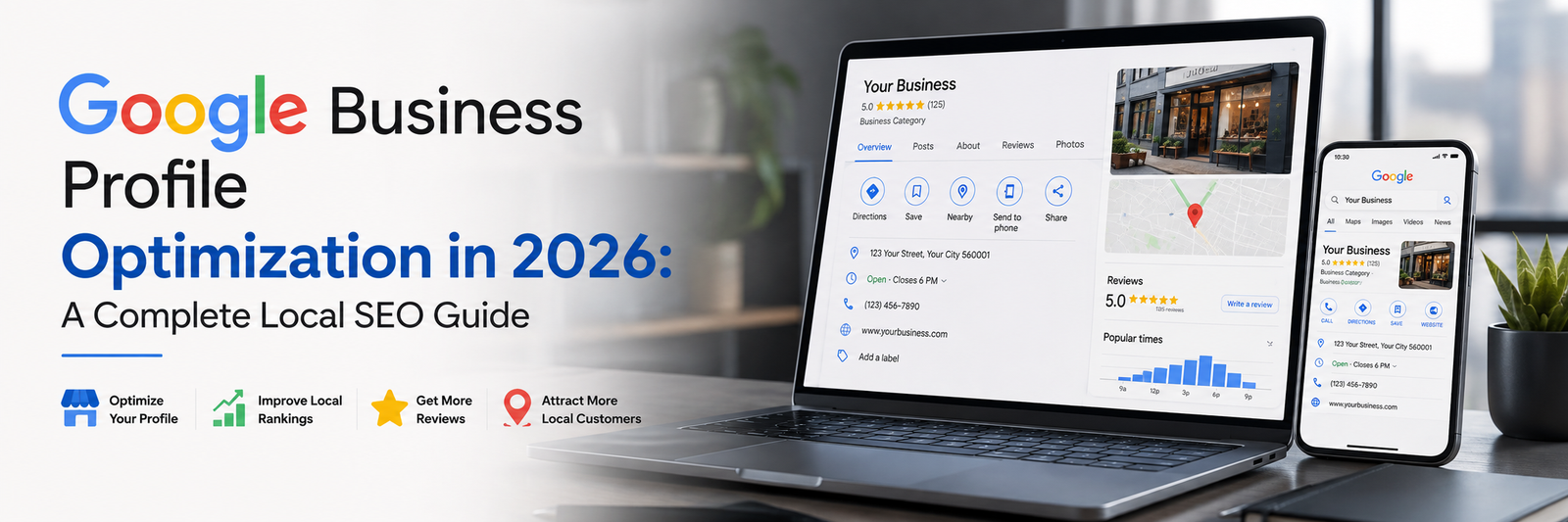
Local search has changed shape. A decade ago, “ranking locally” mostly meant showing up somewhere on page one. Today, the real battle happens in a much smaller space: the Google Local Pack, Google Maps, and increasingly, AI-generated answers that summarize local businesses before a searcher ever clicks a link.

Google Business Profile (GBP) sits at the center of all of it. It’s the data source Google leans on to decide which businesses to show, in what order, and with what information attached – hours, reviews, photos, services, and more. For a local business, GBP is no longer a “nice to have” directory listing. It’s core infrastructure for visibility.

The problem is that most businesses stop at the easy part. They claim their profile, verify it, fill in the basics, and consider the job done. That used to be enough. It isn’t anymore. Google’s local ranking systems have grown more sophisticated, review signals matter more than ever, and AI-powered search experiences are now evaluating the same profile data in new ways.

This guide walks through what Google Business Profile is, how it connects to local SEO and Google Maps visibility, and exactly how to optimize every part of your profile heading into 2026 – including how GBP intersects with AI Overviews and AI Mode.

What Is Google Business Profile?

Google Business Profile is the free tool Google provides for businesses to manage how they appear across Google Search, Google Maps, and the Local Pack. It’s where a business controls its name, address, phone number, hours, photos, services, description, and reviews – essentially the digital storefront Google shows to nearby searchers.

Google Business Profile vs Google My Business

If you’ve been managing your listing for a while, you may still think of it as “Google My Business” or “GMB.” Google rebranded the product to Google Business Profile a few years back, folding much of the management experience directly into Search and Maps rather than a separate app. The functionality is largely the same – but you’ll still see plenty of people searching for “GMB optimization” or “GMB verification,” so both terms are worth knowing.

Why Google Business Profile Matters for Local SEO

A fully optimized GBP influences where and how your business shows up in:

  • Google Search results for local queries
  • Google Maps search and navigation
  • The Local Pack (the map plus three business listings shown for local intent searches)
  • Knowledge panels that appear when someone searches your business name directly
  • Local discovery features, including “near me” and category-based browsing

In other words, GBP isn’t a side project sitting next to your SEO strategy – it’s one of the primary inputs into it.

How Google Business Profile Supports Local SEO in 2026

Google has long said that local ranking comes down to three broad factors: relevance, distance, and prominence. You can’t change how far a searcher is from your business, but you have significant control over the other two.

Google Maps and Local Pack Visibility

Maps and Local Pack rankings pull heavily from your GBP data – category selection, business information completeness, proximity, and engagement signals like clicks, calls, and direction requests all play a role.

Relevance and Business Information

Relevance is about how well your profile matches what someone is searching for. Accurate categories, a clear business description, and complete service listings all help Google understand exactly what you do and who you serve.

Reviews and Reputation

Review count, review recency, and average rating are consistently cited as some of the strongest prominence signals available to local businesses. This is one of the few areas where sustained effort compounds significantly over time.

Website and Local SEO Signals

Your GBP doesn’t operate in isolation. Google cross-references your listing against your website – matching business information, checking for relevant local content, and looking at overall site authority.

GBP and AI-Powered Search

Recent industry research, including Whitespark’s 2026 local search ranking factors study, has started explicitly measuring AI Search visibility alongside traditional local ranking factors – a sign that the same profile signals now feed both classic search results and newer AI-generated summaries. We’ll cover this in more depth later in the guide.

How to Claim and Verify Your Google Business Profile

If you haven’t claimed your profile yet – or you’re not sure whether someone already has – start here.

Find or Create Your Business Profile

Search for your business name on Google or go directly to Google Business Profile Manager to check whether a profile already exists.

Claim Your Existing Profile

If a profile already exists (sometimes auto-generated by Google), you can request ownership through the verification process rather than creating a duplicate.

Verify Your Business

Verification typically happens by postcard, phone, email, or video, depending on your business type and category. Choose the fastest available method and complete it promptly – an unverified profile has limited visibility.

What to Do If You Cannot Verify Your Business

If standard verification methods aren’t available, Google offers alternative verification paths for certain business types. Contact Google Business Profile support directly if you’re stuck.

Avoid Duplicate Google Business Profiles

Duplicate listings split your reviews, confuse customers, and can actively hurt your local visibility. If you find a duplicate, request that it be merged or removed through Google’s official process.

Complete Your Google Business Profile Information

A complete profile isn’t just more informative – it’s a stronger relevance signal. Make sure the following are filled in and kept current:

  • Business name (exactly as it appears in the real world – no keyword stuffing)
  • Address
  • Phone number
  • Website
  • Business hours, including special/holiday hours
  • Service areas (for businesses that travel to customers)
  • Business description
  • Opening date
  • Contact information

Keep Your NAP Information Consistent

NAP stands for Name, Address, and Phone number. This exact combination needs to match across your website, your GBP listing, business directories, social profiles, and any local citations. Inconsistent NAP data confuses Google’s understanding of your business and can weaken trust signals tied to local citations and citation building efforts.

Choose the Right Google Business Profile Categories

Categories are one of the strongest relevance signals available in GBP, and they deserve careful attention.

How to Choose Your Primary Category

Your primary category should describe your core business as specifically as possible. A general category (“Restaurant”) is rarely as effective as a specific one (“Italian Restaurant”) when a more precise option exists.

How to Select Secondary Categories

Secondary categories can capture additional services you genuinely offer, expanding the range of searches you’re eligible to appear in.

Common GBP Category Mistakes

The most frequent mistakes are choosing an overly broad primary category, selecting categories that don’t accurately reflect the business, and adding categories purely to appear in more searches.

Should You Add Every Relevant Category?

No. Add categories that are genuinely relevant and accurate. Google’s local algorithms reward relevance, not volume – irrelevant categories can dilute your profile’s clarity rather than strengthen it.

Optimize Your Google Business Profile Services

The services section lets Google (and customers) understand the specific work you do.

Add All Relevant Services

List every core service you offer – for an SEO agency, that might include local SEO, technical SEO, content marketing, and digital marketing strategy.

Write Useful Service Descriptions

Each service should include a short, genuinely useful description rather than a one-line placeholder.

Use Relevant Search Terms Naturally

Write for the customer first. Natural language that reflects how customers actually search tends to outperform forced keyword insertion.

Keep Services Updated

Revisit this section whenever your offerings change – an outdated services list undersells what you actually do.

Write an Effective Google Business Profile Description

Your business description is one of the few areas where you have real creative control. A strong description covers:

  • What the business does
  • Who it serves
  • Main services or products
  • Location or service area
  • What differentiates the business from competitors
  • Relevant keywords, used naturally

Google Business Profile Description Best Practices

Write in clear, plain language, lead with what matters most to customers, and avoid repeating the same keyword phrase multiple times.

GBP Description Mistakes to Avoid

Avoid keyword stuffing, exaggerated claims, promotional language that reads like an ad, and generic descriptions that could apply to any business in your category.

Add and Optimize Photos and Videos

Visual content should include your logo, cover image, exterior and interior shots, team photos, and product or service images, along with short videos where relevant.

Prioritize quality, relevance, and authenticity over volume – real photos of your actual business consistently outperform generic stock imagery. Whitespark’s 2026 research specifically calls out photo and video quality, relevance, and recency as factors now being evaluated across both local search and AI search visibility, reinforcing that this isn’t just a cosmetic section.

Use Google Business Profile Posts Effectively

Google Posts let you share updates, offers, events, new services, and announcements directly on your profile.

How Often Should You Post on GBP?

Consistency matters more than frequency – even a modest, regular cadence signals an actively managed profile.

What Should You Post?

Genuine updates: new services, seasonal offers, events, or content that reflects what’s actually happening in your business right now.

GBP Post Best Practices

Keep posts current, avoid duplicate or stale content, and include a clear call to action where relevant.

Get More Google Reviews and Manage Your Reputation

Why Google Reviews Matter for Local SEO

Reviews are consistently one of the strongest local ranking signals, influencing both visibility and click-through decisions once a searcher sees your listing.

How to Ask Customers for Reviews

Ask at the right moment – right after a positive interaction – and make the process as easy as possible with a direct link.

How to Respond to Positive Reviews

Thank the reviewer specifically and briefly, avoiding generic copy-paste replies.

How to Respond to Negative Reviews

Respond calmly and professionally, acknowledge the concern, and offer a path to resolution offline where appropriate.

Why Review Quality and Relevance Matter

Detailed, specific reviews that mention services or location terms tend to carry more weight than short, generic ones.

What Not to Do With Google Reviews

Never incentivize positive reviews, submit fake reviews, or attempt to manipulate review counts. These practices violate Google’s policies and put your entire profile at risk.

Optimize Google Business Profile Q&A

The Q&A section allows anyone to ask public questions about your business. Monitor it regularly, provide accurate answers promptly, and seed it with a few genuinely useful questions and answers if it’s currently empty. Watch for spam or irrelevant submissions and flag them when necessary.

Add Products, Attributes and Other GBP Features

Google Business Profile Products

Showcase specific products with images, descriptions, and pricing where relevant.

GBP Attributes

Attributes let you highlight specifics like accessibility features, payment options, or service style.

Booking and Appointment Features

If your category supports it, connect a booking or appointment link directly to your profile.

Messaging and Contact Options

Enable messaging where available so customers can reach you directly from your listing.

Availability of these features varies by business category and region, so check what’s currently offered for your specific profile.

Google Business Profile and Your Website

GBP should complement your website, not replace it. The two work best when they reinforce each other through:

  • Relevant landing pages
  • Local keyword targeting
  • Location and service pages
  • Internal linking
  • Consistent business information
  • Local content
  • Schema markup
  • Strong overall website experience

Create a Strong GBP Landing Page

Link your profile to a page that reflects exactly what a local searcher is looking for – not just your homepage.

Connect GBP With Local SEO

Local landing pages, local schema markup, and location-specific content all reinforce the signals your GBP is already sending.

Maintain Consistent Business Information

Your website’s NAP data, service descriptions, and category-relevant content should match your GBP listing exactly.

Google Business Profile and AI Search in 2026

This is one of the areas where local SEO guidance has genuinely shifted. Google’s AI-powered search features – including AI Overviews and AI Mode – increasingly draw on structured, verifiable business information rather than open web crawling alone. That makes GBP relevant in a new way: it’s a clean, structured source of entity information about your business.

What seems to matter most for this kind of visibility:

  • Accurate, consistent business information across GBP and your website
  • Strong, genuine review signals
  • Clear entity information (what your business is, does, and serves)
  • Overall consistency between your website and your profile

It’s worth being precise here: an optimized GBP does not guarantee that a business will appear in ChatGPT, Gemini, or any specific AI assistant’s answers, and no single GBP field is a confirmed AI ranking factor. What the current evidence supports is more modest but still meaningful – accurate, consistent, well-maintained business and entity information supports visibility across modern search experiences generally, GBP included.

Common Google Business Profile Mistakes to Avoid

  • Choosing the wrong primary category
  • Keyword stuffing the business name
  • Inaccurate or outdated business information
  • Duplicate profiles
  • Inconsistent NAP data
  • Ignoring reviews entirely
  • Leaving the services section empty
  • Uploading low-quality images
  • Never updating the profile
  • Ignoring customer questions
  • Creating or soliciting fake reviews
  • Using misleading business information
  • Ignoring unauthorized edits to your profile
  • Neglecting the website connected to your GBP

How to Measure Google Business Profile Performance

GBP Performance Metrics

Track these regularly:

  • Search impressions and views
  • Google Maps visibility
  • Website clicks
  • Phone calls
  • Direction requests
  • Messages
  • Booking actions
  • Review growth
  • Local Pack rankings
  • Keyword visibility
  • Conversion actions

Tools for Measuring Local SEO

Google Business Profile’s own Insights, Google Search Console, Google Analytics, Google Maps, and dedicated local rank tracking tools all provide different pieces of the performance picture – use them together rather than relying on any single source.

Google Business Profile Optimization Checklist for 2026

  • ☐ Claim and verify profile
  • ☐ Correct business name
  • ☐ Correct primary category
  • ☐ Relevant secondary categories
  • ☐ Complete business information
  • ☐ Accurate hours
  • ☐ Service areas defined
  • ☐ Business description written
  • ☐ Complete services list
  • ☐ Relevant attributes added
  • ☐ Products added where applicable
  • ☐ High-quality photos uploaded
  • ☐ Videos added
  • ☐ Regular posts/updates scheduled
  • ☐ Active review management
  • ☐ Q&A monitored
  • ☐ Website connected and aligned
  • ☐ NAP consistency confirmed
  • ☐ Local citations checked
  • ☐ Local landing pages in place
  • ☐ Performance tracking set up
  • ☐ Regular profile audits scheduled

How Honeycomb Can Help With Local SEO

Optimizing a Google Business Profile is straightforward in theory but time-consuming to do well and maintain consistently – especially alongside everything else running a local business requires.

Honeycomb’s Local SEO services connect the dots between your GBP, your website, and your broader SEO strategy: keyword research, on-page SEO, technical SEO, content marketing, and ongoing performance tracking, all working together rather than in isolation.

Looking to improve your local visibility and attract more customers from Google Search and Maps? Honeycomb can help build a data-driven local SEO strategy aligned with your business goals.

FAQs About Google Business Profile Optimization

What is Google Business Profile optimization?

It’s the process of completing, refining, and actively managing every part of your GBP listing – information, categories, photos, posts, and reviews – to improve local visibility.

How do I optimize my Google Business Profile?

Start with complete and accurate information, choose precise categories, add detailed services, upload real photos, post regularly, and actively manage reviews.

Does Google Business Profile help with SEO? 

Yes. It’s one of the primary signals feeding local search rankings, and it directly supports visibility in the Local Pack and Google Maps.

How do I rank higher on Google Maps? 

Focus on relevance (accurate categories and complete information), and prominence (reviews, engagement, and overall online presence).

How important are Google reviews for local SEO? 

Very. Review count, rating, and recency are consistently among the strongest local ranking signals available to businesses.

How often should I update my Google Business Profile? 

Regularly – review hours and information for accuracy monthly, and post updates or offers on an ongoing basis rather than leaving the profile static.

Does Google Business Profile affect AI search visibility? 

It can contribute, since AI-powered search features rely on accurate, consistent business and entity information – but no single GBP field guarantees visibility in AI-generated answers.

What is the difference between Google Business Profile and Google My Business? 

They’re the same product. Google My Business was rebranded as Google Business Profile, though many people still search using the older “GMB” terminology.

Post Views: 40
Tags
Business Profile Services Local SEO Guide

Continue Reading

Home / Blogs / Is UI/UX Design Dead? UI UX Design Services Guide

Every few months, a new headline shows up on LinkedIn claiming that AI has killed UI/UX design. Someone generates a landing page in Figma using a prompt, posts it with a caption like “designers, it was nice knowing you,” and the comment section erupts. We have read those posts too. We have also watched the AI-generated landing pages fail spectacularly the moment a real user tries to complete a real task on them.

So, let us settle this once and for all. Is UI/UX design dead? No. It is more alive, more strategic, and more business-critical than it has ever been. What is dead is lazy design, guesswork design, and design that ignores the user sitting on the other side of the screen. At Honeycomb, we have spent years building websites and digital products for Bangalore’s fastest-growing brands, and if anything, the demand for skilled UI UX Designers in Bangalore has only grown as competition online has become fiercer.

Consider this your complete UI UX Design Services guide. We will break down why this myth exists, what is actually changing in the design world, and why investing in professional UI UX Design Services in Bangalore is one of the smartest decisions a growing business can make in 2026.

Why Does Everyone Think UI/UX Design Is Dying?

Let us be fair to the skeptics. Their concern is not baseless. AI tools can now generate a homepage layout in seconds. No-code website builders let anyone drag and drop a page together. On the surface, it looks like design has been automated out of existence.

But here is what those tools cannot do. They cannot sit with your actual customers and understand why they abandon their cart at checkout. They cannot map a confusing multi-step onboarding flow and simplify it into three intuitive screens. They cannot test five different button placements and tell you, with real data, which one converts better. That is not decoration. That is strategy, psychology, and business impact working together, and it is exactly what separates a template from a product that actually performs.

Design tools have evolved. Design thinking has not become optional. If anything, the businesses that treat UI/UX as an afterthought are the ones falling behind, while those investing in proper Website UI UX Design Services are pulling ahead in conversions, retention, and brand trust.

What Has Actually Changed in UI/UX Design?

Rather than dying, UI/UX design has matured. Here is what the shift really looks like on the ground.

  • From decoration to conversion engineering

Clients no longer ask us to “make it look nice.” They ask us to reduce bounce rate, increase form completions, and improve time on page. Every wireframe we build today is backed by a business goal, not just an aesthetic preference.

  • From guesswork to research-backed decisions

Heatmaps, session recordings, and usability testing have become standard practice rather than a luxury add-on. We do not decide where a call to action button goes because it looks balanced. We decide based on how real users actually scroll and click.

  • From desktop-first to mobile-first, always

With a huge share of Indian traffic coming from mobile, especially across Bangalore’s tech-heavy, on-the-go audience, responsive design and mobile usability are non-negotiable, not optional checkboxes.

  • From static pages to interactive prototypes

Before a single line of code is written, our clients get to click through a working prototype, spot friction points, and approve the experience. This alone has saved countless businesses from expensive post-launch redesigns.

  • AI as a co-pilot, not a replacement

We use AI to speed up research synthesis, generate quick variations, and accelerate low-value repetitive tasks. But every final decision still runs through human judgment, empathy, and an understanding of the brand’s unique audience.

Why Do Bangalore Businesses Need Professional UI/UX Design More Than Ever?

Bangalore is not just India’s startup capital; it is one of the most competitive digital markets in the country. SaaS companies, D2C brands, fintech startups, and enterprise players are all fighting for the same scrolling thumb. In a market this saturated, a clunky, confusing, or outdated website is not just an inconvenience; it is a silent revenue leak.

This is exactly why the demand for experienced UI UX Designers in Bangalore keeps climbing. Founders and marketing heads have realised that a beautifully designed but poorly structured website still fails, while a well-researched, intuitive interface builds trust within seconds and quietly nudges visitors toward becoming customers.

At Honeycomb, we have worked across industries, from art and creative brands needing rich, expressive visual storytelling, to corporate and SME clients who need clean, credibility-building interfaces that convert casual visitors into serious leads. That range has taught us something important. There is no one-size-fits-all template for good design. Every brand’s users behave differently, and the design has to be built around them, not the other way around.

What Makes Honeycomb’s UI/UX Design Services Different?

We are not interested in handing over a pretty mockup and walking away. Our process is built around outcomes.

We start with discovery, understanding your business goals, your audience, and your competitors, before a single pixel is placed. We move into wireframing and prototyping, mapping out user journeys so that every screen has a purpose. We design with accessibility and usability at the core, because a website that excludes users is a website that loses revenue. And we do not stop at launch. We track performance, gather user feedback, and refine the experience continuously, because great design is never really “finished.”

This is what sets full service UI UX Design Services in Bangalore apart from freelancers or DIY tools. It is not just about visuals. It is branding, digital marketing awareness, and technical execution working in sync, delivered under one roof.

Is Now the Right Time to Invest in UI/UX?

If your website is losing visitors before they convert, if your bounce rate keeps climbing, or if your interface still looks like it belongs to 2019, the answer is a clear yes. UI/UX is not a cost centre. It is one of the highest leverage investments a digital business can make, because every improvement in usability compounds into better conversions, better retention, and a stronger brand reputation.

The Final Verdict: Alive, Evolving, and More Valuable Than Ever

So, is UI/UX design dead? Not even close. It has simply shed its outdated skin and evolved into something far more powerful, part psychology, part strategy, part craft. The businesses winning online right now are not the ones with the flashiest AI-generated page. They are the ones whose digital experience actually understands their users.

If you are ready to build a website that does not just look good but actually performs, Honeycomb Creative Support is ready to help. Let us design an experience your customers will not just visit, but remember.

Ready to transform your website into a conversion machine? Talk to Honeycomb’s UI/UX experts today and let’s build something your users will love.

Frequently Asked Questions

1. Is UI/UX design becoming obsolete because of AI tools?

No. AI tools can speed up certain design tasks, but they cannot replace user research, strategic thinking, or the human judgment needed to build interfaces that truly convert. AI is a support tool, not a substitute for skilled designers.

2. What is the difference between UI design and UX design?

UI, or user interface design, focuses on the visual elements like layout, colours, and typography. UX, or user experience design, focuses on how a user feels and moves through a product, covering usability, structure, and overall journey. Both need to work together for a website to succeed.

3. Why should I hire UI UX Designers in Bangalore instead of a freelancer abroad?

Local designers understand the regional market, user behaviour, and business context far better. Working with UI UX Designers in Bangalore also means easier collaboration, faster turnaround, and a team that understands the competitive digital landscape you are operating in.

4. How long does a typical website UI/UX design project take?

Timelines vary based on scope, but a standard business website usually takes four to eight weeks from discovery to final handoff, including research, wireframing, prototyping, and design refinement.

5. Can good UI/UX design actually increase my sales or leads?

Yes, significantly. A well-designed, intuitive interface reduces friction, builds trust, and guides visitors naturally toward taking action, whether that is filling a form, making a purchase, or booking a call.

6. Do small businesses and startups really need professional UI/UX design services?

Absolutely. In fact, smaller businesses benefit the most, since a strong first impression and smooth user experience can help them compete with larger, more established brands.

7. What industries does Honeycomb provide UI/UX design services for?

Honeycomb works across a wide range of industries including SaaS, D2C, corporate, art and creative brands, education, and more, tailoring the design approach to each audience’s specific behaviour and expectations.

8. How is Honeycomb’s approach to UI/UX design different from others?

Honeycomb combines research-backed UX strategy with strong visual design and branding expertise, all delivered under one roof. This means your website is not just designed; it is engineered to align with your brand and business goals.

9. Does UI/UX design only apply to websites?

No. UI/UX design applies to mobile apps, web applications, dashboards, and any digital product where a user interacts with a screen. Good UX principles remain consistent across all of these.

10. How do I get started with Honeycomb’s UI/UX design services?

Simply reach out to the Honeycomb team with your project details. We begin with a discovery conversation to understand your goals, followed by a tailored proposal designed around your business needs.

Post Views: 38
Tags
UI UX Design Services UI UX Design Services in Bangalore UI UX Designers in Bangalore
Randeep
Written by

Randeep

Randeep VN is a brand storyteller who helps businesses communicate with clarity, purpose, and impact. He specialises in SEO content, thought leadership, and strategic brand messaging that transforms complex ideas into compelling narratives, builds authority, and drives business growth.

Continue Reading

Home / Blogs / Why Professional Corporate Branding Services Are Worth the Investment

Picture two companies selling the exact same product at the exact same price. One looks like it was put together in an afternoon: a mismatched logo, a design that feels stuck in 2015, and marketing materials that seem to disagree with each other. The other feels intentional. Every touchpoint, from the business card to the app icon, tells the same story. Which one would you trust with your money?

Most buyers answer that question in seconds, often without realising it. Branding isn’t decoration. It’s the fastest signal a company sends about whether it can be trusted, and it’s usually judged before a single word of copy is read. That’s the quiet power a Corporate Branding Agency brings to the table, and it’s why the investment pays for itself far beyond the initial project fee.

The Real Cost of Inconsistent Branding

Founders often treat branding as a line item to trim when budgets tighten. It’s an understandable instinct. Unlike a new hire or a software subscription, branding doesn’t show up as a visible cost centre on a spreadsheet. But inconsistency has a price too, it’s just harder to see.

Think about a prospect who visits your website, then finds your LinkedIn page, then walks into your office or scans your product packaging. If those three experiences feel like three different companies, trust erodes with every step. Confusion is expensive. It slows down sales cycles, weakens customer loyalty, and forces marketing teams to work twice as hard just to explain who you are. Professional corporate branding services exist precisely to close that gap, aligning every visual and verbal element so the brand feels like one coherent voice, everywhere it shows up.

What a Corporate Branding Agency Actually Does

There’s a common misconception that a branding agency just designs a nicer logo. In reality, a capable Corporate Branding Agency operates closer to a business strategist than a design shop. The work usually starts with research: understanding your industry, your competitors, and the emotional territory your audience already associates with brands like yours.

From there, the agency builds a visual identity system, covering everything from typography and colour palettes to iconography and photography style, alongside a verbal identity that defines tone of voice, messaging pillars, and brand story. The output isn’t just a pretty deck. It’s a usable brand guideline that internal teams, external vendors, and future hires can reference for years, keeping the brand consistent long after the agency’s project has wrapped.

This is where corporate identity design earns its value. It isn’t about chasing trends. It’s about building a visual and verbal system flexible enough to grow with the company while staying recognisable at every stage.

Why Corporate Branding Services Deliver Real ROI

Business owners reasonably ask whether design spend actually moves the needle on revenue. The evidence, both anecdotal and measurable, tends to say yes.

Strong branding shortens the distance between discovery and decision. When a prospect immediately understands who you are and what you stand for, sales teams spend less time on basic education and more time on genuine conversation. Consistent corporate branding services also strengthen brand recognition, which compounds over time. Every touchpoint that reinforces the same identity makes the next impression land faster and stick longer.

There’s also a talent dimension that gets overlooked. A polished, confident brand doesn’t just attract customers, it attracts better candidates too. People want to work somewhere that looks like it knows where it’s going. And when a company eventually raises funding, seeks partnerships, or enters new markets, a credible brand identity acts as a silent reference check, signaling maturity before a single conversation happens.

Related Read: Corporate Branding for Startups in India (2026)

Signs Your Business Needs Corporate Branding Services

A few patterns tend to show up right before a company realises it’s time to invest:

  • Your visual identity hasn’t been touched since the company was founded, and the business has changed dramatically since then.
  • Different departments are using different logo versions, colours, or messaging without anyone noticing.
  • Customers frequently ask what your company actually does, even after visiting your website.
  • You’re entering a new market or launching a new product line and the existing brand doesn’t stretch to cover it.
  • Competitors with weaker products are winning deals simply because they present better.


Any one of these is a reasonable trigger. Two or three together usually mean the brand is actively costing the business opportunities.

Choosing the Right Corporate Branding Agency

Not every agency approaches branding the same way, and the difference shows up in the results. Look for a partner who asks hard questions before opening a design tool, one who wants to understand your customers and competitive landscape before proposing a single colour. Ask to see how their past work performed, not just how it looked. Strong branding is judged by whether it changed how people perceived and engaged with the business, not by how many design awards it collected.

It also helps to choose a partner who can carry the brand across mediums, from digital platforms to print, packaging, and video, so the identity feels unified rather than fragmented across different vendors handling different pieces.

Honeycomb Creative Support works from exactly that philosophy. As a full service creative agency, Honeycomb pairs strategic brand thinking with hands-on execution across design, web, digital marketing, and print, helping businesses build identities that stay consistent and credible across every channel they touch.

Build a Brand That Earns Trust Before You Say a Word

A logo can be copied. A colour palette can be imitated. What can’t be replicated is a brand built on genuine strategy, consistency, and craft, the kind that makes people feel something before they’ve even read your pitch. That’s the real return on investing in professional branding: not just a better-looking company, but one that’s easier to trust, easier to remember, and easier to choose.

If your business is ready for an identity that matches the quality of what you actually do, Honeycomb Creative Support’s Graphic Design team is ready to help you build it. Visit Honeycomb Creative Support to start the conversation.

Frequently Asked Questions

How long does a typical corporate branding project take?
Most engagements run between six and twelve weeks, depending on the depth of research, the number of stakeholders involved, and how many touchpoints need to be redesigned.

Is corporate branding only necessary for large companies?
No. Small and mid-sized businesses often benefit even more, since a clear brand identity helps them compete against larger, better-funded competitors without matching their marketing budgets.

What’s the difference between branding and marketing?
Branding defines who you are and how you’re perceived. Marketing is how you communicate that identity to drive action. Marketing built on weak branding tends to underperform, no matter how clever the campaign.

How often should a brand identity be refreshed?
There’s no fixed timeline, but most businesses revisit their identity every three to five years, or sooner if the business model, audience, or market position shifts significantly.

Can branding really be measured in terms of ROI?
Yes, through indicators like improved conversion rates, shorter sales cycles, higher customer retention, and stronger brand recall in surveys or market research.

Post Views: 48
Tags
Branding Agency Branding Services
Randeep
Written by

Randeep

Randeep VN is a brand storyteller who helps businesses communicate with clarity, purpose, and impact. He specialises in SEO content, thought leadership, and strategic brand messaging that transforms complex ideas into compelling narratives, builds authority, and drives business growth.

Continue Reading

Home / Blogs / Corporate Branding Agency for B2B Companies in India

B2B companies have a strange relationship with branding. Ask a manufacturing firm or an industrial services company about their brand, and many will point to their product specifications, their client list, or their years in business. Branding, if it comes up at all, gets treated as something consumer companies worry about, not something that applies to a business selling to other businesses.

That assumption costs B2B companies more than they realise. A distributor evaluating three potential suppliers, a procurement head shortlisting vendors, or an enterprise buyer researching a new partner all form an opinion about credibility long before a sales call happens, based almost entirely on how professional and consistent a company presents itself. This is exactly where a corporate branding agency becomes relevant, not as a nice-to-have for companies with consumer-facing products, but as groundwork for any business trying to win trust before a relationship even begins.


Why B2B Branding Gets Overlooked

Part of the reason is structural. B2B sales cycles are longer and more relationship-driven than B2C, so companies assume the relationship itself does the persuading, and branding is just decoration around it. But relationships have to start somewhere, and increasingly, they start with research done entirely online, before a prospect ever picks up the phone.

A procurement manager comparing vendors will look at your website, your case studies, and your overall presentation before reaching out. If that first impression feels inconsistent or dated, you may never get the chance to have the relationship-building conversation that B2B companies rely on so heavily.


What Corporate Branding Actually Means for a B2B Company

This is where clarity matters. Corporate branding services are not about making an industrial company look flashy or consumer-friendly. They are about building a coherent identity, positioning, messaging, and visual system that communicates competence, reliability, and expertise clearly and consistently across every touchpoint a buyer might encounter.

For a B2B company, that often includes things a consumer brand rarely worries about: technical documentation that still reflects brand consistency, a corporate presentation that holds up in a boardroom, an annual report that reinforces credibility with investors, and a website that speaks to procurement teams and technical evaluators, not just casual browsers.

Related Read: Best Branding Services in India


The Trust Gap B2B Buyers Actually Feel

Here is a belief worth sitting with: B2B buyers do not choose vendors purely on capability. They choose based on perceived reliability, and perception is shaped heavily by presentation. Two companies with comparable technical capability will not get equal consideration if one looks significantly more professional, current, and consistent than the other. Buyers rarely say this out loud, since nobody wants to admit a decision was influenced by a website, but it happens constantly, especially in the early shortlisting stages before technical evaluation even begins.


Where Branding Fits Into a Long B2B Sales Cycle

Unlike a consumer purchase, B2B decisions often involve multiple stakeholders, a technical evaluator, a procurement lead, a finance approver, sometimes a CEO signing off at the end. Each of these people forms an impression at a different touchpoint. A technical evaluator might review a product spec sheet. A finance approver might glance at your company profile. A CEO might only see your homepage for thirty seconds before a final decision.

Strong corporate branding does not try to persuade any single stakeholder with one clever message. It builds enough consistency across every touchpoint that no matter which document or page a stakeholder happens to see, the impression reinforces the same story instead of contradicting it.

Related Read: Top 10 Corporate Branding Agencies in India to Build a Strong Business Identity


Common Branding Mistakes B2B Companies Make

A few patterns show up repeatedly. Companies rely on outdated corporate presentations that have not been touched in years, even as the business itself has evolved considerably. Websites get built once and never revisited, despite the company’s positioning shifting entirely since launch. And perhaps most common, different departments produce materials independently, a sales deck here, a trade show banner there, with no shared visual or messaging system tying them together. The result is a company that looks like three different businesses depending on which document a prospect happens to see first.


What Strong B2B Branding Actually Delivers

Beyond looking more polished, effective corporate branding shortens the trust-building phase of a long sales cycle. When a prospect already senses competence and consistency from your website and materials, the sales conversation starts further along than it would with a company still working to establish basic credibility. It also supports easier fundraising conversations, stronger dealer and distributor relationships, and better recruitment, since technical talent increasingly evaluates a company’s brand presence the same way customers do.


Industries Where This Matters Most

Manufacturing, industrial services, healthcare technology, and enterprise SaaS companies tend to feel this gap most acutely, largely because their sales cycles are long, their stakeholders are numerous, and their competitors are often technically similar enough that presentation becomes a genuine differentiator. In categories where products look interchangeable on paper, brand clarity is frequently the deciding factor in who gets shortlisted at all.


What to Expect From a Corporate Branding Engagement

A properly run engagement typically starts with a brand audit and positioning work, understanding how the company is currently perceived versus how it wants to be perceived. From there, messaging gets refined for the specific stakeholders in a typical buying committee, followed by visual identity work, and finally rollout across the materials that matter most: website, corporate presentation, case studies, and sales collateral. Skipping straight to visual design without this groundwork tends to produce a company that looks better without actually building more trust.


A Word on Honeycomb

Honeycomb Creative Support works with B2B companies across brand strategy, identity design, website development, corporate presentations, and content, building a consistent system rather than a collection of disconnected assets. For a B2B business managing multiple stakeholders across a long sales cycle, that consistency is often what quietly closes the trust gap competitors leave open.


The Real Advantage Nobody Talks About

Most B2B companies compete on capability, assuming a strong product speaks for itself. But capability is table stakes in most industries by now. What actually differentiates one credible vendor from another, in the eyes of a buyer comparing several similar options, is how clearly and consistently that credibility gets communicated. That is not a marketing nicety. It is often the actual deciding factor in who gets the meeting at all.

If your business has strong capability but a brand presence that has not kept pace, it is worth finding out where that gap is costing you opportunities. Reach out to Honeycomb for a free corporate branding audit and see how your current presentation compares to what your buyers are actually evaluating.


Frequently Asked Questions

1. Do B2B companies really need corporate branding?
Yes. B2B buyers form impressions about reliability and competence long before direct contact, often based on a website or corporate presentation. Strong branding shortens the trust-building phase of a typically long sales cycle.

2. What is the difference between corporate branding and marketing for a B2B company?
Corporate branding builds the underlying identity, positioning, and messaging a company communicates consistently. Marketing uses that identity to generate demand. Branding should come first, since marketing without clear positioning tends to underperform.

3. What do corporate branding services typically include?
Brand strategy and positioning, visual identity design, messaging development, and rollout across key materials like websites, corporate presentations, case studies, and sales collateral.

4. How does branding help with B2B sales cycles?
By building consistent credibility across every stakeholder touchpoint, from a technical evaluator’s spec review to a CEO’s brief glance at the homepage, the impression stays coherent no matter who sees what first.

5. Which industries benefit most from strong B2B branding?
Manufacturing, industrial services, healthcare technology, and enterprise SaaS tend to benefit most, particularly where products are technically similar and presentation becomes a genuine differentiator.

6. How long does a corporate branding engagement usually take?
It varies by scope, but a typical engagement covering brand audit, positioning, identity, and rollout across core materials generally takes six to ten weeks.

Post Views: 18
Tags
Branding Services Corporate Branding Agency

Continue Reading

Home / Blogs / Best Branding Services in India for Startups and Growing Businesses

Startups rarely fail because the product was bad. They fail because nobody trusted the product enough to try it in the first place. And trust, more often than not, starts with how a brand looks, sounds, and feels before a customer even reads what you actually do.

This is exactly why more founders across India are searching for the Best Branding Services, not after they have raised a big round or hit a revenue milestone, but right at the point where they are trying to be taken seriously for the first time. Let’s talk about what actually matters when you are building a brand from the ground up, or reshaping one that has outgrown its early identity.


Why Do Startups Need Branding Earlier Than They Think?

Most founders assume branding is a later-stage problem, something to worry about once the product is stable and revenue is coming in. In reality, the opposite is true. Early impressions are incredibly hard to undo. If your first pitch deck, website, and social presence look inconsistent or amateur, that perception sticks in the minds of investors, early customers, and potential hires long after you fix it.

A professional Branding Agency helps you get this right from day one, so you are not spending your growth phase trying to convince people you are more credible than your current visual identity suggests.


What Is the Real Difference Between a Logo and a Brand?

This confusion trips up so many early-stage businesses. A logo is one asset. A brand is the entire experience someone has with your business, how your website feels, how your team communicates, what your packaging says about your values, and the emotional response people have when they think of you.

Founders who invest only in a logo and skip the deeper strategy usually end up rebuilding everything within a year or two, because a logo without a clear brand foundation behind it simply cannot carry the weight of a growing business.


How Should a Startup Think About Branding on a Limited Budget?

This is a fair and common concern, and the honest answer is that branding does not have to mean an expensive, months-long overhaul. What it does need is intentionality. A startup does not need fifteen brand assets on day one. It needs a clear, well-thought-out identity covering the essentials, logo, colour palette, typography, tone of voice, and a simple set of guidelines, built with enough strategic thinking that it can scale as the business grows.

Working with the right partner for Corporate Branding Services early on actually saves money long term, since you avoid the far more expensive cost of a full rebrand later.


Why Does Brand Consistency Matter So Much for Growing Businesses?

As a business grows, more people start creating content on its behalf, marketing teams, freelancers, sales decks, social media managers, sometimes all at once. Without clear guidelines, this is exactly when brands start to look fragmented. One post looks polished, another looks completely different, and customers quietly start to notice.

A Corporate Branding Agency solves this by creating a documented system, not just a set of pretty assets, so that everyone creating content for your business, internal or external, stays aligned without needing to ask for approval on every small decision.


What Should Founders Actually Look for in a Branding Partner?

Not every agency is the right fit for every stage of business. Here is what genuinely matters when evaluating options.

Look for a partner who asks about your business model and audience before showing you mood boards. Strategy should always come before visuals. Look for evidence of research based thinking, not just an impressive portfolio of pretty logos. Ask how they think about scalability, since your five person startup today might be a fifty person company in two years, and your brand identity needs room to grow with you, not constrain you.

Finally, look for a partner who understands the Indian market specifically. A Branding Agency that understands local consumer behaviour, cultural context, and regional nuance will build something that resonates here, while still being credible if you expand internationally later.


How Does Branding Actually Help Startups Raise Funding and Win Customers?

Investors evaluate hundreds of pitch decks, and founders who present a coherent, professional brand identity signal something important without saying a word, that they understand how to build something people will trust. The same logic applies to your first customers. In a market where trust is earned quickly or lost instantly, a confident, consistent brand does real work in shortening that trust-building process.

This is not a soft, immeasurable benefit either. Businesses with strong, consistent branding often see better conversion rates on their websites, more referral traffic, and stronger retention, simply because people remember and recommend brands that feel put together and dependable.


How Does Honeycomb Support Startups and Growing Businesses Differently?

At Honeycomb Creative Support, we understand that startups and growing businesses do not need the same approach as a large enterprise rebranding after twenty years. Our process is built to move at the pace founders actually need, without skipping the strategic groundwork that makes a brand last.

We start by understanding the business itself, its goals, its audience, and where it is headed over the next few years, not just where it stands today. From there, our team builds an identity that is genuinely distinctive rather than templated, then documents it clearly so it stays consistent as the business scales.

Because branding, web design, and digital marketing sit under one roof at Honeycomb, the identity we create does not stay locked in a static guideline document. It gets carried across your website, campaigns, and every customer touchpoint, so growth never comes at the cost of consistency. This integrated approach is central to how our Corporate Branding Agency work supports founders who are serious about building something that lasts.


When Should a Growing Business Consider Rebranding Instead of Refreshing?

Not every business needs to start from scratch. Sometimes a brand refresh, sharpening colours, modernising typography, tightening messaging, is enough to signal growth without confusing existing customers. A full rebrand becomes necessary when the business model has fundamentally changed, when you are entering a completely new market, or when your current identity actively works against how you want to be perceived. A good branding partner will tell you honestly which one you actually need, rather than pushing for the bigger, more expensive option by default.


Conclusion

For startups and growing businesses in India, branding is not a finishing touch, it is one of the earliest and most important investments you can make in how the world perceives your business. Getting it right early saves money, builds trust faster, and gives your team a consistent foundation to grow from. Honeycomb Creative Support works closely with founders and growing teams to build brand identities that are strategic, distinctive, and built to scale, so your business looks exactly as credible as the work you are putting into it.


Frequently Asked Questions

1. At what stage should a startup invest in professional branding?

Ideally, before or right around launch. Early impressions with investors, customers, and hires are hard to reverse, so having a clear, professional identity from the start saves both money and credibility later.

2. How much do branding services typically cost for a startup in India?

Costs vary based on scope, but many agencies offer scalable packages suited to early stage budgets, covering the essentials first with room to expand the identity system as the business grows.

3. What is included in a typical startup branding package?

This usually includes brand strategy, logo design, colour palette and typography, tone of voice guidelines, and a basic brand guide, sometimes extending to business collateral and social media templates.

4. How is corporate branding different from startup branding?

Corporate branding for established businesses often involves repositioning, multi-stakeholder alignment, and larger-scale rollout across departments, while startup branding focuses on building a strong, scalable foundation from scratch.

5. Can a growing business rebrand without losing existing customers?

Yes, when done thoughtfully. A phased rollout, clear communication about the change, and retaining core brand elements customers already recognise can make a rebrand feel like evolution rather than disruption.

6. How long does it take to build a brand identity for a startup?

Most startup branding projects take around four to six weeks, depending on how much strategic research and stakeholder input is involved.

7. Does branding really impact fundraising for startups?

Yes, indirectly but meaningfully. A polished, professional brand signals credibility and attention to detail, which can influence how investors perceive a founder’s ability to execute.

8. Why should startups choose an Indian branding agency over an international one?

A local agency understands Indian consumer behaviour, market context, and cultural nuance more intimately, while still being fully capable of building an identity that holds up internationally as the business scales.

Post Views: 15
Tags
Branding Agency Branding Services

Continue Reading

Home / Blogs / Top Reasons to Hire a Professional Branding Agency in India

Every business owner reaches a point where the logo made by a cousin’s friend, or the brand colours picked in a hurry three years ago, just stop working. Your business has grown, your audience has changed, and your brand still looks like it belongs to a different, smaller company. That gap is usually the first sign that it is time to bring in a professional Branding Agency.

This is not about vanity. A strong brand identity directly affects how much people trust you, how much they are willing to pay you, and whether they choose you over a competitor who looks more polished and put together. Let’s look at why hiring the right partner for Branding Services makes such a measurable difference.


Why Does Brand Perception Matter More Than You Think?

People judge businesses the same way they judge people, quickly and mostly on appearance. Within seconds of seeing your website, packaging, or social media page, a potential customer forms an opinion about whether you are credible, professional, and worth their time.

A Corporate Branding Agency understands this psychology deeply. They know how colour, typography, spacing, and tone of voice combine to build trust before a single word of your pitch is spoken. DIY branding or a rushed freelance job often misses these subtleties, leaving your business looking inconsistent or, worse, forgettable.


What Can a Professional Agency Do That You Cannot Do Alone?

Founders and marketing teams are experts in their own business, not necessarily in visual identity, market positioning, or design psychology. That is a different skill set entirely, built through years of studying what actually makes brands stick in people’s minds.

A professional agency brings structured thinking to the table. They start with research, not guesswork, studying your industry, your competitors, and your audience before a single design element is created. This is the real value behind Corporate Branding Services, a process built on strategy first, aesthetics second.


How Does Strong Branding Actually Impact Revenue?

Branding impacts revenue by shortening sales cycles and supporting premium pricing. It is not a cost centre, it is a growth lever.

  • Consistent, professional branding builds recognition, and recognition builds trust.
  • Trust shortens sales cycles because customers spend less time wondering if you are legitimate.
  • A polished brand signals quality even before your product or service proves it, which allows you to charge a premium.
  • Businesses that invest in proper branding consistently report better customer retention and stronger word of mouth, because people remember and recommend brands that feel coherent and confident.


Why Does Consistency Across Platforms Matter So Much?

Consistency matters because your brand shows up everywhere and any mismatch quietly undermines the trust you’re trying to build. Your identity appears on your website, social media, email signatures, printed materials, office signage, and even your invoices. If each of these looks like it belongs to a different company, that inconsistency costs you credibility.

A good branding partner creates a full identity system, not just a logo. This includes brand guidelines covering colour palettes, typography, imagery style, and tone of voice, so that whoever creates content for your business internal team or external vendor keeps everything aligned. This consistency is what separates a business that looks established from one that looks like it is still figuring things out.

What Does the Branding Process With an Agency Actually Look Like?

A professional branding process moves through four stages: discovery, strategy, design, and documentation.

  1. Discovery – understanding your business goals, audience, and competitive landscape.
  2. Strategy – defining positioning, messaging, and brand personality.
  3. Design – developing the logo, colour, typography, and supporting visual assets.
  4. Documentation – compiling everything into brand guidelines so the identity stays consistent as your business grows.

Skipping straight to the design stage which is what most DIY or freelance projects do is exactly why so many brand identities feel shallow or disconnected from the business behind them.

Why Should Indian Businesses Specifically Work With a Local Branding Agency?

Indian businesses benefit from a local agency because regional consumer behaviour and cultural nuance genuinely shape how a brand is perceived, something a generic, template-based or purely international service typically misses. India’s market is diverse, layered, and fast moving.

At the same time, businesses today are not just competing locally. Many Indian brands are scaling internationally, and a strong branding partner knows how to build an identity that feels authentic locally while still holding up on a global stage.

How Does Honeycomb Approach Branding Differently?

At Honeycomb Creative Support, branding is never treated as a standalone design task. It sits at the intersection of strategy, creativity, and long-term business goals. The approach starts with genuinely understanding what makes a business unique, its values, its audience, and the problem it solves  before a single visual element is created.

Because branding, web design, and digital marketing all live under one roof at Honeycomb, the identity built for a client does not stay locked inside a brand guideline document. It gets carried consistently across websites, campaigns, packaging, and print, so every touchpoint reinforces the same story. This integrated approach is what Honeycomb’s Branding Agency work is built around, and it’s the reason clients come back as they grow rather than needing to rebuild their identity from scratch every few years.

When Is the Right Time to Hire a Branding Agency?

The right time is when your visual identity feels outdated, your messaging is inconsistent, or you’re entering a new market or launching a new product line. There is rarely a single “perfect” moment, but these are the clearest signals that it’s time to bring in professional Corporate Branding Services rather than patching things together internally.

The earlier you invest in getting this right, the less you will spend later correcting inconsistent, disconnected branding that has already reached your customers.

Conclusion

Your brand is often the first impression, and sometimes the only impression, a potential customer will ever have of your business. Treating it as an afterthought is one of the most common and costly mistakes a growing company can make. A professional branding agency does not just make things look better it builds the trust, consistency, and recognition your business needs to compete and grow with confidence. Honeycomb Creative Support brings strategy, design, and storytelling together to help Indian businesses build brands that genuinely stand out and stay consistent as they scale.

Frequently Asked Questions

1. What is the difference between a logo design service and a full branding agency?
A logo is just one visual element. A full branding agency builds an entire identity system, including strategy, messaging, colour and typography guidelines, and consistency across every platform your business uses.

2. How much does it cost to hire a professional branding agency in India?
Costs vary depending on the scope of work, whether you need a complete rebrand or specific assets. It is best to think of this as an investment in long-term trust and recognition rather than a one-time expense.

3. How long does a typical branding project take?
Most branding projects take between four and eight weeks, depending on the depth of research, the number of stakeholders involved, and how many assets need to be developed.

4. Can a branding agency help an existing business with a rebrand, not just new businesses?
Yes, and this is actually one of the most common types of projects agencies handle. A rebrand is often needed when a business has outgrown its original identity or is repositioning itself in the market.

5. What is included in typical corporate branding services?
This usually includes brand strategy, logo and visual identity design, brand guidelines, messaging and tone of voice, and often extends to website design, packaging, and marketing collateral for full consistency.

6. How do I know if my business actually needs branding help right now?
If your visual identity feels inconsistent across platforms, if you struggle to explain what makes your business different, or if your brand no longer reflects how much your business has grown, these are clear signs it is time.

7. Does branding really affect sales and revenue?
Yes. Strong, consistent branding builds trust faster, which shortens sales cycles and often allows businesses to charge a premium compared to competitors with a weaker or less consistent identity.

8. Why choose a local Indian branding agency instead of an international one?
A local agency understands regional consumer behaviour, cultural nuance, and market dynamics far more intimately, while still being capable of building an identity that works on a global scale.

Post Views: 7
Tags
Branding Agency Corporate Branding Services

Continue Reading

Home / Blogs / UI UX Design Agency Cost: How Much Do Agencies Charge?

“How much will this cost?” is usually the first question founders ask, and honestly, it is a fair one. Good UI UX design is an investment, not an expense, but that does not mean you should sign a contract without understanding what you are actually paying for.

As a UI UX Design Agency in Bangalore, we get this question in nearly every discovery call. So, instead of giving you a vague range and moving on, let’s break down exactly what drives UI UX pricing, what different engagement models look like, and how to know if a quote is fair or inflated.

Why Does UI UX Design Pricing Vary So Much Between Agencies?

If you have requested a few quotes already, you have probably noticed the numbers swing wildly, sometimes by lakhs, for what sounds like the same project. This happens because UI UX design is not a single, standardised service. It includes research, wireframing, prototyping, visual design, usability testing, and often ongoing iteration, and different agencies include different combinations of these in their pricing.

A Professional UI UX Design Company will walk you through exactly what is included before quoting a number. If an agency gives you a price without first asking about your goals, your users, or your product complexity, that is usually a sign they are quoting a template, not a strategy.

What Factors Actually Influence the Final Cost?

A few variables consistently drive pricing up or down, regardless of which agency you approach.

Project complexity matters most. A simple marketing website needs far less design work than a multi-screen SaaS dashboard or a mobile app with complex user flows. The number of screens or pages involved directly affects timeline and cost, since each screen typically needs its own wireframe, design iteration, and review cycle.

The depth of research also matters. Agencies that conduct real user research, competitor analysis, and usability testing charge more than those that skip straight to visual design, but that research is often what separates a design that looks good from one that actually converts.

Finally, the experience level of the team plays a role. A senior UX strategist and a junior visual designer bring very different value to a project, and pricing usually reflects that difference in expertise.

What Are the Common Pricing Models Agencies Use?

Understanding how agencies structure their pricing helps you compare quotes more intelligently.

Fixed project pricing is common for well-defined scopes, where the agency quotes a set amount for a specific deliverable, such as a complete app redesign. This works well when requirements are clear from the start.

Hourly or retainer-based pricing suits ongoing work, such as a product that needs continuous design support as new features roll out. This model offers flexibility but requires trust and clear communication to avoid scope creep.

Milestone-based pricing splits payment across project phases, research, wireframing, visual design, and final handoff, so you pay as value is delivered rather than committing the full budget upfront. Many growing businesses prefer this model because it keeps both sides accountable at each stage.

How Much Should You Realistically Expect to Pay?

Every project is different, but here is a general sense of how scope affects investment.

A simple website or landing page redesign, focused mainly on visual polish and basic usability improvements, sits at the lower end of the spectrum. A mid-sized product, such as a business website with multiple user journeys or a basic app with a handful of core screens, requires more research and iteration, placing it in the middle range. A complex SaaS platform or app with advanced user flows, multiple user roles, and extensive testing requirements sits at the higher end, since this level of work demands deeper strategy and significantly more design hours.

The honest advice here is to be wary of quotes that seem dramatically lower than everyone else’s. In UI UX design, unusually cheap pricing almost always means research and testing are being skipped entirely, and that gap shows up later in poor user retention and costly redesigns.

Is Cheaper UI UX Design Actually More Expensive in the Long Run?

This is the question most founders do not ask early enough, and it is the one that matters most. Poor UI/UX design not only looks unpolished but also directly costs you, users. Confusing navigation increases drop-off. Cluttered interfaces reduce conversions. A product that frustrates users in the first few minutes rarely gets a second chance.

Fixing these problems after launch is almost always more expensive than getting the design right the first time, because you are not just redesigning; you are also trying to win back user trust and rebuild lost momentum. This is exactly why working with the Best UI UX Design Agency in Bangalore you can genuinely afford is a smarter long-term decision than choosing the cheapest option available.

What Questions Should You Ask Before Accepting a Quote?

A transparent agency will not hesitate to answer these clearly. Ask exactly what is included in the price: wireframes, prototypes, user testing, revisions, and final design files. Ask how many rounds of revisions are covered before additional charges apply. Ask whether user research and usability testing are part of the process or offered as an add-on. And ask to see examples of past work at a similar scope to your project, not just their most impressive portfolio piece.

These questions quickly separate agencies who price based on genuine process from those pricing based on guesswork.

How Does Honeycomb Approach UI UX Pricing and Process?

At Honeycomb Creative Support, we believe pricing should be transparent from the very first conversation. As a UI UX Design Agency in Bangalore, our process always begins with understanding your product, your users, and your business goals before we discuss numbers, because a fair quote can only come from genuinely understanding the scope involved.

We structure most engagements around clear milestones, research, wireframing, prototyping, and final design, so you always know what you are paying for and why. Because UI UX design sits alongside our web development, branding, and digital marketing services under one roof, the interfaces we design are built with real-world performance and conversion goals in mind, not just visual appeal.

Conclusion

UI UX design pricing depends on far more than a simple per-screen rate. Complexity, research depth, and the experience of the team all shape what you should reasonably expect to pay, and understanding these factors helps you evaluate quotes with confidence rather than guesswork. The cheapest option rarely turns out to be the most cost-effective one once you factor in user retention and future redesign costs. Honeycomb Creative Support works with startups and growing businesses across Bangalore and beyond to deliver UI UX design that is priced transparently and built to genuinely perform.

Frequently Asked Questions

1. What is the average cost of hiring a UI UX design agency in India?
Costs vary significantly based on project complexity, ranging from smaller website-focused engagements to much larger investments for complex, multi-screen products. It is best to request a detailed scope-based quote rather than relying on a general average.

2. Do UI UX design agencies charge per screen or per project?
Both models exist. Some agencies quote per screen for simpler projects, while others prefer fixed project or milestone-based pricing for more complex products with multiple user flows.

3. Is it worth paying more for user research as part of the UI UX process?
Yes. User research helps identify real usability issues before launch, which typically saves significant redesign costs later and improves overall user retention and conversion rates.

4. How long does a typical UI UX design project take?
Most projects take between four and twelve weeks, depending on the number of screens, the depth of research required, and how many rounds of revisions are involved.

5. What is included in a professional UI UX design package?
This generally includes user research, wireframing, interactive prototypes, visual design, and usability testing, though the exact inclusions vary by agency and should always be confirmed upfront.

6. Why do some agencies charge significantly less than others for similar projects?
Lower pricing usually means certain steps, such as user research, testing, or multiple revision rounds, are being skipped, which can lead to a weaker end product and costlier fixes down the line.

7. Should I hire a freelancer or a professional UI UX design company?
Freelancers can work well for very small, simple projects, but a professional agency typically brings a full team, structured process, and broader expertise, which matters more as project complexity increases.

8. How do I know if a UI UX design agency’s quote is fair?
Compare quotes based on what is actually included, not just the final number. A fair quote should clearly outline research, design phases, revision rounds, and deliverables rather than a single vague figure.

Post Views: 18
Tags
Best UI UX Design Agency in Bangalore Professional UI UX Design Company UI UX Design Agency in Bangalore

Continue Reading

Home / Blogs / 12 Types of Websites: Guide by Web Design Company in Bangalore

Not every website is built to do the same job. A hospital does not need what an online store needs, and a personal blog has nothing in common with a SaaS product page. Yet so many businesses approach website design with a one-size-fits-all mindset, and end up with a site that looks fine but does not actually work for their goals.

As a Web Design Company in Bangalore, we get asked the same question in almost every first meeting: what kind of website do we actually need? So, before you brief your next project, here is a practical guide to the 12 most common types of websites, what each one is built for, and what separates an average version of it from a genuinely effective one.

What Is a Business Website and Who Needs One?

This is the most common starting point for any company. A business website introduces who you are, what you offer, and why someone should trust you. It typically includes a homepage, an about page, services, and a contact section.

The mistake most businesses make here is treating this as a digital brochure instead of a lead generation tool. A well-built business site, developed by a Professional Web Design Company, is structured around clear calls to action, fast load times, and a layout that guides visitors toward booking a call or filling a form, not just reading about you.

Why Do E-Commerce Websites Need a Different Approach Entirely?

An online store is not just a website with a shopping cart bolted on. It needs secure payment gateways, smooth product filtering, fast page speed, even with hundreds of product images, and a checkout process with as little friction as possible.

Cart abandonment is one of the biggest silent killers of e-commerce revenue, and it is almost always caused by slow load times, confusing navigation, or a checkout that asks for too much too soon. This is where thoughtful UX design genuinely pays for itself.

What Makes a Portfolio Website Actually Stand Out?

Designers, photographers, architects, and other creative professionals rely on portfolio websites to showcase their work. Here, visuals do the heavy lifting, but the temptation to prioritise style over usability is real.

A strong portfolio site balances striking imagery with fast performance and simple navigation, because even the most beautiful gallery is useless if it takes ten seconds to load or is impossible to browse on a phone.

How Is a Landing Page Different from a Regular Website Page?

A landing page has exactly one job: to convert visitors for a specific campaign or offer. Unlike a homepage that serves many purposes, a landing page strips away distractions like navigation menus and unrelated links, keeping the visitor focused entirely on one action.

This is where good copywriting and design work together closely. A single unclear headline or a buried call to action can quietly tank an entire ad campaign’s return on investment.

Why Do Blogs Still Matter for Businesses in 2026?

Blogs are far from outdated. A well-maintained blog builds organic search visibility, positions your business as knowledgeable in your field, and gives you fresh content to share across social media and email.

The businesses that get the most value from blogging treat it as a long-term content strategy, not a box to tick once and forget. Consistency and genuine expertise matter more than volume here.

What Should a Non-profit Website Prioritise?

Non-profit websites carry a unique responsibility, building emotional connection while making it incredibly easy for visitors to donate, volunteer, or learn about a cause. Clarity and trust matter enormously here, since visitors are often making a decision based on empathy within seconds.

Simple, transparent storytelling paired with a frictionless donation process consistently outperforms flashy design choices that distract from the mission.

Why Do Educational Websites Need Structured, Accessible Design?

Schools, universities, and e-learning platforms need websites that organise large volumes of information without overwhelming visitors. Course listings, faculty details, admissions information, and student portals all need to coexist without becoming a cluttered mess.

Accessibility is especially important here, since these sites serve a genuinely wide range of users, including those relying on screen readers or navigating with limited technical familiarity.

What Makes a Real Estate Website Effective?

Real estate websites live or die on their search and filtering functionality. Visitors want to filter by location, price, size, and amenities quickly, and they want high-quality images and virtual tours that actually load fast, not spin endlessly.

Property websites that combine strong visuals with a genuinely smooth browsing experience consistently generate more qualified inquiries than ones relying on looks alone.

Why Do SaaS and Tech Websites Need to Explain Complexity Simply?

Software and technology companies often sell something invisible: a platform, a service, a capability that is hard to picture. The website’s job is to translate that complexity into something a visitor can understand within seconds, then guide them toward a demo or free trial.

This is one of the trickiest categories to get right, since it demands both technical accuracy and genuinely persuasive, plain language messaging working together.

What Should a Healthcare Website Get Right Above Everything Else?

Trust is everything here. Healthcare websites need to communicate credibility, safety, and empathy, while also making it simple for patients to book appointments or access information. Compliance and data privacy considerations add another layer of complexity that general design agencies often overlook.

Why Do Membership Websites Need Strong Backend Functionality?

Membership and subscription-based websites require secure login systems, gated content, and often payment processing for recurring billing. The user experience needs to feel seamless from signup through to ongoing access, since friction anywhere in that journey directly impacts retention.

What Is a Portal Website and Why Is It So Different from a Regular Site?

Portals, whether for employees, vendors, or customers, are less about public-facing design and more about functionality, security, and ease of use for a specific logged-in audience. These sites prioritise clear information architecture and reliable performance over visual flair, since users interact with them repeatedly, often daily.

Why Should Every Website Today Be Built with Responsive Design as the Default?

This is not really a separate category; it is a requirement that runs through all 11 types above. Responsive Website Development ensures your site looks and functions properly whether someone is browsing on a desktop, tablet, or phone. With mobile traffic now dominating most industries, this is simply non-negotiable.

A site that is not properly responsive does not just look broken on smaller screens; it actively costs you visitors, leads, and search ranking, since search engines factor mobile usability directly into how they rank pages.

How Honeycomb Approaches Every Website Type Differently

At Honeycomb Creative Support, we do not believe in templated solutions dressed up as custom design. As a Professional Web Design Company, our process starts with understanding exactly which category your website falls into and what success looks like for that specific type, whether that is donations for a non-profit, demo requests for a SaaS platform, or appointment bookings for a healthcare provider.

Because branding, web development, and digital marketing sit under one roof with us, every website we build is designed with performance, SEO, and responsive design integrated from day one, not bolted on afterwards.

Choosing the right type of website and building it properly makes the difference between a site that simply exists online and one that actually drives results for your business. Whether you need an e-commerce store, a SaaS product site, or a healthcare platform built around trust and compliance, the strategy behind it matters just as much as the design itself. Honeycomb Creative Support brings that strategic thinking to every project, helping businesses in Bangalore and beyond build websites that genuinely work for their goals.

Frequently Asked Questions

1. How do I know which type of website my business actually needs?
Start with your primary goal. If it is selling products, you need e-commerce. If it is generating leads, a business website or landing page works best. A good web design partner will help you identify this clearly before any design work begins.

2. What makes responsive website development so important today?
Most website traffic now comes from mobile devices, and search engines rank mobile-friendly sites higher. A responsive site ensures a consistent experience across every screen size, which directly impacts both usability and search visibility.

3. Can one website combine multiple types, like a blog and an e-commerce store?
Yes, many businesses combine categories, such as an online store with an integrated blog for content marketing. The key is planning the site architecture properly so both functions work smoothly together.

4. How long does it typically take to design and develop a website?
This depends heavily on the type and complexity, but most business or portfolio websites take four to eight weeks, while e-commerce, SaaS, or portal websites with custom functionality can take longer.

5. Why should I hire a professional web design company instead of using a website builder?
Website builders work for very simple needs, but a professional web design company brings strategy, custom functionality, proper SEO structure, and design that is built around your specific business goals rather than a generic template.

6. Do nonprofit and educational websites need SEO too?
Absolutely. Visibility matters just as much for nonprofits seeking donors and volunteers, and for educational institutions attracting prospective students, as it does for any commercial business.

7. What is the biggest mistake businesses make when building a website?
Treating design as purely visual and skipping strategy. A website without a clear purpose, target audience, and conversion goal rarely performs well, regardless of how polished it looks.

8. Does Honeycomb work with businesses outside Bangalore as well?
Yes, while we are proud to be a trusted web design company in Bangalore, we work with clients across India and internationally, bringing the same strategic, integrated approach to every project.

Post Views: 14
Tags
Professional Web Design Company Responsive Website Development Web Design Agency for Tech Companies web design company Web design company in bangalore

Continue Reading

Home / Blogs / 15 Best AI SEO Tools to Improve Rankings and Content in 2026

Honeycomb is a Bangalore-headquartered marketing communication agency that has run SEO campaigns for clients across India, the US, UK, and Australia for over a decade through our in-house SEO practice. The recommendations below come from tools our team has actually used inside client campaigns, supplemented with research into vendor documentation and independent reviews where we haven’t run a tool ourselves – each is flagged accordingly.

Introduction

Artificial intelligence has quietly rewired almost every stage of SEO work. Keyword research that used to take an afternoon of spreadsheet-building now happens in minutes. Content briefs that once required manually reading ten competing articles can be generated, checked, and refined before your coffee gets cold. Technical audits that flagged a handful of issues now surface patterns across thousands of URLs and prioritize what to fix first.

None of that makes AI a replacement for SEO judgment. The tools in this guide are genuinely useful, but every one of them still needs a human checking search intent, verifying facts, and deciding what’s actually worth publishing. Treat AI as a force multiplier for an SEO strategy you already understand, not a shortcut around having one.

This guide evaluates 15 of the best AI SEO tools available in 2026 based on practical use cases, core features, pricing structure, ease of use, and overall value for businesses, agencies, and in-house SEO professionals.

How We Evaluated These Tools

We assessed each tool against a consistent set of criteria rather than ranking by popularity alone:

  • Ease of use – how quickly a new user can get value from the interface
  • Keyword research capabilities – depth of search volume, intent, and clustering data
  • Content optimization features – how well the tool helps content match what’s already ranking
  • Technical SEO functionality – crawling, auditing, and issue detection
  • AI writing quality – coherence, factual reliability, and how much editing output needs
  • Reporting and analytics – how easily data becomes a client-ready or stakeholder-ready report
  • Integrations – compatibility with Google Search Console, Analytics, WordPress, and CRM platforms
  • Pricing and value – what you get relative to what you pay, not just the lowest sticker price
  • Customer support – responsiveness and quality of documentation
  • Suitable user types – who each tool actually fits best

Pricing for every tool below changes frequently as vendors adjust tiers and usage limits, so treat the figures here as a general guide and confirm current pricing directly on each vendor’s site before you budget against it.

What Are AI SEO Tools?

Definition and How They Differ From Traditional SEO Software

An AI SEO tool uses machine learning or generative AI – typically large language models – to perform tasks that traditional SEO software required a human to do manually: interpreting search intent, drafting content, spotting patterns across large datasets, or summarizing a technical audit into next steps. Traditional SEO software (think early-generation rank trackers or keyword databases) mostly organizes and displays data; AI SEO tools go a step further and generate recommendations, drafts, or prioritized actions from that data.

AI has become close to essential in modern SEO because the sheer volume of content, competitors, and search variations involved in any real campaign now exceeds what a team can process manually in a reasonable timeframe – especially with search itself increasingly mediated by AI-generated answers rather than a simple list of blue links.

How AI Is Changing SEO

  • Faster keyword research – clustering thousands of keyword variations by intent in seconds rather than hours
  • Content planning – generating briefs and outlines based on what’s already ranking for a topic
  • Content optimization – scoring drafts against competitor content and suggesting semantic gaps
  • Technical SEO improvements – prioritizing crawl and indexing issues by likely impact
  • Reporting automation – pulling performance data into client-ready dashboards without manual exports
  • Competitor analysis – surfacing content gaps and keyword opportunities competitors already own

Who Should Use AI SEO Tools?

  • SEO agencies managing multiple client accounts
  • Digital marketers running integrated campaigns
  • Content creators and bloggers
  • Small businesses without a dedicated SEO hire
  • Ecommerce stores managing large product catalogs
  • Enterprise marketing teams coordinating across departments

Benefits of Using AI SEO Tools

Save time on repetitive SEO tasks. Tasks like generating meta descriptions, clustering keywords, or auditing hundreds of URLs are exactly the kind of repetitive, pattern-based work AI handles well, freeing your team for strategy and judgment calls.

Improve keyword research. AI models are better than manual review at surfacing search intent, related keyword clusters, and content gaps you might not have thought to search for directly.

Create better content. AI tools assist with outlines, on-page optimization, readability improvements, and checking that a draft covers the topic as thoroughly as top-ranking competitors.

Strengthen technical SEO. AI-assisted crawlers can flag indexing problems, broken links, and site health issues, then prioritize them by likely traffic or ranking impact instead of listing everything with equal weight.

Enhance reporting and analytics. AI simplifies pulling performance data into a narrative summary, which matters as much for internal stakeholder buy-in as it does for client reporting.

Best AI SEO Tools in 2026

1. ChatGPT

Best for SEO Research and Content Planning

ChatGPT isn’t a dedicated SEO platform, but it’s become a default first step in most SEO workflows – for brainstorming topic clusters, drafting outlines, summarizing competitor content, and explaining technical concepts to clients or junior team members.

  • Key features: Conversational research and drafting, custom GPTs for repeatable workflows, web browsing for current information, file upload and analysis
  • Advantages: Extremely flexible, fast for early-stage ideation, useful across the entire content workflow rather than one narrow task
  • Limitations: No built-in SEO data (search volume, rankings, backlinks) – it needs to be paired with a dedicated SEO tool for that; outputs need fact-checking before publishing
  • Pricing: Free tier available; paid plans unlock higher usage limits and more advanced models
  • Best suited for: Every user type, as a research and drafting companion rather than a standalone SEO suite
  • Our take: Use it to accelerate the thinking stage of SEO – outlines, angle ideas, competitor summaries – but verify every statistic and claim before it goes into published content.

2. Semrush AI Toolkit

Best for Comprehensive SEO Campaigns

Semrush has layered AI features across its existing suite rather than launching a standalone product, which means AI-assisted keyword research, content optimization, and search visibility insights sit inside the same platform you’d already use for rank tracking and site audits.

  • Key features: AI-assisted keyword research and clustering, competitor gap analysis, content optimization scoring, AI-generated search visibility insights, reporting dashboards
  • Advantages: One platform covers research, optimization, and reporting, reducing tool-switching for agencies managing full campaigns
  • Limitations: Pricing scales quickly for agencies managing multiple client accounts; the breadth of features has a learning curve
  • Pricing: Tiered monthly plans, with higher tiers required for multi-project agency use
  • Best suited for: Agencies and in-house teams running full-service SEO campaigns
  • Our take: Strong default choice if you want one platform rather than stitching together several point solutions.

3. Ahrefs

Best for Keyword Research and Backlink Analysis

Ahrefs remains one of the most trusted sources of backlink and keyword data in the industry, and its AI-assisted features (Content Gap analysis, AI writing assistance, brand monitoring) sit on top of what is still primarily a best-in-class data platform.

  • Key features: Site Explorer, backlink analysis, Content Gap analysis, AI content assistance, brand mention monitoring
  • Advantages: Exceptionally reliable backlink index, strong keyword data across multiple search engines
  • Limitations: AI writing and content features are secondary to its core data tools, not the main draw
  • Pricing: Tiered plans based on usage limits and number of projects
  • Best suited for: SEOs who prioritize data accuracy for backlink and competitive research
  • Our take: If you only need one tool for link and keyword data, this is usually it – the AI layer is a bonus, not the reason to buy it.

4. Surfer SEO

Best for Content Optimization

Surfer’s Content Editor is built specifically around the moment a writer sits down to draft or revise a page, scoring the draft in real time against what’s already ranking for the target keyword.

  • Key features: Content Editor with live scoring, NLP-based keyword and entity recommendations, internal linking suggestions, SERP analyzer
  • Advantages: Genuinely useful for writers who aren’t SEO specialists – it translates ranking-factor data into plain-language suggestions
  • Limitations: Scores can be over-optimized for if used mechanically rather than as a guide; works best combined with genuine subject-matter expertise
  • Pricing: Tiered monthly plans based on the number of content pieces and audits included
  • Best suited for: Content teams and writers who need optimization guidance without deep SEO training
  • Our take: Effective as a content quality checkpoint, but don’t let the score become the goal – search intent and originality still matter more.

5. Frase

Best for AI Content Briefs

Frase focuses on the brief-writing stage: analyzing the current SERP for a target keyword and generating an outline, along with FAQ suggestions pulled from “People Also Ask” and related searches.

  • Key features: SERP analysis, AI-generated content outlines, on-page optimization scoring, automatic FAQ generation
  • Advantages: Speeds up the brief-writing process significantly for content teams working with freelance writers
  • Limitations: Best used as a starting point – briefs still benefit from a human editor adding strategic direction
  • Pricing: Tiered plans based on number of documents and SERP analyses per month
  • Best suited for: Content teams and agencies that outsource writing and need consistent, data-backed briefs
  • Our take: A practical time-saver specifically for the brief stage of content production.

6. Clearscope

Best for Enterprise Content Optimization

Clearscope is a premium content optimization tool built for larger content teams, offering content grading against semantic keyword targets and integrations that fit into enterprise editorial workflows.

  • Key features: Content grading, semantic keyword recommendations, Google Docs and WordPress integrations, team collaboration features
  • Advantages: Clean, editor-friendly interface; strong semantic recommendations
  • Limitations: Priced at a premium relative to comparable tools, which can be hard to justify for small teams or solo bloggers
  • Pricing: Positioned toward the higher end of the content optimization category
  • Best suited for: Enterprise content teams and agencies managing high content volume
  • Our take: Worth the investment if content production is a core, ongoing function rather than an occasional task.

7. Jasper AI

Best for Marketing Content Creation

Jasper is built primarily as a marketing content generator rather than an SEO-first tool, with brand voice customization and templates spanning blog posts, ad copy, and social content, plus SEO integrations for keyword-aware drafting.

  • Key features: Long-form blog writing, marketing copy templates, brand voice training, SEO mode integrations with tools like Surfer
  • Advantages: Strong for teams that need consistent brand voice across a high volume of marketing content, not just blog posts
  • Limitations: SEO capability is secondary to its content generation focus – pair it with a dedicated optimization tool
  • Pricing: Tiered plans based on word volume and number of seats
  • Best suited for: Marketing teams producing content across multiple channels, not exclusively blog SEO
  • Our take: A strong drafting engine when brand voice consistency matters as much as search performance.

8. Market Muse

Best for Building Topical Authority

MarketMuse takes a wider view than page-by-page optimization, modeling your entire content inventory against a topic to identify gaps and prioritize what to write next in order to build genuine topical authority.

  • Key features: Topic modeling, content inventory analysis, content planning recommendations, competitive content gap detection
  • Advantages: Strategic rather than tactical – useful for planning a content roadmap, not just optimizing one article
  • Limitations: Steeper learning curve than single-article optimization tools; better suited to teams thinking in content clusters
  • Pricing: Tiered plans, with more advanced planning features on higher tiers
  • Best suited for: Content strategists and teams building out pillar-and-cluster content structures
  • Our take: A useful planning layer sitting above the tools that optimize individual pages.

9. Writesonic

Best for AI-Assisted Content Production

Writesonic pairs SEO-focused article generation with a broader suite of marketing content tools and a built-in AI chatbot feature, aiming to be a one-stop content production platform.

  • Key features: SEO article generation, AI chatbot builder, marketing copy templates, content optimization scoring
  • Advantages: Broad feature set at a generally accessible price point compared to enterprise-tier competitors
  • Limitations: Output quality can be inconsistent across content types and still needs editorial review
  • Pricing: Tiered plans based on word count and feature access
  • Best suited for: Small businesses and solo marketers needing a lower-cost, all-in-one content tool
  • Our take: A reasonable starting point for teams without budget for multiple specialized tools, provided output is edited before publishing.

10. Alli AI

Best for Automated SEO Optimization

Alli AI focuses on technical and on-page SEO automation, allowing changes like meta tags, header structure, and internal links to be implemented in bulk across a site without manually editing individual pages.

  • Key features: Technical SEO automation, on-page optimization at scale, bulk implementation of changes, A/B testing of SEO changes
  • Advantages: Genuinely useful for large sites where manual page-by-page edits aren’t practical
  • Limitations: Automated bulk changes carry real risk if not reviewed carefully – this is a tool that rewards SEO experience, not a beginner-friendly starting point
  • Pricing: Tiered plans generally scaled to site size
  • Best suited for: Larger sites and experienced SEO teams comfortable reviewing automated changes before they go live
  • Our take: Powerful, but treat every bulk change as something to review, not something to set and forget.

11. Rank Math AI

Best for WordPress SEO

Rank Math is one of the most widely used WordPress SEO plugins, and its AI Content Assistant layers AI-generated suggestions – titles, meta descriptions, schema recommendations – directly into the WordPress editor.

  • Key features: AI Content Assistant, schema markup recommendations, on-page SEO scoring, native WordPress integration
  • Advantages: Lives inside the CMS your content team already uses, reducing tool-switching for WordPress sites specifically
  • Limitations: WordPress-specific – not useful outside that ecosystem
  • Pricing: Free tier available; paid tiers unlock AI credits and advanced schema features
  • Best suited for: WordPress site owners and agencies managing WordPress client sites
  • Our take: An easy add if you’re already on WordPress and want AI suggestions without leaving the editor.

12. SE Ranking

Best for Small Businesses and Agencies

SE Ranking positions itself as a more budget-friendly alternative to the larger all-in-one suites, covering keyword tracking, website audits, competitor analysis, and AI writing features in a single platform.

  • Key features: Keyword rank tracking, website audit tool, AI writing assistant, competitor analysis, white-label reporting
  • Advantages: Lower cost of entry than comparable all-in-one platforms, with white-label reporting useful for agencies
  • Limitations: Data depth (particularly backlink index size) generally trails category leaders like Ahrefs and Semrush
  • Pricing: Tiered plans, generally positioned below Semrush and Ahrefs on cost
  • Best suited for: Small businesses and smaller agencies that need solid coverage without enterprise pricing
  • Our take: A sensible middle-ground choice for teams that find Semrush or Ahrefs pricing hard to justify.

13. Screaming Frog SEO Spider

Best for Technical SEO Audits

Screaming Frog remains a category staple for technical audits – a desktop crawler that surfaces broken links, redirect chains, duplicate content, and indexing issues, now with AI-assisted analysis layered into recent versions.

  • Key features: Full website crawling, technical issue detection, AI-assisted analysis features, flexible data export
  • Advantages: Extremely thorough at the technical layer; the export flexibility makes it easy to build custom reports
  • Limitations: Interface is data-dense and better suited to technically confident users than beginners
  • Pricing: Free tier for smaller crawls; paid license required for larger sites and full feature access
  • Best suited for: Technical SEOs and developers running in-depth site audits
  • Our take: Still one of the most reliable tools for technical audits – the AI additions are a helpful bonus, not the core value.

14. Google Search Console

Best Free SEO Performance Tool

Google Search Console remains the most authoritative – and free – source of how Google actually sees and ranks your site, and it’s increasingly the tool teams use to understand how AI Overviews are affecting click-through rates on their own pages.

  • Key features: Search performance reporting, index coverage monitoring, Core Web Vitals data, integration into most AI SEO workflow tools
  • Advantages: Free, direct from Google, and the ground-truth source most other tools pull data from or reconcile against
  • Limitations: Limited historical data window and no competitor data – it only shows your own site
  • Pricing: Free
  • Best suited for: Every website owner, regardless of budget or team size
  • Our take: Non-negotiable. Every other tool on this list should be checked against what Search Console actually reports.

15. Whatagraph

Best for AI SEO Reporting

Whatagraph focuses on the reporting layer rather than research or content, pulling data from multiple marketing platforms into automated dashboards designed for client and stakeholder reporting.

  • Key features: Cross-platform marketing dashboards, automated SEO reporting, agency client reporting templates, wide range of integrations
  • Advantages: Saves significant manual reporting time for agencies managing several client accounts
  • Limitations: Not a research or optimization tool – it’s purely for visualizing and reporting data pulled from other sources
  • Pricing: Tiered plans generally based on number of connected data sources and reports
  • Best suited for: Agencies that need polished, automated client reporting
  • Our take: A strong finishing tool once your research and optimization stack is already in place.

How to Choose the Right AI SEO Tool

Consider your SEO goals. Choose based on whether your priority is content creation, technical SEO, keyword research, reporting, or full-service campaign management – few teams need all 15 tools above at once.

Evaluate your budget. Compare free and paid options with total cost of ownership in mind, not just the entry-level price, since usage limits often push real-world cost higher than the advertised starting tier.

Review available integrations. Prioritize tools that connect cleanly with Google Analytics, Google Search Console, your CMS (especially WordPress if that’s your platform), and your CRM.

Consider your team size. Freelancers generally do better with lighter, cheaper tools; agencies need multi-client and white-label features; enterprise teams need collaboration and permissions controls.

Prioritize ease of use. The most feature-rich tool isn’t the right choice if your team won’t actually use half of what it offers – match the tool to your team’s existing workflow and technical comfort.

Best Practices for Using AI SEO Tools

  • Combine AI with human expertise. AI accelerates research and drafting; strategic judgment about what to publish and why still needs a person.
  • Verify every AI-generated recommendation. Statistics, claims, and even keyword data can be wrong or outdated – check before publishing.
  • Focus on search intent, not just keyword density or optimization scores.
  • Add original experience and examples that no AI tool can generate on its own – this is what increasingly separates content that gets cited in AI Overviews from content that doesn’t.
  • Update existing content regularly rather than only focusing on new publication.
  • Monitor performance using analytics, not assumptions about what “should” be working.
  • Build topical authority by covering a subject thoroughly across multiple pieces, instead of targeting isolated keywords in one-off posts.

Common Mistakes to Avoid

  • Publishing AI content without human review – factual errors and generic phrasing are still common failure modes
  • Ignoring user intent in favor of chasing a keyword purely because it has volume
  • Overusing AI-generated content at the expense of original insight or first-hand experience
  • Forgetting technical SEO while focusing entirely on content tools
  • Neglecting content updates on older pages that are losing relevance or accuracy
  • Relying on a single SEO tool for research, optimization, technical audits, and reporting – most serious campaigns need at least two or three tools working together

AI SEO Tools and Google AI Overviews

What Are Google AI Overviews?

Google AI Overviews are AI-generated summaries, powered by Google’s Gemini models, that appear above traditional organic results for many searches. Rather than showing a plain list of links, Google synthesizes an answer from multiple sources and cites a handful of them alongside the summary. Google began rolling this out broadly in 2024, and by 2026 AI Overviews appear on a substantial share of search queries, particularly for informational, question-based searches.

How AI SEO Tools Support AI Search Optimization

Several tools above now report on AI Overview visibility specifically, tracking whether and how often your pages get cited in AI-generated answers, separately from traditional rankings. This matters because citation in an AI Overview doesn’t always correlate with a top-10 organic ranking – Google’s synthesis process favors the passage that best answers a specific sub-question over the page with the highest overall page authority.

Understanding Answer Engine Optimization (AEO)

Answer Engine Optimization refers to structuring content so that AI systems – Google AI Overviews, ChatGPT, Perplexity, and similar tools – can easily extract a clear, accurate answer from it. In practice, this means clear headings, direct answers early in a section, and well-marked FAQ or HowTo content that AI systems can parse cleanly.

Understanding Generative Engine Optimization (GEO)

Generative Engine Optimization is the broader discipline of optimizing for AI-generated search experiences as a category, not just Google’s implementation specifically – covering how content gets cited, summarized, or referenced across AI Overviews, AI chat assistants, and other generative search surfaces.

Why High-Quality, Experience-Based Content Matters

AI systems increasingly favor content that demonstrates genuine first-hand experience, clear expertise, and traceable authority – not because AI can detect “authenticity” directly, but because that kind of content tends to be more specific, more accurate, and more citable than generic, templated writing. This is exactly why E-E-A-T signals (author credentials, original data, transparent methodology) matter as much for AI search visibility as they do for traditional rankings.

Frequently Asked Questions

What are AI SEO tools? 

AI SEO tools use machine learning or generative AI to assist with tasks like keyword research, content optimization, technical audits, and reporting – automating and accelerating work that used to require entirely manual analysis.

Which AI SEO tool is best for beginners? 

Google Search Console (free, directly from Google) combined with an approachable content tool like Frase or Surfer SEO gives beginners a solid, low-cost starting point before investing in a full-suite platform.

What is the best AI SEO tool for agencies? 

Semrush AI Toolkit or Ahrefs both suit agencies managing multiple client campaigns end-to-end, while SE Ranking is a strong lower-cost alternative for smaller agencies.

Are free AI SEO tools worth using? 

Yes – Google Search Console is essential regardless of budget, and most paid platforms offer limited free tiers that are genuinely useful for testing fit before committing to a paid plan.

Can AI replace SEO professionals? 

No. AI tools speed up research, drafting, and reporting, but strategic decisions – what to prioritize, how to interpret ambiguous data, and how to build genuine expertise into content – still require human judgment.

Which AI SEO tool is best for technical SEO? 

Screaming Frog SEO Spider remains the category standard for in-depth technical audits, with Alli AI as an option for teams that also want automated bulk implementation of fixes.

Which AI SEO tool is best for content optimization?

Surfer SEO and Clearscope both specialize here – Surfer tends to suit smaller teams and individual writers, while Clearscope is built for higher-volume enterprise content operations.

Can AI SEO tools improve rankings in Google? 

They can improve the underlying quality and completeness of your content and technical setup, which supports rankings – but no tool guarantees a ranking improvement, since Google’s algorithm weighs many factors outside any single tool’s visibility.

Are AI SEO tools helpful for AI Overviews? 

Yes, several tools now track AI Overview citation specifically, and the broader practice of structuring content clearly (direct answers, FAQ schema, strong topical depth) that these tools encourage also improves your odds of being cited in AI-generated search results.

Conclusion

AI SEO tools can meaningfully improve productivity, content quality, technical health, and reporting – but only when paired with genuine strategic thinking. The tools above cover the full range of an SEO workflow, from ChatGPT’s flexibility in early research through Screaming Frog’s technical depth and Whatagraph’s reporting automation. Pick based on where your current workflow has the biggest gap, not based on which tool has the most features. The strongest results still come from combining AI’s speed with human expertise, original experience, and a clear strategy – not from AI running the show alone.

Have questions about building an AI-assisted SEO strategy for your business? Get in touch with Honeycomb’s SEO team for a consultation.

Post Views: 24

Continue Reading

WhatsApp