Honeycomb is a Bangalore-headquartered marketing communication agency that has run SEO campaigns for clients across India, the US, UK, and Australia for over a decade through our in-house SEO practice. The recommendations below come from tools our team has actually used inside client campaigns, supplemented with research into vendor documentation and independent reviews where we haven’t run a tool ourselves – each is flagged accordingly.
Introduction
Artificial intelligence has quietly rewired almost every stage of SEO work. Keyword research that used to take an afternoon of spreadsheet-building now happens in minutes. Content briefs that once required manually reading ten competing articles can be generated, checked, and refined before your coffee gets cold. Technical audits that flagged a handful of issues now surface patterns across thousands of URLs and prioritize what to fix first.
None of that makes AI a replacement for SEO judgment. The tools in this guide are genuinely useful, but every one of them still needs a human checking search intent, verifying facts, and deciding what’s actually worth publishing. Treat AI as a force multiplier for an SEO strategy you already understand, not a shortcut around having one.
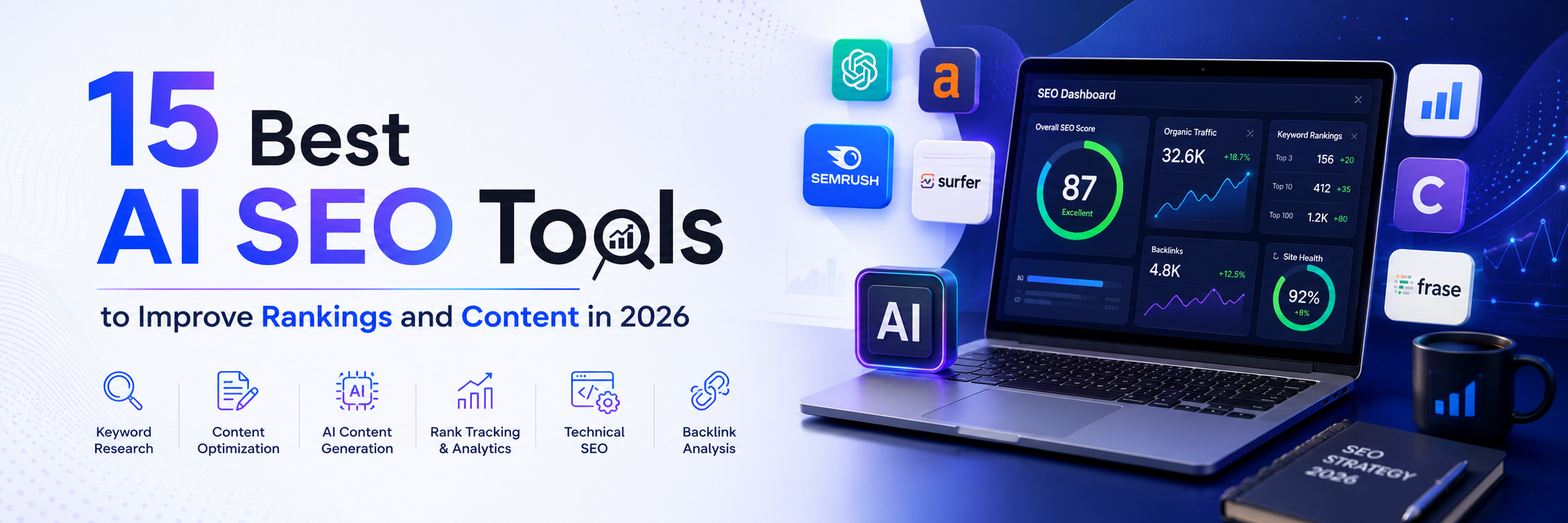
This guide evaluates 15 of the best AI SEO tools available in 2026 based on practical use cases, core features, pricing structure, ease of use, and overall value for businesses, agencies, and in-house SEO professionals.
How We Evaluated These Tools
We assessed each tool against a consistent set of criteria rather than ranking by popularity alone:
- Ease of use – how quickly a new user can get value from the interface
- Keyword research capabilities – depth of search volume, intent, and clustering data
- Content optimization features – how well the tool helps content match what’s already ranking
- Technical SEO functionality – crawling, auditing, and issue detection
- AI writing quality – coherence, factual reliability, and how much editing output needs
- Reporting and analytics – how easily data becomes a client-ready or stakeholder-ready report
- Integrations – compatibility with Google Search Console, Analytics, WordPress, and CRM platforms
- Pricing and value – what you get relative to what you pay, not just the lowest sticker price
- Customer support – responsiveness and quality of documentation
- Suitable user types – who each tool actually fits best
Pricing for every tool below changes frequently as vendors adjust tiers and usage limits, so treat the figures here as a general guide and confirm current pricing directly on each vendor’s site before you budget against it.
What Are AI SEO Tools?
Definition and How They Differ From Traditional SEO Software
An AI SEO tool uses machine learning or generative AI – typically large language models – to perform tasks that traditional SEO software required a human to do manually: interpreting search intent, drafting content, spotting patterns across large datasets, or summarizing a technical audit into next steps. Traditional SEO software (think early-generation rank trackers or keyword databases) mostly organizes and displays data; AI SEO tools go a step further and generate recommendations, drafts, or prioritized actions from that data.
AI has become close to essential in modern SEO because the sheer volume of content, competitors, and search variations involved in any real campaign now exceeds what a team can process manually in a reasonable timeframe – especially with search itself increasingly mediated by AI-generated answers rather than a simple list of blue links.
How AI Is Changing SEO
- Faster keyword research – clustering thousands of keyword variations by intent in seconds rather than hours
- Content planning – generating briefs and outlines based on what’s already ranking for a topic
- Content optimization – scoring drafts against competitor content and suggesting semantic gaps
- Technical SEO improvements – prioritizing crawl and indexing issues by likely impact
- Reporting automation – pulling performance data into client-ready dashboards without manual exports
- Competitor analysis – surfacing content gaps and keyword opportunities competitors already own
Who Should Use AI SEO Tools?
- SEO agencies managing multiple client accounts
- Digital marketers running integrated campaigns
- Content creators and bloggers
- Small businesses without a dedicated SEO hire
- Ecommerce stores managing large product catalogs
- Enterprise marketing teams coordinating across departments
Benefits of Using AI SEO Tools
Save time on repetitive SEO tasks. Tasks like generating meta descriptions, clustering keywords, or auditing hundreds of URLs are exactly the kind of repetitive, pattern-based work AI handles well, freeing your team for strategy and judgment calls.
Improve keyword research. AI models are better than manual review at surfacing search intent, related keyword clusters, and content gaps you might not have thought to search for directly.
Create better content. AI tools assist with outlines, on-page optimization, readability improvements, and checking that a draft covers the topic as thoroughly as top-ranking competitors.
Strengthen technical SEO. AI-assisted crawlers can flag indexing problems, broken links, and site health issues, then prioritize them by likely traffic or ranking impact instead of listing everything with equal weight.
Enhance reporting and analytics. AI simplifies pulling performance data into a narrative summary, which matters as much for internal stakeholder buy-in as it does for client reporting.
Best AI SEO Tools in 2026
1. ChatGPT
Best for SEO Research and Content Planning
ChatGPT isn’t a dedicated SEO platform, but it’s become a default first step in most SEO workflows – for brainstorming topic clusters, drafting outlines, summarizing competitor content, and explaining technical concepts to clients or junior team members.
- Key features: Conversational research and drafting, custom GPTs for repeatable workflows, web browsing for current information, file upload and analysis
- Advantages: Extremely flexible, fast for early-stage ideation, useful across the entire content workflow rather than one narrow task
- Limitations: No built-in SEO data (search volume, rankings, backlinks) – it needs to be paired with a dedicated SEO tool for that; outputs need fact-checking before publishing
- Pricing: Free tier available; paid plans unlock higher usage limits and more advanced models
- Best suited for: Every user type, as a research and drafting companion rather than a standalone SEO suite
- Our take: Use it to accelerate the thinking stage of SEO – outlines, angle ideas, competitor summaries – but verify every statistic and claim before it goes into published content.
2. Semrush AI Toolkit

Best for Comprehensive SEO Campaigns
Semrush has layered AI features across its existing suite rather than launching a standalone product, which means AI-assisted keyword research, content optimization, and search visibility insights sit inside the same platform you’d already use for rank tracking and site audits.
- Key features: AI-assisted keyword research and clustering, competitor gap analysis, content optimization scoring, AI-generated search visibility insights, reporting dashboards
- Advantages: One platform covers research, optimization, and reporting, reducing tool-switching for agencies managing full campaigns
- Limitations: Pricing scales quickly for agencies managing multiple client accounts; the breadth of features has a learning curve
- Pricing: Tiered monthly plans, with higher tiers required for multi-project agency use
- Best suited for: Agencies and in-house teams running full-service SEO campaigns
- Our take: Strong default choice if you want one platform rather than stitching together several point solutions.
3. Ahrefs
Best for Keyword Research and Backlink Analysis
Ahrefs remains one of the most trusted sources of backlink and keyword data in the industry, and its AI-assisted features (Content Gap analysis, AI writing assistance, brand monitoring) sit on top of what is still primarily a best-in-class data platform.
- Key features: Site Explorer, backlink analysis, Content Gap analysis, AI content assistance, brand mention monitoring
- Advantages: Exceptionally reliable backlink index, strong keyword data across multiple search engines
- Limitations: AI writing and content features are secondary to its core data tools, not the main draw
- Pricing: Tiered plans based on usage limits and number of projects
- Best suited for: SEOs who prioritize data accuracy for backlink and competitive research
- Our take: If you only need one tool for link and keyword data, this is usually it – the AI layer is a bonus, not the reason to buy it.
4. Surfer SEO
Best for Content Optimization
Surfer’s Content Editor is built specifically around the moment a writer sits down to draft or revise a page, scoring the draft in real time against what’s already ranking for the target keyword.
- Key features: Content Editor with live scoring, NLP-based keyword and entity recommendations, internal linking suggestions, SERP analyzer
- Advantages: Genuinely useful for writers who aren’t SEO specialists – it translates ranking-factor data into plain-language suggestions
- Limitations: Scores can be over-optimized for if used mechanically rather than as a guide; works best combined with genuine subject-matter expertise
- Pricing: Tiered monthly plans based on the number of content pieces and audits included
- Best suited for: Content teams and writers who need optimization guidance without deep SEO training
- Our take: Effective as a content quality checkpoint, but don’t let the score become the goal – search intent and originality still matter more.
5. Frase
Best for AI Content Briefs
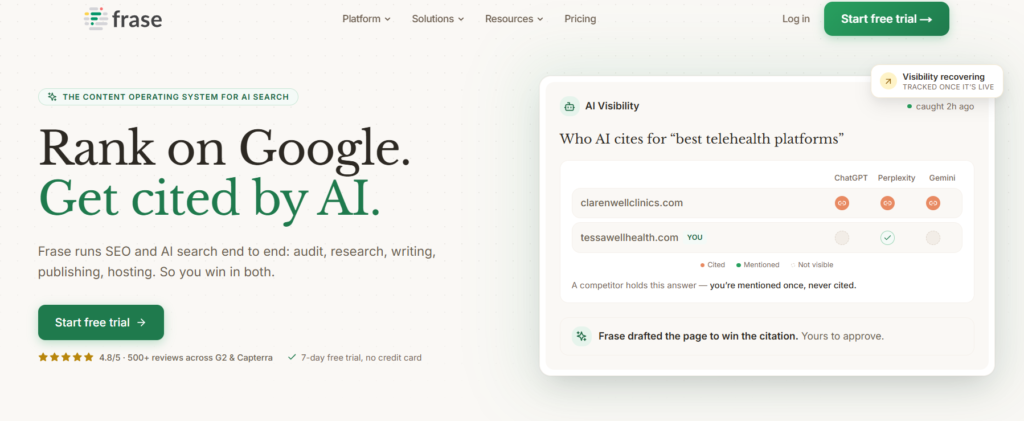
Frase focuses on the brief-writing stage: analyzing the current SERP for a target keyword and generating an outline, along with FAQ suggestions pulled from “People Also Ask” and related searches.
- Key features: SERP analysis, AI-generated content outlines, on-page optimization scoring, automatic FAQ generation
- Advantages: Speeds up the brief-writing process significantly for content teams working with freelance writers
- Limitations: Best used as a starting point – briefs still benefit from a human editor adding strategic direction
- Pricing: Tiered plans based on number of documents and SERP analyses per month
- Best suited for: Content teams and agencies that outsource writing and need consistent, data-backed briefs
- Our take: A practical time-saver specifically for the brief stage of content production.
6. Clearscope
Best for Enterprise Content Optimization
Clearscope is a premium content optimization tool built for larger content teams, offering content grading against semantic keyword targets and integrations that fit into enterprise editorial workflows.
- Key features: Content grading, semantic keyword recommendations, Google Docs and WordPress integrations, team collaboration features
- Advantages: Clean, editor-friendly interface; strong semantic recommendations
- Limitations: Priced at a premium relative to comparable tools, which can be hard to justify for small teams or solo bloggers
- Pricing: Positioned toward the higher end of the content optimization category
- Best suited for: Enterprise content teams and agencies managing high content volume
- Our take: Worth the investment if content production is a core, ongoing function rather than an occasional task.
7. Jasper AI
Best for Marketing Content Creation
Jasper is built primarily as a marketing content generator rather than an SEO-first tool, with brand voice customization and templates spanning blog posts, ad copy, and social content, plus SEO integrations for keyword-aware drafting.
- Key features: Long-form blog writing, marketing copy templates, brand voice training, SEO mode integrations with tools like Surfer
- Advantages: Strong for teams that need consistent brand voice across a high volume of marketing content, not just blog posts
- Limitations: SEO capability is secondary to its content generation focus – pair it with a dedicated optimization tool
- Pricing: Tiered plans based on word volume and number of seats
- Best suited for: Marketing teams producing content across multiple channels, not exclusively blog SEO
- Our take: A strong drafting engine when brand voice consistency matters as much as search performance.
8. Market Muse
Best for Building Topical Authority
MarketMuse takes a wider view than page-by-page optimization, modeling your entire content inventory against a topic to identify gaps and prioritize what to write next in order to build genuine topical authority.
- Key features: Topic modeling, content inventory analysis, content planning recommendations, competitive content gap detection
- Advantages: Strategic rather than tactical – useful for planning a content roadmap, not just optimizing one article
- Limitations: Steeper learning curve than single-article optimization tools; better suited to teams thinking in content clusters
- Pricing: Tiered plans, with more advanced planning features on higher tiers
- Best suited for: Content strategists and teams building out pillar-and-cluster content structures
- Our take: A useful planning layer sitting above the tools that optimize individual pages.
9. Writesonic
Best for AI-Assisted Content Production
Writesonic pairs SEO-focused article generation with a broader suite of marketing content tools and a built-in AI chatbot feature, aiming to be a one-stop content production platform.
- Key features: SEO article generation, AI chatbot builder, marketing copy templates, content optimization scoring
- Advantages: Broad feature set at a generally accessible price point compared to enterprise-tier competitors
- Limitations: Output quality can be inconsistent across content types and still needs editorial review
- Pricing: Tiered plans based on word count and feature access
- Best suited for: Small businesses and solo marketers needing a lower-cost, all-in-one content tool
- Our take: A reasonable starting point for teams without budget for multiple specialized tools, provided output is edited before publishing.
10. Alli AI
Best for Automated SEO Optimization
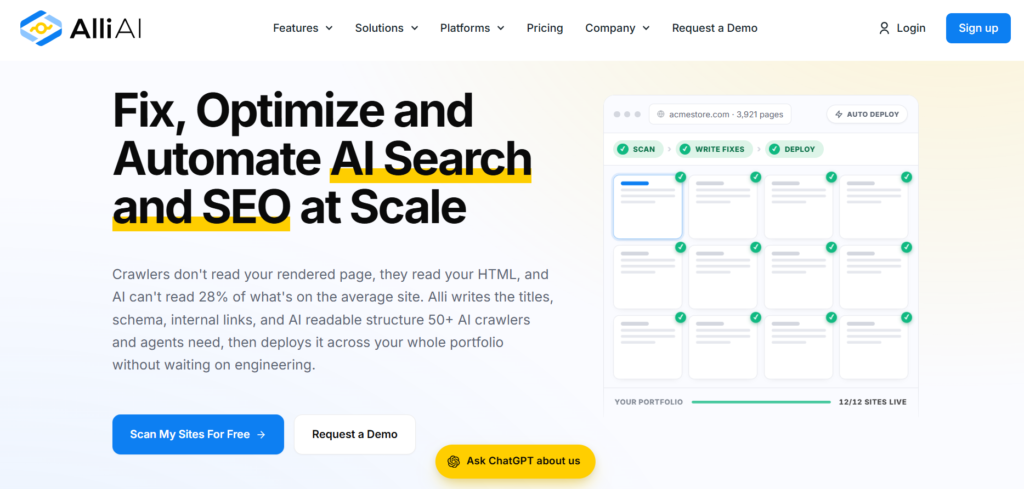
Alli AI focuses on technical and on-page SEO automation, allowing changes like meta tags, header structure, and internal links to be implemented in bulk across a site without manually editing individual pages.
- Key features: Technical SEO automation, on-page optimization at scale, bulk implementation of changes, A/B testing of SEO changes
- Advantages: Genuinely useful for large sites where manual page-by-page edits aren’t practical
- Limitations: Automated bulk changes carry real risk if not reviewed carefully – this is a tool that rewards SEO experience, not a beginner-friendly starting point
- Pricing: Tiered plans generally scaled to site size
- Best suited for: Larger sites and experienced SEO teams comfortable reviewing automated changes before they go live
- Our take: Powerful, but treat every bulk change as something to review, not something to set and forget.
11. Rank Math AI
Best for WordPress SEO
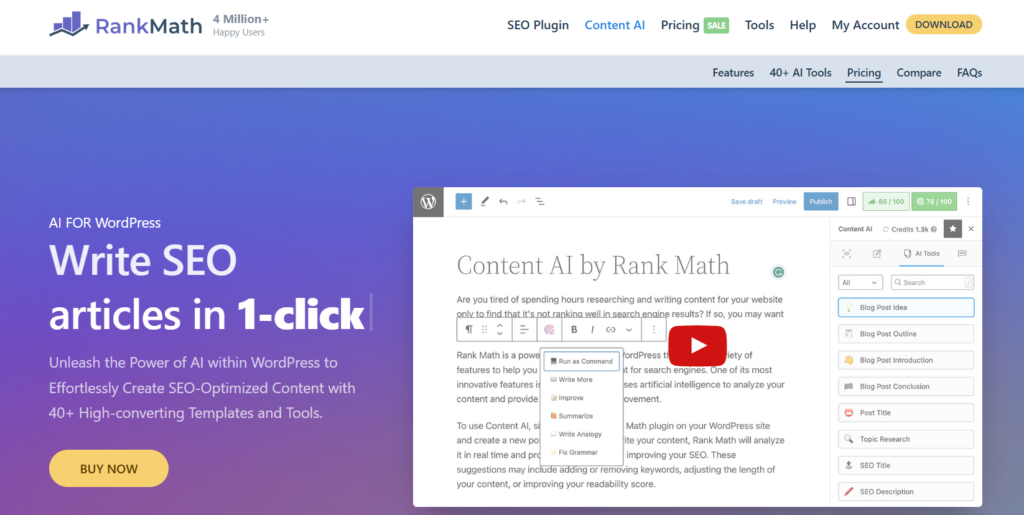
Rank Math is one of the most widely used WordPress SEO plugins, and its AI Content Assistant layers AI-generated suggestions – titles, meta descriptions, schema recommendations – directly into the WordPress editor.
- Key features: AI Content Assistant, schema markup recommendations, on-page SEO scoring, native WordPress integration
- Advantages: Lives inside the CMS your content team already uses, reducing tool-switching for WordPress sites specifically
- Limitations: WordPress-specific – not useful outside that ecosystem
- Pricing: Free tier available; paid tiers unlock AI credits and advanced schema features
- Best suited for: WordPress site owners and agencies managing WordPress client sites
- Our take: An easy add if you’re already on WordPress and want AI suggestions without leaving the editor.
12. SE Ranking
Best for Small Businesses and Agencies
SE Ranking positions itself as a more budget-friendly alternative to the larger all-in-one suites, covering keyword tracking, website audits, competitor analysis, and AI writing features in a single platform.
- Key features: Keyword rank tracking, website audit tool, AI writing assistant, competitor analysis, white-label reporting
- Advantages: Lower cost of entry than comparable all-in-one platforms, with white-label reporting useful for agencies
- Limitations: Data depth (particularly backlink index size) generally trails category leaders like Ahrefs and Semrush
- Pricing: Tiered plans, generally positioned below Semrush and Ahrefs on cost
- Best suited for: Small businesses and smaller agencies that need solid coverage without enterprise pricing
- Our take: A sensible middle-ground choice for teams that find Semrush or Ahrefs pricing hard to justify.
13. Screaming Frog SEO Spider
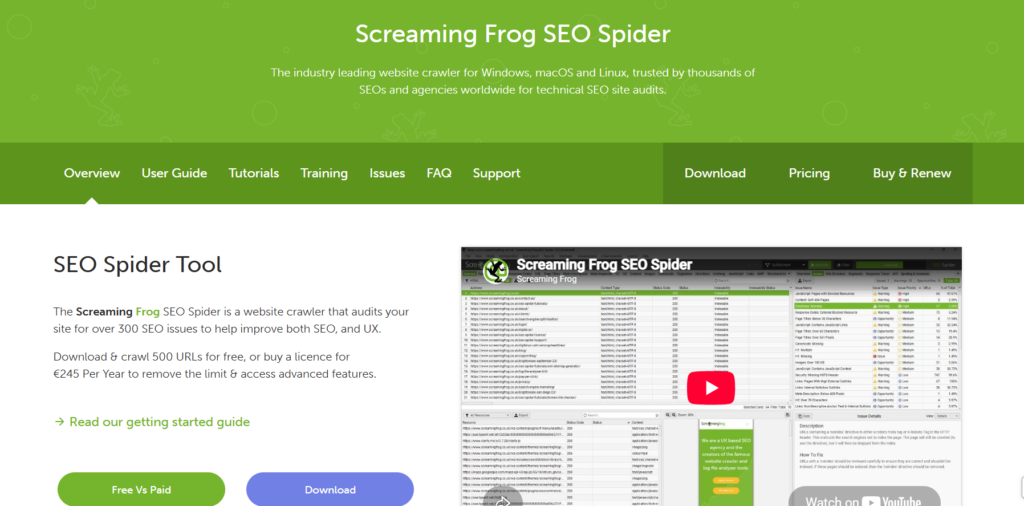
Best for Technical SEO Audits
Screaming Frog remains a category staple for technical audits – a desktop crawler that surfaces broken links, redirect chains, duplicate content, and indexing issues, now with AI-assisted analysis layered into recent versions.
- Key features: Full website crawling, technical issue detection, AI-assisted analysis features, flexible data export
- Advantages: Extremely thorough at the technical layer; the export flexibility makes it easy to build custom reports
- Limitations: Interface is data-dense and better suited to technically confident users than beginners
- Pricing: Free tier for smaller crawls; paid license required for larger sites and full feature access
- Best suited for: Technical SEOs and developers running in-depth site audits
- Our take: Still one of the most reliable tools for technical audits – the AI additions are a helpful bonus, not the core value.
14. Google Search Console
Best Free SEO Performance Tool
Google Search Console remains the most authoritative – and free – source of how Google actually sees and ranks your site, and it’s increasingly the tool teams use to understand how AI Overviews are affecting click-through rates on their own pages.
- Key features: Search performance reporting, index coverage monitoring, Core Web Vitals data, integration into most AI SEO workflow tools
- Advantages: Free, direct from Google, and the ground-truth source most other tools pull data from or reconcile against
- Limitations: Limited historical data window and no competitor data – it only shows your own site
- Pricing: Free
- Best suited for: Every website owner, regardless of budget or team size
- Our take: Non-negotiable. Every other tool on this list should be checked against what Search Console actually reports.
15. Whatagraph
Best for AI SEO Reporting
Whatagraph focuses on the reporting layer rather than research or content, pulling data from multiple marketing platforms into automated dashboards designed for client and stakeholder reporting.
- Key features: Cross-platform marketing dashboards, automated SEO reporting, agency client reporting templates, wide range of integrations
- Advantages: Saves significant manual reporting time for agencies managing several client accounts
- Limitations: Not a research or optimization tool – it’s purely for visualizing and reporting data pulled from other sources
- Pricing: Tiered plans generally based on number of connected data sources and reports
- Best suited for: Agencies that need polished, automated client reporting
- Our take: A strong finishing tool once your research and optimization stack is already in place.
How to Choose the Right AI SEO Tool
Consider your SEO goals. Choose based on whether your priority is content creation, technical SEO, keyword research, reporting, or full-service campaign management – few teams need all 15 tools above at once.
Evaluate your budget. Compare free and paid options with total cost of ownership in mind, not just the entry-level price, since usage limits often push real-world cost higher than the advertised starting tier.
Review available integrations. Prioritize tools that connect cleanly with Google Analytics, Google Search Console, your CMS (especially WordPress if that’s your platform), and your CRM.
Consider your team size. Freelancers generally do better with lighter, cheaper tools; agencies need multi-client and white-label features; enterprise teams need collaboration and permissions controls.
Prioritize ease of use. The most feature-rich tool isn’t the right choice if your team won’t actually use half of what it offers – match the tool to your team’s existing workflow and technical comfort.
Best Practices for Using AI SEO Tools
- Combine AI with human expertise. AI accelerates research and drafting; strategic judgment about what to publish and why still needs a person.
- Verify every AI-generated recommendation. Statistics, claims, and even keyword data can be wrong or outdated – check before publishing.
- Focus on search intent, not just keyword density or optimization scores.
- Add original experience and examples that no AI tool can generate on its own – this is what increasingly separates content that gets cited in AI Overviews from content that doesn’t.
- Update existing content regularly rather than only focusing on new publication.
- Monitor performance using analytics, not assumptions about what “should” be working.
- Build topical authority by covering a subject thoroughly across multiple pieces, instead of targeting isolated keywords in one-off posts.
Common Mistakes to Avoid
- Publishing AI content without human review – factual errors and generic phrasing are still common failure modes
- Ignoring user intent in favor of chasing a keyword purely because it has volume
- Overusing AI-generated content at the expense of original insight or first-hand experience
- Forgetting technical SEO while focusing entirely on content tools
- Neglecting content updates on older pages that are losing relevance or accuracy
- Relying on a single SEO tool for research, optimization, technical audits, and reporting – most serious campaigns need at least two or three tools working together
AI SEO Tools and Google AI Overviews
What Are Google AI Overviews?
Google AI Overviews are AI-generated summaries, powered by Google’s Gemini models, that appear above traditional organic results for many searches. Rather than showing a plain list of links, Google synthesizes an answer from multiple sources and cites a handful of them alongside the summary. Google began rolling this out broadly in 2024, and by 2026 AI Overviews appear on a substantial share of search queries, particularly for informational, question-based searches.
How AI SEO Tools Support AI Search Optimization
Several tools above now report on AI Overview visibility specifically, tracking whether and how often your pages get cited in AI-generated answers, separately from traditional rankings. This matters because citation in an AI Overview doesn’t always correlate with a top-10 organic ranking – Google’s synthesis process favors the passage that best answers a specific sub-question over the page with the highest overall page authority.
Understanding Answer Engine Optimization (AEO)
Answer Engine Optimization refers to structuring content so that AI systems – Google AI Overviews, ChatGPT, Perplexity, and similar tools – can easily extract a clear, accurate answer from it. In practice, this means clear headings, direct answers early in a section, and well-marked FAQ or HowTo content that AI systems can parse cleanly.
Understanding Generative Engine Optimization (GEO)
Generative Engine Optimization is the broader discipline of optimizing for AI-generated search experiences as a category, not just Google’s implementation specifically – covering how content gets cited, summarized, or referenced across AI Overviews, AI chat assistants, and other generative search surfaces.
Why High-Quality, Experience-Based Content Matters
AI systems increasingly favor content that demonstrates genuine first-hand experience, clear expertise, and traceable authority – not because AI can detect “authenticity” directly, but because that kind of content tends to be more specific, more accurate, and more citable than generic, templated writing. This is exactly why E-E-A-T signals (author credentials, original data, transparent methodology) matter as much for AI search visibility as they do for traditional rankings.
Frequently Asked Questions
What are AI SEO tools?
AI SEO tools use machine learning or generative AI to assist with tasks like keyword research, content optimization, technical audits, and reporting – automating and accelerating work that used to require entirely manual analysis.
Which AI SEO tool is best for beginners?
Google Search Console (free, directly from Google) combined with an approachable content tool like Frase or Surfer SEO gives beginners a solid, low-cost starting point before investing in a full-suite platform.
What is the best AI SEO tool for agencies?
Semrush AI Toolkit or Ahrefs both suit agencies managing multiple client campaigns end-to-end, while SE Ranking is a strong lower-cost alternative for smaller agencies.
Are free AI SEO tools worth using?
Yes – Google Search Console is essential regardless of budget, and most paid platforms offer limited free tiers that are genuinely useful for testing fit before committing to a paid plan.
Can AI replace SEO professionals?
No. AI tools speed up research, drafting, and reporting, but strategic decisions – what to prioritize, how to interpret ambiguous data, and how to build genuine expertise into content – still require human judgment.
Which AI SEO tool is best for technical SEO?
Screaming Frog SEO Spider remains the category standard for in-depth technical audits, with Alli AI as an option for teams that also want automated bulk implementation of fixes.
Which AI SEO tool is best for content optimization?
Surfer SEO and Clearscope both specialize here – Surfer tends to suit smaller teams and individual writers, while Clearscope is built for higher-volume enterprise content operations.
Can AI SEO tools improve rankings in Google?
They can improve the underlying quality and completeness of your content and technical setup, which supports rankings – but no tool guarantees a ranking improvement, since Google’s algorithm weighs many factors outside any single tool’s visibility.
Are AI SEO tools helpful for AI Overviews?
Yes, several tools now track AI Overview citation specifically, and the broader practice of structuring content clearly (direct answers, FAQ schema, strong topical depth) that these tools encourage also improves your odds of being cited in AI-generated search results.
Conclusion
AI SEO tools can meaningfully improve productivity, content quality, technical health, and reporting – but only when paired with genuine strategic thinking. The tools above cover the full range of an SEO workflow, from ChatGPT’s flexibility in early research through Screaming Frog’s technical depth and Whatagraph’s reporting automation. Pick based on where your current workflow has the biggest gap, not based on which tool has the most features. The strongest results still come from combining AI’s speed with human expertise, original experience, and a clear strategy – not from AI running the show alone.
Have questions about building an AI-assisted SEO strategy for your business? Get in touch with Honeycomb’s SEO team for a consultation.