



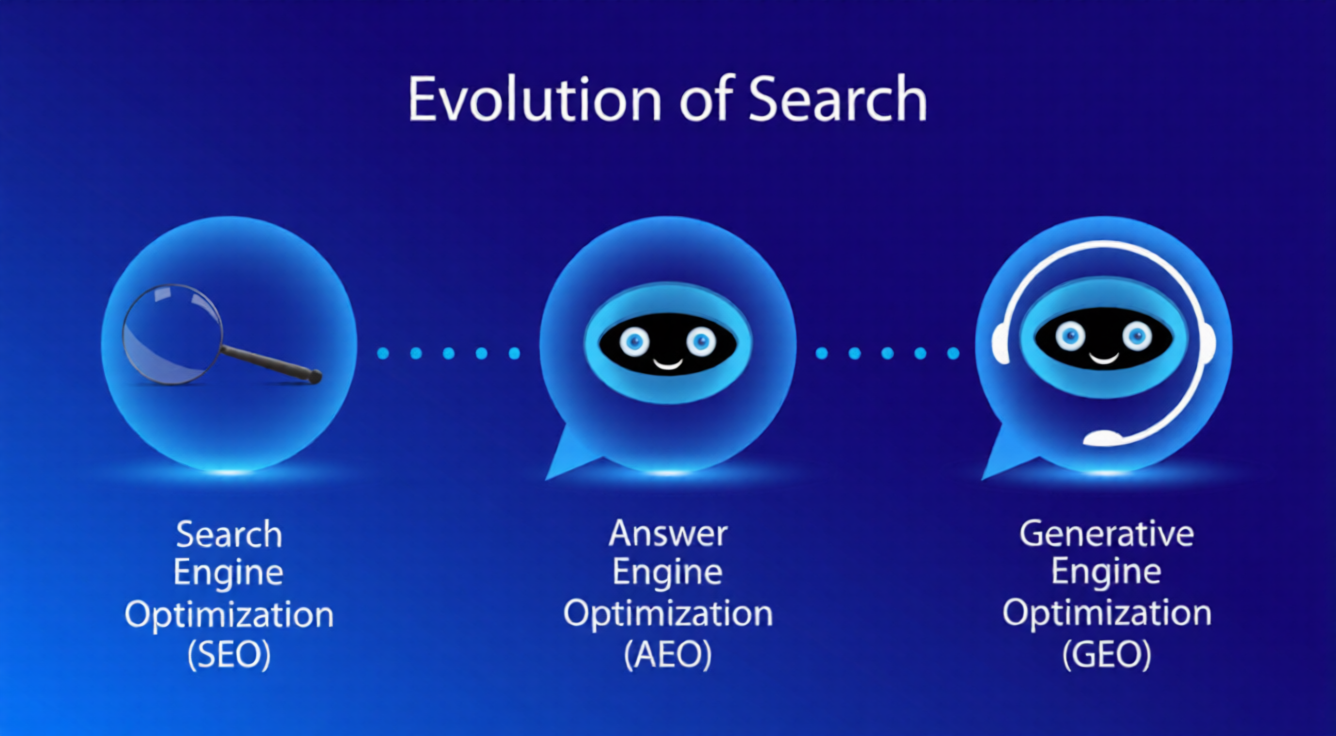
Everything a founder, CEO, or marketer needs to understand about the three ways customers find you online and why you need all three
Search is no longer one channel. It’s three. And if your business is only optimized for one of them, you’re invisible to a growing portion of your market, and you don’t even know it.
Why search changed and why it matters to your business
For nearly two decades, “search” meant one thing: Google. You optimized your website, built backlinks, and tracked traffic. That was the game, and the rules were relatively stable.
Then three things happened simultaneously.
Voice search became mainstream. AI assistants became personal. And generative AI platforms like ChatGPT, Perplexity, and Google’s AI Overviews began answering questions directly without redirecting users to any website.
2010 The era of traditional search
One channel. One strategy.
Google dominated entirely. Rank on page one, get traffic. SEO was the only game in town.
2018 The rise of voice & answers
People started asking, not typing.
Siri, Alexa, and Google’s featured snippets changed behaviour. Zero-click searches exceeded 50% of all queries.
2026 The generative AI era
Three channels. Three strategies.
ChatGPT, Perplexity, and AI Overviews synthesize answers directly. Your business needs to show up on all three search surfaces or cede ground to competitors who do.
The result? The same customer searching for the same thing may now find an answer on Google’s traditional results page, through an AI assistant’s spoken response, or inside a ChatGPT-generated summary. Three surfaces. Three different optimization strategies. One business that needs to appear on all of them.
The Three Pillars Defined
Let’s break down each one clearly, what it is, what it does, and why it exists.
Pillar 1
SEO Search Engine Optimization
The practice of making your content discoverable and highly ranked on traditional search engines like Google and Bing. When someone types a query, the search engine crawls billions of pages, evaluates them by relevance and authority, and returns a ranked list of results. SEO is everything you do to appear and rank high on that list.
The three pillars of SEO
01. Technical SEO: Site speed, mobile-friendliness, crawlability, indexation, and Core Web Vitals. This is the foundation. If Google can’t crawl and understand your site, nothing else matters.
02. On-page SEO: Content quality, keyword strategy, heading structure, internal linking, and metadata. This is where relevance is established.
03. Off-page SEO: Backlinks, brand mentions, digital PR, and authority signals from other websites. This is how trust is built in Google’s eyes.
The most important thing to understand about SEO: it’s not about tricking an algorithm. It’s about genuinely being the best, most useful, most trustworthy answer to a question. The businesses that approach it that way consistently outperform those chasing shortcuts.
Pillar 2
AEO Answer Engine Optimization
The practice of structuring your content to be selected as the direct answer by AI assistants, voice platforms, and featured snippet systems. Where SEO gets you on the results page, AEO gets you into the answer box or spoken directly into someone’s ear through their smart device.
Where AEO shows up
01. Google’s Featured Snippets: The highlighted answer box at the top of search results, above all organic rankings.
02. Voice search Siri, Alexa, and Google Assistant read one answer aloud. There’s no second place in voice.
03. People Also Ask: The expandable Q&A section in Google that rewards concise, well-structured answers.
04. AI-powered search results, Microsoft Bing’s Copilot integration and Google’s SGE (Search Generative Experience) pull from AEO-optimized content.
The key shift AEO addresses: people no longer scroll through ten blue links to find an answer. They ask a question and expect an immediate, single, accurate response. Zero-click searches now account for over half of all Google queries. AEO is how you capture that behaviour.
Pillar 3
GEO Generative Engine Optimization
The practice of building content and authority that gets cited, referenced, or synthesized by large language model-powered platforms. When ChatGPT, Perplexity, or Google’s AI Overviews generate a response to a user’s question, they draw from sources they deem authoritative. GEO is the discipline of becoming one of those sources.
What makes GEO fundamentally different
Unlike SEO and AEO, where the user typically sees a URL or a source attribution, GEO often operates invisibly. The AI generates a response, your expertise is baked into that response, and the user acts on it without ever visiting your website. Your brand and ideas travel, even when your URL doesn’t.
01. Topical authority at depth AI systems favor sources that cover a topic comprehensively, not superficially. Thin content is never cited.
02. Original data and research AI platforms actively seek and cite unique insights, proprietary data, and original perspectives that can’t be found elsewhere.
03. Entity recognition: Your brand, your name, your expertise needs to be consistently associated with your field across the web, not just on your own site.
04. Citation breadth: Being referenced by other credible sources, publications, and platforms signals to AI systems that you’re worth citing.
One analogy that makes it all click
The easiest way I’ve found to explain the difference between SEO, AEO, and GEO to business leaders is through a restaurant analogy. Same business, same customer, three completely different discovery moments.
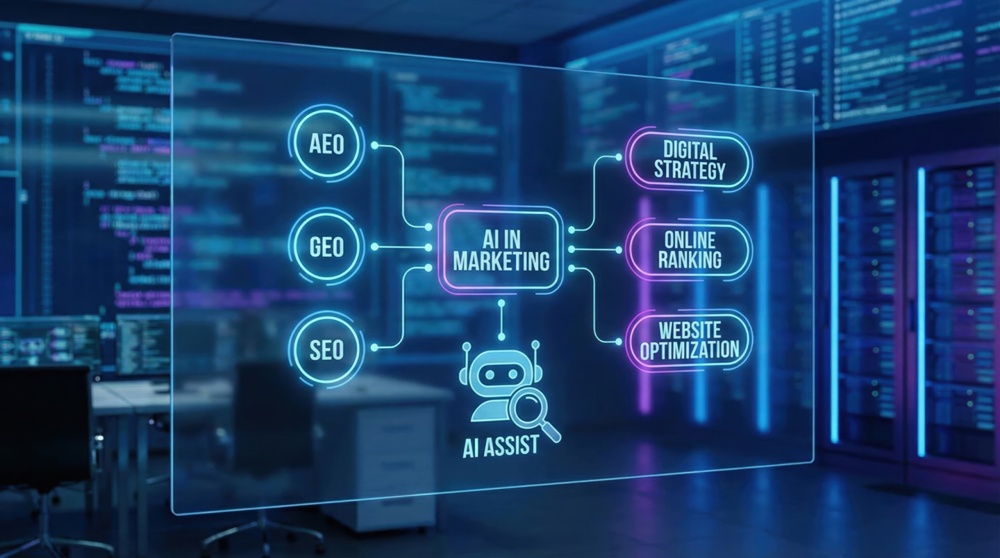
The Restaurant Analogy
SEO: A customer opens Google and types “best Italian restaurant near me.” Your restaurant shows up in the search results. They click your listing and make a reservation. You were visible.
AEO: A customer asks their phone, “Where should I eat tonight?” The assistant speaks your restaurant’s name as the recommended choice. No screen, no scroll, no click. You were selected.
GEO: A customer asks ChatGPT, “Best restaurant for a client dinner in Bangalore.” The AI writes a detailed recommendation, and your restaurant, along with your reputation for professional atmosphere, is cited in the answer. You were trusted.
The customer in each scenario is the same person with the same intent. What changes is how they searched, and which channel your business needed to be present on to reach them.
“SEO is about being visible. AEO is about being selected. GEO is about being trusted as a source.”
The three goals of modern search optimization
SEO vs AEO vs GEO: a side-by-side comparison
| Dimension | SEO | AEO | GEO |
| Target platform | Google, Bing, Yahoo | Siri, Alexa, Google Assistant, Featured Snippets | ChatGPT, Perplexity, Google AI Overviews, Bing Copilot |
| User behaviour | Type a query, scroll results, and click a link | Asks a question, receives one spoken/displayed answer | Asks an AI, receives a synthesized written response |
| Primary goal | Rank high on the results page | Be chosen as the direct answer | Be cited as a trusted source |
| Key tactics | Keywords, backlinks, technical optimization, page speed | Q&A structure, schema markup, concise definitions, and featured snippet targeting | Topical depth, original data, entity authority, citation building |
| Traffic type | Click-through traffic to your site | Often zero-click visibility without visits | Brand authority influence without direct attribution |
| Result format | Ranked list of URLs | Single answer box or spoken response | AI-generated paragraph citing sources |
| Maturity | Established (30+ years) | Maturing (5–8 years) | Emerging (2–3 years) |
| Competitive window | Highly competitive | Moderately competitive | Wide open move now |
What to actually do with the action framework
Understanding the three channels is one thing. Knowing what to do about them is another. Here is the practical framework I use with my clients’ founders, CMOs, and marketing teams who need to move from understanding to execution.
The core principle: one content strategy, three optimization layers
You don’t need three separate content teams or three separate budgets. The most efficient approach is to create content that serves all three channels simultaneously, each piece of content optimized at multiple layers before it’s published.
Layer 1 SEO
Make it findable on Google
- Keyword research and intent mapping
- Technical site health (speed, crawlability)
- Strong heading structure (H1–H3)
- Internal linking strategy
- Backlink building and digital PR
- Regular content updates
Layer 2 AEO
Make it answerable
- Question-and-answer format
- Schema markup (FAQ, HowTo, Article)
- Concise definitions (40–60 words)
- Target “People Also Ask” queries
- Voice-friendly sentence structure
- Clear, direct opening paragraphs
Layer 3 GEO
Make it authoritative
- Original research and data
- Deep topical coverage (pillar content)
- Expert author attribution
- Earn citations from credible sites
- Build entity associations (name + niche)
- Consistent publishing cadence
The SEO checklist for 2026
- Core Web Vitals passing on all key pages
- Keyword strategy aligned to buying intent, not just volume
- Topical clusters (not isolated blog posts)
- E-E-A-T signals: Experience, Expertise, Authority, Trust
- Mobile-first indexing compliance
The AEO checklist for 2026
- Every key page has a clear, concise definition of its primary topic
- FAQ schema deployed on service and product pages
- Content answers questions in the first 100 words
- Conversational language (how people actually speak)
- HowTo schema for process-based content
The GEO checklist for 2026
- At least one piece of original research or data per quarter
- Comprehensive pillar pages covering your core topics in full depth
- Author bio pages with clear credentials and expertise signals
- Guest articles and quotes in industry publications
- Wikipedia and Wikidata entity presence where relevant
The five mistakes most businesses are making right now
1. Treating SEO as the only search channel
If your entire digital strategy is built around Google rankings, you’re optimizing for yesterday’s internet. Voice search queries have exploded, and generative AI platforms are rapidly becoming primary discovery channels, especially for professional services, B2B products, and high-consideration purchases.
2. Writing content for search engines, not for humans
Keyword-stuffed content might have worked in 2012. Today, it actively hurts you. Google’s Helpful Content system, AI assistants, and generative AI platforms all prioritize content that genuinely helps the reader. The algorithm has finally caught up to what good writing always required.
3. Ignoring voice search behavior
Typed queries and spoken queries are structurally different. Someone types “Italian restaurant Bangalore.” They ask, “What’s the best Italian restaurant for a business dinner in Bangalore?” AEO requires you to optimize for natural language, complete questions, and conversational answers, not just typed keyword fragments.
4. Waiting for GEO to “mature” before investing
This is the most costly mistake I see right now. The businesses building topical authority and getting cited across the web today are establishing positions that will compound for years. Once AI systems develop strong associations between a brand and a topic, those associations are extremely difficult for competitors to displace. The window to get ahead is now, not later.
5. Separating SEO, AEO, and GEO into silos
These are not three separate strategies requiring three separate teams and three separate budgets. There are three optimization layers applied to the same content. A well-constructed piece of content with depth, structure, expert voice, and technical excellence serves all three channels simultaneously. The most efficient investment is integration, not separation.
The strategic view: what this means for your business
I’ve worked in SEO for 15 years. I’ve watched it evolve from keyword stuffing to PageRank, from Panda and Penguin updates to E-E-A-T, from desktop to mobile-first indexing. Every wave of change created winners and losers, and the pattern has always been the same.
The businesses that moved early and built genuine authority before the shift became obvious captured positions that their slower competitors struggled to dislodge for years. The businesses that waited until the change was undeniable found themselves starting from zero in a much more crowded field.
We are at that inflection point right now with GEO.
“The brands winning the next decade aren’t chasing algorithms. They’re building genuine topical authority and every search channel rewards that.”
The integrated search strategy principle
The good news for founders and CEOs is this: the underlying work required to win on all three channels is the same work that builds a lasting, defensible brand. Create genuinely useful content. Develop real expertise. Be consistently present in your field. Structure what you publish so it’s easy for humans and machines alike to understand and trust.
That’s it. That’s the strategy. The three channels SEO, AEO, and GEO are simply the three surfaces that reward it.
The complete picture in five sentences
SEO is the established practice of ranking on Google and traditional search engines built on technical excellence, great content, and earned authority.
AEO is the emerging discipline of being selected as the direct answer by voice assistants and AI-enhanced search built on a clear structure, concise definitions, and schema markup.
GEO is the frontier practice of being cited and trusted by generative AI platforms like ChatGPT and Perplexity, built on topical depth, original thinking, and cross-web authority.
Together, they represent the three ways your customers discover businesses like yours in 2026.
The businesses that integrate all three into a single, coherent content strategy will have a compounding advantage that grows more powerful every year. Found this useful?
Follow for weekly insights on search strategy, AI-driven marketing, and what’s actually working for businesses right now, no fluff, just 15 years of real-world experience.
SEO Expert · 15 Years in Search, Helping founders and CMOs build authority that compounds.
#SEO#AEO#GEO#SearchMarketing#AISearch#DigitalMarketing#GrowthMarketing#MarketingStrategy