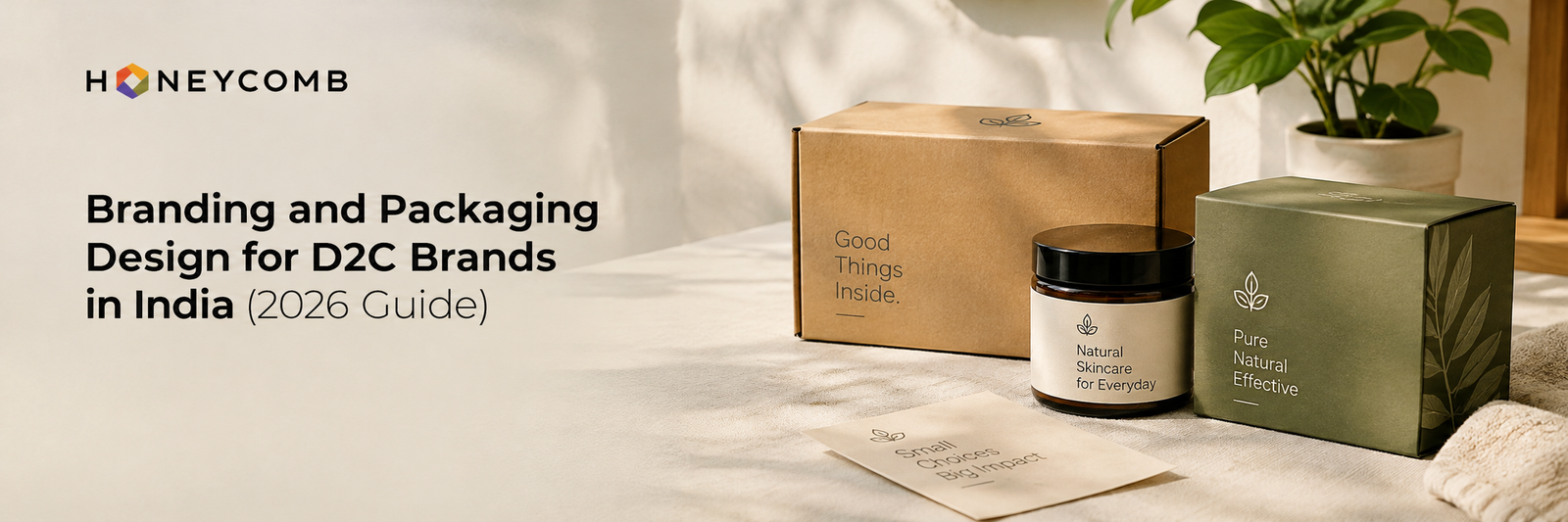
Your customer decides whether to trust your D2C brand in the ten seconds after a delivery partner hands over the parcel. No ad, influencer reel or discount code gets a vote. The box does all the talking.
In 2026, Indian shoppers meet hundreds of brands a day, yet they remember only the few that felt considered when the carton reached their hands. When branding and packaging design work as one system, that moment becomes your cheapest marketing channel. When they do not, it becomes a return request. Here is how to build the first kind.
Why Branding and Packaging Design Are One Job
Most founders brief a logo first and a box later, often with different vendors. The result is a brand that looks confident on Instagram and confused in the hand. At Honeycomb, a branding and creative agency with 18 years of experience, we treat the pack as the brand’s most physical page. Colour, typography, tone of voice and material must all say the same thing.
Your brand identity is the promise. Your packaging is the proof. A premium positioning printed on thin stock with a cluttered label breaks that promise before the product is even opened.
Five Shifts Shaping D2C Packaging in India in 2026
- Marketplace-first thumbnails. Your pack must read at thumbnail size on Amazon and quick-commerce apps, not just on a shelf. Bold hierarchy beats fine detail.
- Regional confidence. Bilingual labels and local cultural cues are now a strength, not an afterthought.
- Sustainable packaging with proof. Buyers distrust vague green claims. State the material and how to dispose of it.
- Unboxing as content. A thoughtful unboxing experience gets filmed, shared and remembered. That is free reach.
- Scalable systems. Variants, sizes and festive editions need one flexible design system, not twelve separate designs.
How a Branding Agency in India Should Work
A good branding agency in India diagnoses before it decorates. Our process follows five steps:
- Product discovery: We study your product, audience, competitors and price point before any creative work begins.
- Concept development: We explore structure and visuals together, balancing shelf appeal with function.
- Design development: Typography, colour and graphics are refined into one cohesive packaging system.
- Artwork and production: Files are prepared for print with technical accuracy. Many beautiful designs die at the printer, so we plan for production from day one.
- Final delivery: You receive production-ready assets and guidelines, so every future SKU stays on brand.
The Five-Question Test Before You Print
Before any pack goes to production, run it through these questions. Our opinion is that a design which fails even one of them is not ready.
- Can a stranger tell what it is in three seconds? Category and benefit should be obvious at a glance.
- Does it still work at thumbnail size? Shrink the artwork to the size of a phone screenshot and check.
- Does it feel like your brand voice? A playful brand should not ship a stiff, corporate label.
- Can it stretch across variants? Add a new flavour, size or shade and see whether the system holds.
- Can it be made at your target cost? Board, finish and print method must match your margins.
Where to Spend and Where to Save
Founders often overspend on embellishments and underspend on fundamentals. Invest in clear hierarchy, sound structure and one memorable tactile moment, such as a distinctive closure or insert. Save by standardising box formats across variants, limiting special finishes to hero products and designing label systems that share a common template. Smart packaging design is rarely about spending more. It is about spending where the customer actually notices.
Four Mistakes We See Again and Again
- Designing for the photoshoot, not the shelf. A pack that looks stunning on a white background can disappear in a crowded aisle or a tiny app thumbnail.
- Cramming every claim onto the front panel. Clarity builds trust. Choose one hero message.
- Ignoring production realities. Board, finish and cost per unit decide whether a design survives scale.
- Skipping brand guidelines. Without them, every new SKU drifts a little further from the original idea.
Your Box Is the Only Salesperson Who Never Sleeps
Think about what a D2C brand cannot control: courier delays, rising ad costs, competitor discounts. Now think about what it can. Every parcel is a controlled, repeatable, zero-media-cost meeting with a paying customer. Strong packaging lifts perceived value, supports a higher price, reduces the confusion that leads to returns, and hands your customers something worth sharing. Brands that treat it as an afterthought pay for it in every ad rupee they spend to make up the difference.
That is the case Honeycomb makes to every founder. As a creative agency that brings strategy, design, content and production under one roof, we build identities and packs that work together from the first brief to the final print file.
Ready to turn your next parcel into your best pitch? Explore our packaging design services at www.honeycombindia.net, or book a call with the Honeycomb team today.
Frequently Asked Questions
What is branding and packaging design for D2C brands?
It is the combined work of defining your brand’s identity, voice and visual language, then applying it to your box, label and inserts so the product feels consistent from first glance to unboxing.
How much should a D2C brand spend on packaging?
There is no fixed figure. Start with your target margin and cost per unit, then design within that limit. Smart design often adds more perceived value than a costlier material would.
Do I need a brand identity before packaging design?
Yes. Packaging is the most visible application of your identity. Designing it first usually means redoing it later.
How do I choose the right branding agency in India?
Look for strategy before aesthetics, relevant experience, in-house production knowledge and a clear process. Ask how the agency prepares print-ready artwork.
Can sustainable packaging still feel premium?
Absolutely. Thoughtful material choices, clean structure and honest labelling can feel more premium than heavy, over-finished packs.
Can one design system cover multiple product variants?
It should. A scalable system keeps every variant recognisable as part of one brand while making each one easy to tell apart.