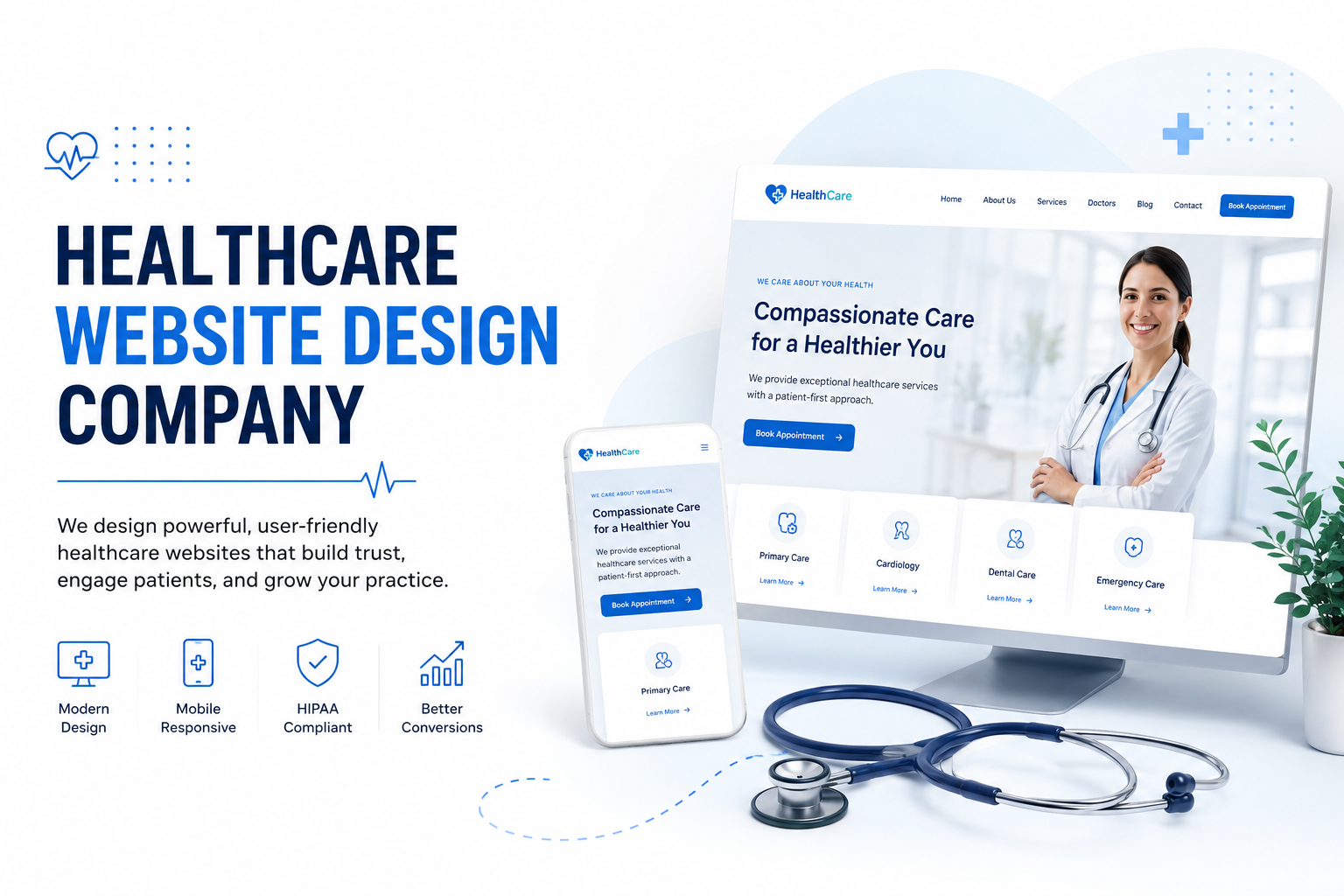
Healthcare has changed dramatically over the last few years. Patients now search symptoms online before visiting clinics. Hospitals compete digitally before they compete physically. Healthcare brands are expected to provide seamless online experiences that feel fast, trustworthy, and accessible across devices.
In 2026, a basic website will no longer be enough.
Every modern healthcare website design company is now expected to build platforms that support user trust, accessibility, performance, and long-term scalability from day one. These are no longer “premium add-ons.” They are the standard users expect.
Yet many healthcare websites still struggle with slow interfaces, confusing navigation, outdated visuals, and poor mobile experiences. Which is impressive, considering nobody visiting a healthcare website is hoping for additional stress as a bonus feature.
Here are the seven features every reliable healthcare web development company should already be building by default in 2026.
Mobile first user experience
Most healthcare users today access websites through mobile devices. Patients often search during urgent or stressful situations. A cluttered mobile experience creates friction that users simply will not tolerate. Mobile usability is no longer optional. It directly impacts trust, engagement, and conversion rates. A modern healthcare website design company has to treat mobile-first design as the foundation, not a responsive adaptation. That means layouts that adjust naturally, pages that load quickly even on weaker networks, and navigation that does not require precision-level finger gymnastics. If users struggle to find basic information or complete simple actions on mobile, the problem is not technical. It is structural. And in healthcare, friction does not get tolerated. It gets abandoned.
Structure That Makes Sense to Humans and AI Systems
Search has changed quietly but completely. People are no longer only typing fragmented keywords. They are asking full questions, using voice search, and increasingly relying on AI tools that summarize information directly from websites. This changes what “good structure” means. A strong healthcare web development company now builds websites that are easy for both humans and machines to interpret. That means clear hierarchies, logical grouping of services, and content that answers questions instead of hiding behind jargon.
The goal is simple: when someone asks, “Do you offer this treatment?” The answer should not require detective work. If the structure is messy, even the best services become invisible in search. Not because they are not valuable, but because they are not readable in the way modern systems expect.
Booking Systems That Don’t Waste Patient Energy
No one visits a healthcare website for entertainment. They come with intent. Usually, a clear one. But many websites still turn appointment booking into a multi-step exercise that feels like paperwork disguised as UX. A good system respects the user’s time. It allows quick selection of doctors, shows availability clearly, confirms instantly, and does not ask for unnecessary information upfront. A reliable healthcare website design company understands that every extra step in a booking flow is a potential drop-off point. Especially when users are already dealing with stress, urgency, or discomfort. Simplicity here is not just convenience. It directly impacts conversions and patient experience.
Accessibility Is Not a Feature, It Is a Responsibility
Healthcare websites are not built for one type of user. They are used by elderly patients, caregivers, people with disabilities, and individuals who may not be digitally fluent. Accessibility is what ensures none of them is excluded. Readable fonts, strong contrast, clear navigation, keyboard support, and screen-reader compatibility are not “extra features.” They are basic expectations of a responsible digital experience. A thoughtful healthcare web development company treats accessibility as part of the foundation, not a compliance checkbox added later. Because in healthcare, excluding someone digitally often translates to excluding them physically as well.
Trust is built in small design decisions
Healthcare decisions are deeply personal. People do not just evaluate services. They evaluate safety, credibility, and reliability before taking action. That is why trust cannot be treated as a branding exercise alone.
It shows up in small things:
- How clean the layout feels
- How clearly doctor profiles are presented
- Whether certifications are easy to find
- Whether contact information feels real and accessible
A strong healthcare website design company knows that users rarely articulate distrust. They simply leave when something feels off. Trust is not built through persuasion. It is built through consistency.
Speed and security are non-negotiable now
Healthcare websites often handle sensitive interactions, from inquiries to bookings and sometimes even patient data. If a website is slow or feels insecure, users do not wait to analyze why. They exit. Fast load times, SSL encryption, stable hosting, and secure data handling are now baseline expectations for any serious healthcare platform. A dependable healthcare web development company ensures performance and security are not treated as backend concerns but as core user experience elements. Because reliability is not something users read about. It is something they feel instantly.
Scalability Is What Keeps Websites Relevant
Healthcare businesses do not stay static. They expand into new services, adopt telemedicine, add locations, integrate patient systems, and evolve operations constantly. A website that cannot scale with that growth becomes a limitation instead of an asset. Modern systems are built to support future layers like patient portals, AI assistants, analytics tools, and CRM integrations without needing a complete rebuild every time. A future-ready healthcare website design company builds infrastructure that evolves with the business, not against it. Because rebuilding a website every time the company grows is not a strategy. It is a technical regret repeated on a schedule.
Conclusion
In 2026, healthcare websites are expected to do much more than provide information. They must support trust, accessibility, discoverability, performance, and business growth simultaneously. The strongest healthcare brands today are investing in digital experiences that feel clear, fast, and genuinely user-focused. A modern healthcare web development company should already be building these features by default, not treating them as optional upgrades. Because in healthcare, digital experience directly shapes how users perceive care itself. Oddly enough, people prefer websites that reduce anxiety instead of adding to it. A truly radical development in technology.
Contact Us:
Call Us: 90352 90915
E-mail: vani@honeycombindia.net
Location: No. 29, 3rd Cross, Venkata Reddy Layout, 6th Block, Koramangala, Bengaluru – 560 095.