Picture a trade fair in Bangalore. Hundreds of stalls, thousands of handouts, and a prospect who gives each brochure exactly three seconds. A few get opened. Most get binned. The difference rarely comes down to the printer. It comes down to brochure design, and specifically to two early decisions: the size you choose and the fold you pick. As part of our Creative Design Services, we at Honeycomb help businesses create visually appealing brochures that communicate their message effectively and leave a lasting impression. Get the size and fold right, and your message flows. Get them wrong, and even brilliant copy disappears into the crease. In this guide, we break down standard Indian brochure sizes, compare bi-fold, tri-fold, and Z-fold formats, and share the template specifications that keep your file print-ready.
What Is a Brochure?
Let’s settle the brochure’s meaning first. A brochure is a folded printed piece that presents your business, product or service in a compact, portable format. Unlike a single-sheet flyer, it has multiple panels, so it can tell a story with a beginning, middle and end.
Why a Company Brochure Still Pays Off
Digital gets the headlines, yet the benefits of brochure marketing keep it relevant across India:
- It is tangible: Buyers keep it on the desk and return to it.
- It builds trust: It works in face-to-face selling, from B2B meetings to exhibitions.
- It works offline: No signal, no problem.
- It controls the story. You decide the order in which people read.
A well-made company brochure also tells prospects you are established and detail-oriented before you say a word.
Standard Brochure Sizes in India
India follows ISO A-series paper sizes, so your printer will work in A4 and A3 formats.
| Format | Flat Size (mm) | Folded Size (mm) | Best For |
| A4 Bi-fold | 210 x 297 | 148 x 210 (A5) | Company profiles, menus |
| A3 Bi-fold | 297 x 420 | 210 x 297 (A4) | Premium catalogues |
| A4 Tri-fold | 297 x 210 | approx. 99 x 210 (DL) | Services, price lists |
| A4 Z-fold | 297 x 210 | approx. 99 x 210 (DL) | Processes, events, timelines |
Our rule of thumb: A4 flat is the safest choice for most Indian businesses. It prints economically, and the folded DL size slips neatly into standard envelopes and rack displays.
Bi-fold Brochure: Simple and Elegant
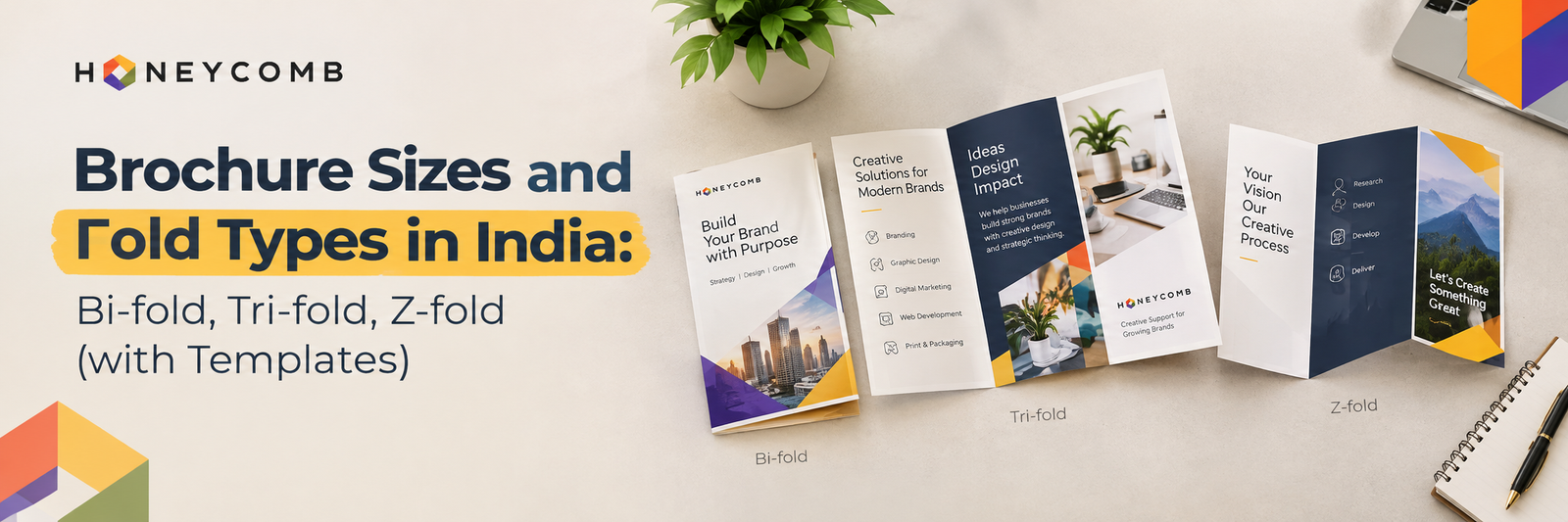
A bi-fold has one central fold and four panels: a bold front cover, a roomy inside spread and a back panel for contact details.
Use it when: your message is focused, such as a company introduction, a product launch or a restaurant menu.
Honeycomb tip: The inside spread works as one continuous canvas. Run a hero image or a key statistic across it, but keep faces and critical text at least 5 mm away from the centre crease.
Tri-fold Brochure: The Indian Marketing Classic
The tri-fold has two folds and six panels. It is the most popular format in India because it suits layered information: problem, solution, proof, offer.
Use it when: you are presenting several services, pricing tiers, or a clinic, school or real estate overview.
Honeycomb tip: The inner flap panel should be about 2 mm narrower than the others, or it will buckle when folded. Many DIY files skip this and arrive at the printer misaligned.
Z-fold Brochure: The Storyteller
A Z-fold zigzags like an accordion, so each panel reveals itself in sequence. That makes it ideal for narrative flow.
Use it when: you want to guide readers through a process, a timeline or a before and after journey.
Honeycomb tip: Design the open spread as one panoramic image. When the reader unfolds it fully, the reveal feels like a small piece of theatre.
Brochure Cover Design: Win the First Three Seconds
Your brochure cover does the selling before a single word is read. Keep these principles in mind:
- One idea only: One strong image and one headline.
- Lead with the benefit: “Grow Faster with Smarter Branding” beats “About Our Company.”
- Protect the logo space: Give it clear breathing room.
- Use finishes wisely: Spot UV, matte lamination or soft-touch coating adds perceived value.
This is where professional brochure design separates itself from a template that looks like everyone else’s.
Template Setup Checklist
Whether you start from our templates or your own, set up your file like this:
- Bleed: 3 mm on all sides
- Safe margin: 5 mm inside the trim line
- Resolution: 300 DPI for images
- Colour mode: CMYK, not RGB
- Paper: 130 to 170 GSM art paper for inner pages, 250 to 300 GSM for premium covers
- Fonts: Outlined or embedded
Honeycomb’s bi-fold, tri-fold and Z-fold layouts follow these specifications, so your artwork stays print-ready from the first draft.
Three Brochure Design Mistakes We See Often
Too much text: White space is not wasted space. It is what makes your message readable.
Ignoring the fold: Text or faces split by a crease look careless.
No clear call to action: Every brochure needs one next step: call, scan or visit.
Your Brochure Is a Silent Salesperson. Here Is Why Honeycomb Should Train It
A brochure never takes a day off. It sits in a prospect’s hands, repeats your pitch perfectly and makes your brand look as sharp on day thirty as on day one. The right size controls your costs, the right fold controls your story, and strong brochure design controls the outcome.
At Honeycomb Creative Support, we do not just design pages. We combine branding, design strategy and premium printing under one roof, so what you approve on screen is exactly what lands in your customer’s hands. No vendor confusion. No colour surprises. Just consistent, impact-driven design.
Ready to turn paper into profit? Visit the Honeycomb website, explore our graphic design services and get a brochure that opens doors, quite literally.
Frequently Asked Questions
What is the most common brochure size in India?
A4 (210 x 297 mm) is the most widely used, folded into a bi-fold, tri-fold or Z-fold.
Which fold is best for a company brochure?
Tri-fold suits multi-service companies, bi-fold suits focused profiles, and Z-fold suits process-led stories.
How many panels does a brochure have?
Folded formats typically have 4 to 6 panels. For larger catalogues, consider a stapled or perfect-bound booklet.
What paper is best for professional brochure design?
Use 130 to 170 GSM art paper for inner pages. For a premium cover, choose 250 to 300 GSM with matte or gloss lamination.
What is the difference between a brochure and a flyer?
A flyer is usually a single sheet with one message. A brochure is folded, with multiple panels for deeper storytelling.
Does a brochure still help in a digital world?
Yes. Printed brochures build trust, support sales conversations and complement your digital marketing.
Can Honeycomb provide print-ready brochure templates?
Yes. We provide bi-fold, tri-fold and Z-fold templates with correct bleeds, margins and fold guides.